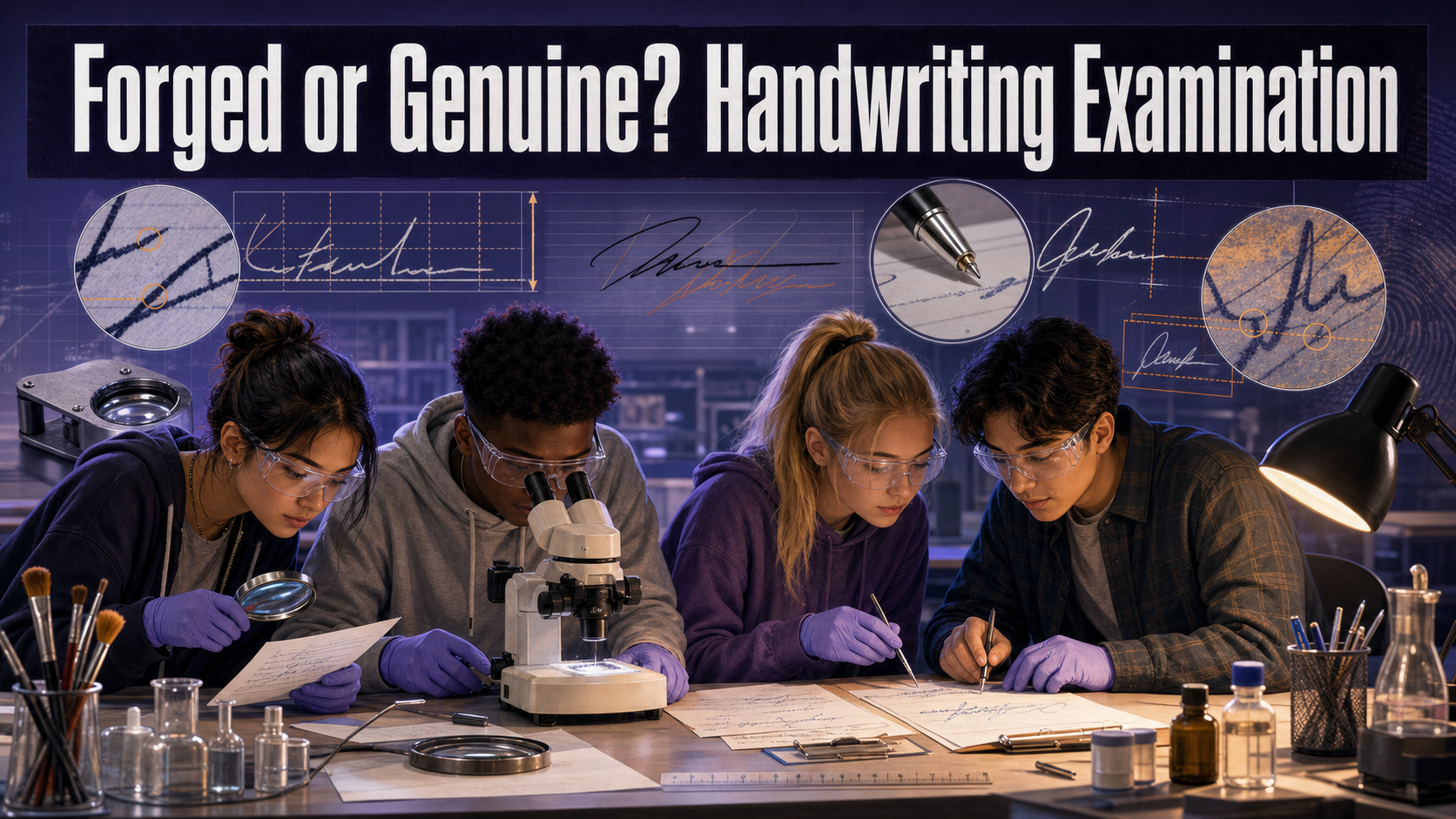
Forged or Genuine? Handwriting Examination
Welcome, Investigators!

Anyone can copy a signature. Almost nobody can copy the way it was written — the effortless speed, the steady pressure, the little habits a person doesn't even know they have. A forger has to draw slowly and carefully, and that carefulness leaves tremors and hesitations all over the page. Today you'll learn to spot them. Follow the evidence!
The Case
A check for a large sum has been cashed, and the account holder swears the signature isn't theirs. You've recovered three questioned signatures — one may be genuine, the others may be forgeries — plus you can collect known writing from the people involved. The bank needs to know which signatures to trust.
Your job: gather proper exemplars, examine the questioned signatures for the tell-tale signs of forgery, and rank all three from most likely forged to most likely genuine — using features, not gut feeling.
Learning Objectives
By the end of this investigation you will be able to:
- Define the features examiners compare: line quality, slant, spacing, and letter formation.
- Collect requested writing exemplars under fair, standardized conditions.
- Analyze questioned signatures for signs of natural writing versus simulated forgery.
- Rank three questioned signatures by likelihood of forgery and defend the ranking with evidence.
Quick Facts
| Lab type | 🔀 Combination (bench examination + MicroSim) |
| Group size | 2–3 investigators |
| Time | 45–55 minutes |
| Cost | ≈ $6 per group (mostly paper) |
| Ties to | Ch 14 — Handwriting Analysis, Line Quality, Slant and Spacing Analysis, Requested Writing Exemplars, Simulated Forgery, Traced Forgery |
Materials
Per group (≈ $6):
- Exemplar collection sheets (lined paper works)
- The "questioned document" set — one check with three signatures, prepared by the teacher (one genuine + simulated forgeries)
- Ruler and protractor (for measuring slant and spacing)
- Hand magnifier or loupe (for line quality)
- The same pen for all exemplars (a fair-test control)
- Shared: a classroom laptop or tablet for the MicroSim
Ethics & Fair-Test Rules

- Exemplars must be collected fairly: same pen, same paper, same phrase, dictated at a normal pace. Rushing or coaching a writer contaminates the sample.
- Never let a suspect see the questioned document while giving exemplars — that invites deliberate disguise.
- Handwriting comparison is an opinion of a trained examiner, not a chemical test. Treat every conclusion as "the evidence suggests," never "this proves."
Background: You Can't Fake Fluency
Everyone's mature handwriting settles into a set of unconscious habits — the way you cross a t, how far your letters lean, how much air you leave between words. Document examiners compare a questioned writing to known writing across features like line quality (smooth and confident vs. shaky and hesitant), slant (the angle letters lean), spacing (gaps between letters and words), letter formation, pen lifts, and the baseline the writing rides on.
The giveaway of most forgeries is line quality. When you write your own name, you do it fast and smooth without thinking — the pen glides. A forger, by contrast, has to draw someone else's signature slowly and deliberately, producing tell-tale tremor, blunt starts and stops, and unnatural pen lifts in the middle of a stroke. A simulated forgery (copied freehand) often nails the overall look but fails on this fluency; a traced forgery matches the shape almost perfectly but can be too slow and shaky, and often sits oddly on the baseline.
One caution: everybody's writing also shows natural variation — you never sign your name exactly the same way twice. So an examiner looks for consistent, meaningful differences, not tiny wobbles. Start by learning which features to watch.
Explore: Handwriting Characteristics Comparison
Handwriting Characteristics Comparison Interactive MicroSim
Type: microsim
sim-id: handwriting-comparison
Library: p5.js
Status: Implemented
Learning Objective: Identify the characteristics used to compare a questioned writing sample with a known exemplar (Bloom Level 1 — Remember).
Click each characteristic — Line Quality, Slant, Spacing, Letter Formation, Pen Lifts, Baseline — to highlight it on both samples, then toggle the questioned sample between authentic and forged and watch which features turn red. Use the magnification slider to look closer. Train your eye here before you examine the real check.
Procedure
Part 1 — Collect exemplars.
- Choose the phrase or name that appears on the check. Have each of your known writers copy it several times on the exemplar sheet, using the same pen at a normal pace.
- Do not show writers the questioned document. Collect enough repetitions to see each person's natural variation.
Part 2 — Examine the questioned signatures.
- For each of the three questioned signatures, measure the slant with a protractor and the letter/word spacing with a ruler.
- Under the magnifier, judge line quality: is the stroke smooth and confident, or does it show tremor, blunt stops, or mid-stroke pen lifts?
- Check the baseline — does the writing ride evenly, or drift and waver like a slow, careful copy?
Part 3 — Compare and rank.
- Line each questioned signature up against the genuine exemplars. Note where it agrees and where it shows consistent, meaningful differences.
- Rank the three questioned signatures from most likely forged to most likely genuine, and list the deciding feature for each.
Data Collection
Fill in one row per questioned signature.
| Signature | Slant (°) | Avg. spacing (mm) | Line quality (smooth / tremor) | Pen lifts? | Baseline (steady / drifts) | Forgery likelihood (1 = most) |
|---|---|---|---|---|---|---|
| Exemplar (known) | — | |||||
| Questioned #1 | ||||||
| Questioned #2 | ||||||
| Questioned #3 |
Analysis Questions
- Which questioned signature is most likely forged? Cite two features (for example, tremor plus a slant difference) that led you there.
- Which signature looks genuine, and how did you separate its natural variation from a real difference?
- Why is line quality often a better forgery indicator than the overall shape of the signature?
- A traced forgery can match the shape almost perfectly. What feature might still give it away, and why?
- Handwriting examination is an examiner's opinion, and the 2009 NAS report urged more measured error rates for it. How should that shape the way you word your conclusion to the bank?
Deliverable
Turn in a one-page Questioned Document Report that ranks the three signatures from most to least likely forged, with the deciding feature noted for each and your exemplar sheet attached. State conclusions as "the evidence suggests Questioned #__ is a simulated forgery," never as proof.
Investigator Tip

Collect several exemplars, not one. A single sample can't show you a person's natural range — and if you don't know their range, you can't tell a real difference from an ordinary day-to-day wobble. More knowns, better calls.
Extension Challenge: Traced vs. Simulated
Make two forgeries of the same signature: one by copying it freehand (a simulated forgery) and one by tracing it over a light source (a traced forgery). Swap with another group. Can they tell which is which? List the features that separate a shaky-but-accurate tracing from a smooth-but-wrong freehand copy.
Teacher Notes
Setup, timing, and grading (click to expand)
- Prep: Prepare the check with three signatures — one genuine, one simulated forgery (freehand copy), and one traced forgery — and keep the key sealed. Exaggerate the tremor slightly on the forgeries so a hand lens can catch it.
- Fair exemplars: Model the collection rules first. The most common student error is letting a "suspect" glance at the questioned signature — call it out early.
- The MicroSim is the trainer. Have students toggle authentic/forged and name each red-flag feature before touching the real check; it front-loads the vocabulary.
- Differentiation: For a shorter version, examine one questioned signature instead of three. For a challenge, add a genuine signature written by the account holder while injured or rushed, so natural variation is wide.
- Assessment focus: Reward students who cite specific features, who distinguish natural variation from meaningful difference, and who use opinion-appropriate language ("the evidence suggests").
Case Closed — For Now

You ranked three signatures without ever seeing the pen touch paper — reading tremor, slant, and hesitation the way a real document examiner does. A forger can copy a shape, but they can't copy fluency, and now you know exactly where to look for the crack. Sharp eyes, investigators. Follow the evidence!