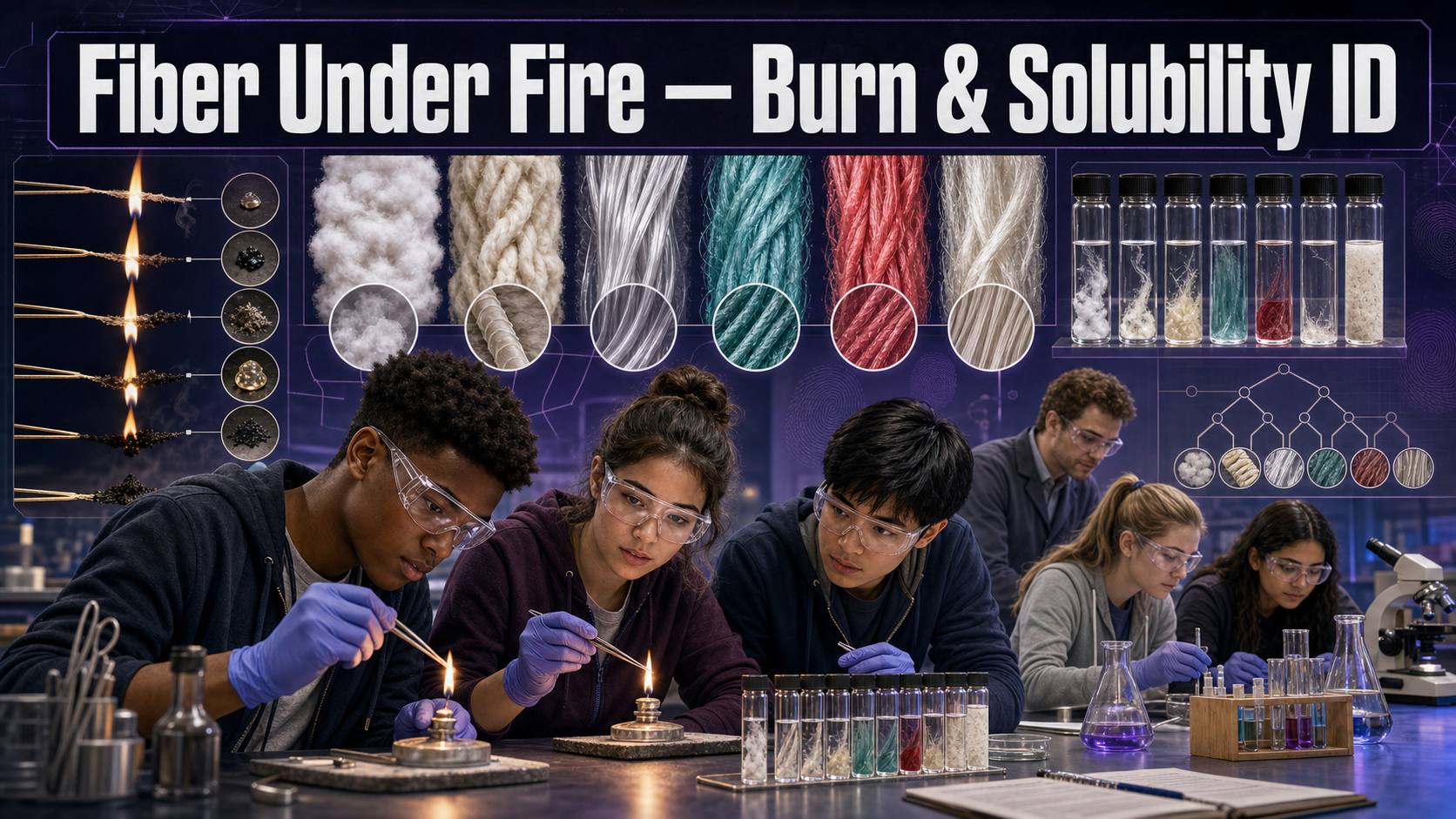
Fiber Under Fire — Burn & Solubility ID
Welcome, Investigators!

Every fabric burns, melts, and dissolves in its own telltale way — a chemical confession waiting for a careful investigator to trigger it. Six unknown fibers came out of a suspect's car, and one of them may match a victim's sweater. Goggles on, flame low. Follow the evidence!
The Case
A hit-and-run. The victim was wearing a distinctive knit sweater when they were struck, and tiny fibers were transferred to whatever brushed against them — Locard's principle at work. When a suspect's car is searched, investigators recover six different fiber snippets caught in the upholstery and seat gaps. Only one type should match the victim's sweater; the rest are innocent household fibers. The six unknowns are known to be drawn from this set:
cotton, wool, nylon, polyester, acrylic, silk.
Your job: run a controlled burn test and an acetone solubility test on each unknown, key each fiber down a dichotomous identification chart, and determine which recovered fiber is consistent with the victim's sweater — using the fiber's behavior, not the suspect's story.
Learning Objectives
By the end of this investigation you will be able to:
- Distinguish natural fibers from synthetic fibers by their burn behavior, odor, and ash.
- Perform an acetone solubility spot test and interpret the result.
- Use a dichotomous key to identify an unknown fiber from its test results.
- Determine which recovered fiber is consistent with a known reference and justify the match with evidence.
Quick Facts
| Lab type | 🧪 Physical bench lab |
| Group size | 2–3 investigators |
| Time | 50–60 minutes |
| Cost | ≈ $20 per group (consumables) |
| Ties to | Ch 4 — Natural Fibers, Synthetic Fibers, Burn Testing of Fibers, Chemical Solubility Testing, Fiber Microscopy |
Materials
Per group (≈ $20):
- Small labeled samples of 6 fibers: cotton, wool, nylon, polyester, acrylic, silk (as yarn or fabric snippets)
- 1 "victim's sweater" reference fiber (matches one of the six)
- 6 "unknown" samples labeled U-1 … U-6
- Long metal tweezers or forceps
- 1 tea light or Bunsen burner (one flame per bench)
- Heat-proof ceramic tile or metal tray
- Acetone (nail-polish remover) in a small labeled dropper bottle
- Spot plate or small glass dishes for the solubility test
- Shared: the Fiber Identification Tree MicroSim (below) as the digital key
Safety & Fire Rules — Read Before You Light Anything

- Goggles on at all times. Tie back hair, roll up loose sleeves, and clear the bench of paper before any flame is lit.
- Burn tests run in a fume hood or well-ventilated area, teacher-supervised, one flame per bench. Burning synthetics releases irritating fumes — never inhale directly; waft the smoke toward your nose to smell it.
- Burn only a tiny snippet held in metal tweezers, over the heat-proof tile. Drop nothing while it's burning. Have water nearby.
- Acetone is flammable. Keep the acetone bottle closed and far from the flame — never do the solubility test next to a lit burner.
- Only simulant/known fibers here — no accelerants, no large samples, no unsupervised flame.
Background: How Fibers Confess
Fibers split into two big families. Natural fibers come from plants or animals: cotton (plant cellulose) and wool and silk (animal protein). Synthetic fibers are manufactured from plastics: nylon, polyester, and acrylic. Those two families behave completely differently when you test them, and that difference is the heart of fiber identification.
The burn test exploits chemistry you can see and smell. Natural cellulose (cotton) burns fast like paper, smells of burning leaves, and leaves a soft gray ash. Natural protein (wool, silk) burns slowly, self-extinguishes, smells of burning hair, and leaves a crushable black bead. Synthetics, being plastics, melt and shrink away from the flame, often drip, smell chemical or sweet, and harden into a hard plastic bead you can't crush. Watching how a fiber meets the flame — burn, melt, or shrink — sorts natural from synthetic almost instantly.
The solubility test adds a second, independent line of evidence. Acetone dissolves acrylic (and softens some acetates) but leaves cotton, wool, polyester, and nylon essentially untouched. Because burn behavior and solubility are independent, using both lets you build a dichotomous key — a branching chart where each yes/no answer splits the possibilities in half until one fiber remains. Practice keying a fiber in the simulator before you strike a match.
Explore: Fiber Identification Tree
Fiber Identification Tree Interactive MicroSim
Type: microsim
sim-id: fiber-identification-tree
Library: p5.js
Status: Specified
Learning Objective: Use a dichotomous key to identify an unknown fiber from its burn and solubility results (Bloom Level 3 — Apply).
Follow the branches: does it burn or melt? What does it smell like? What kind of residue? Each answer sends you down one branch and rules out whole families of fiber. Notice how just two or three good observations are enough to land on a single identification — that's the power of a dichotomous key.
Procedure
Part 1 — Learn the reference behaviors.
- With the teacher's flame lit and goggles on, burn a tiny snippet of each known fiber (cotton, wool, nylon, polyester, acrylic, silk) one at a time, held in tweezers over the tile.
- For each, record: does it burn or melt? How does it approach the flame? Waft the smoke and note the odor. Describe the residue (ash, soft bead, hard bead).
- Extinguish and cool each sample before moving on.
Part 2 — Test the unknowns.
- Repeat the burn test on each unknown U-1 … U-6, recording burn/melt behavior, odor, and residue for each.
- Move away from the flame. Place a small snippet of each unknown in a spot-plate well, add a drop of acetone, and watch for 1 minute. Record whether the fiber dissolves/softens or stays intact.
Part 3 — Key it and match.
- Run each unknown's results through the Fiber Identification Tree MicroSim or a printed dichotomous key. Record the fiber name the key gives.
- Burn and acetone-test the victim's sweater reference the same way.
- Compare: which unknown's identification and behaviors are consistent with the victim's sweater fiber? That's your transfer evidence.
Data Collection
| Sample | Burns or melts? | Odor | Residue (ash / soft bead / hard bead) | Dissolves in acetone? | Fiber identified |
|---|---|---|---|---|---|
| U-1 | |||||
| U-2 | |||||
| U-3 | |||||
| U-4 | |||||
| U-5 | |||||
| U-6 | |||||
| Victim's sweater |
Analysis Questions
- Which unknown is consistent with the victim's sweater? Cite the burn behavior, odor, residue, and solubility result that support your match.
- Sort your six unknowns into natural and synthetic. Which single burn observation was the fastest way to tell the two families apart?
- The acetone test only reacted with one fiber. Which one, and why does adding this independent test make your identification more reliable than the burn test alone?
- Two fibers can burn similarly. Describe a case where the burn test alone is ambiguous, and explain how the solubility test or microscopy resolves it.
- Fibers are class evidence. A matching fiber tells you the sweater type is consistent with the car — but not that this sweater shed this fiber. Explain the difference and why it matters in court.
Deliverable
Turn in a completed Fiber Identification Report: your full data table, the identity of each of the six unknowns, and a clear statement of which recovered fiber is consistent with the victim's sweater — with the specific test results that justify it. Note any unknown whose identity you were unsure of and why.
What Does the Data Tell Us?

A fiber match puts a type of fabric in that car — it does not prove the victim's exact sweater was there. Fibers are class evidence: powerful for excluding suspects and for building a web of consistency, but rarely enough to individualize on their own. The famous 1981 Wayne Williams case turned on fibers precisely because investigators stacked many unusual fiber types together, not one.
Extension Challenge: Under the Microscope
Burn and solubility tests destroy the sample. Real labs look first, then burn. Mount an uncut strand of two of your fibers and examine them under a microscope: cotton looks like a twisted ribbon, wool shows overlapping scales, and synthetics look like smooth, uniform rods (sometimes with a colored dot of delustrant). Sketch two fibers and explain how microscopy could identify a fiber without destroying it.
Teacher Notes
Setup, timing, and grading (click to expand)
- Prep: Cut fiber snippets small — a few centimeters is plenty, and small samples burn safely and briefly. Pre-load the six unknowns so each maps to a known fiber, and record your answer key. Dispense acetone in small drop-bottles; keep the main supply closed and away from every flame.
- Safety first, always: One flame per bench, teacher-supervised, in a fume hood or by an open window. Goggles are non-negotiable. Run the burn station and the acetone station physically apart so solvent never sits near fire.
- Differentiation: For a shorter version, provide the known-fiber reference behaviors and have groups test only the unknowns. For a challenge, add a blend (e.g., poly-cotton) so students see intermediate behavior and must reason about mixtures.
- Assessment focus: Reward safe technique, wafting to smell, correct use of the dichotomous key, and — most of all — a report that says consistent with and correctly frames fibers as class evidence rather than an individual match.
Case Closed — For Now

Flame, odor, ash, and a drop of acetone — four simple observations, and you named six fibers and tied one to the scene. You let each fabric confess in its own language and stayed honest about what a fiber can and can't prove. Sharp work, investigators. Follow the evidence!