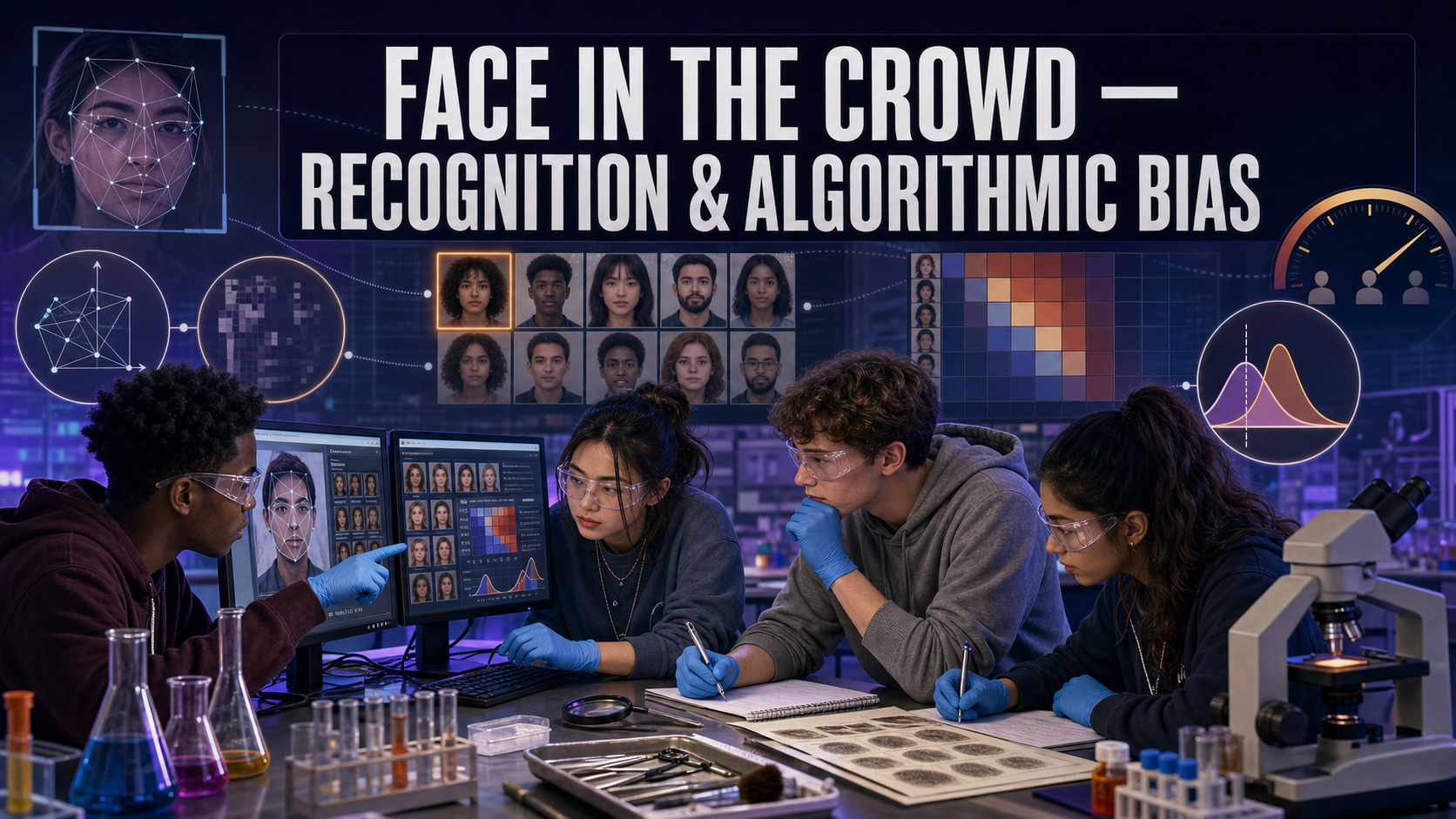
Face in the Crowd — Recognition & Algorithmic Bias
Welcome, Investigators!

A camera catches a face. A computer says "92% match." Case closed? Not so fast. Today you'll open up how facial recognition actually works, audit where it gets less reliable, and decide what a match really earns you in an investigation. The answer will surprise you. Follow the evidence!
The Case
A convenience-store camera captured the face of someone the police want to identify. Investigators run the image through a facial-recognition system, which returns a ranked list of candidates with confidence scores. The top candidate scores high.
But a good investigator asks harder questions. How did the system reach that score? And is it equally reliable for everyone? Independent testing has shown that many facial-recognition systems are less accurate for some demographic groups than others — which means a confidence score can mean different things for different faces. Your job: trace the pipeline that produced the match, run an audit of its accuracy across groups, and reach a defensible judgment about what this match should — and should not — be used for.
Learning Objectives
By the end of this investigation you will be able to:
- Describe the four stages of a facial-recognition pipeline in order.
- Interpret a match confidence score and a candidate ranking.
- Analyze audit data showing accuracy differences across demographic groups.
- Evaluate whether a face match meets the bar for evidence versus a lead.
Quick Facts
| Lab type | 💻 Virtual |
| Group size | 2–3 investigators |
| Time | 45–55 minutes |
| Cost | $0 — computer-based |
| Ties to | Ch 16 — Facial Recognition Overview, Face Detection Algorithms, Facial Landmark Detection, Algorithmic Bias, Facial Recognition Admissibility, CCTV Surveillance Analysis |
Materials
Per group:
- None — a laptop and a browser.
- The instructor's provided sample probe image, candidate gallery, and the audit data table.
- Assumes access to one computer per group.
Handle This Evidence — and This Topic — With Care

- A facial-recognition match is an investigative lead, not proof of identity. Several people have been wrongly arrested after an over-trusted match — real cases with real harm. Treat a match as a hypothesis to verify.
- The accuracy differences you'll examine are a documented, technical fact about certain systems — not a statement about any group of people. Discuss the technology's limits, respectfully and factually.
- Use only the provided sample data. Running real people's faces through recognition tools without authority raises serious privacy and civil-rights concerns.
Background: How a Face Becomes a Match
Facial recognition isn't magic and it isn't a photograph comparison. It's a pipeline of four stages, and understanding them is the key to judging a result.
- Detect — the system first finds that there is a face in the image and boxes it. Poor lighting, angle, or low-resolution CCTV can make even this first step fail.
- Landmark — it locates key points on the face (eye corners, nose tip, mouth edges), which lets it align and normalize the face for comparison.
- Encode — it converts the aligned face into a string of numbers, a faceprint or embedding, that summarizes the face's measurable features.
- Match — it compares that faceprint against a gallery and returns the closest candidates, each with a confidence score and a rank.
Here's the part that matters most for justice. The U.S. National Institute of Standards and Technology (NIST) and other researchers have tested many systems and found that accuracy is not uniform — false-match rates can be substantially higher for some demographic groups (by skin tone, sex, and age) than others. A "92% match" is not an equally reliable number for every face. That is algorithmic bias: a system performing unevenly across groups, usually because of what data it was trained on. It's the central reason courts treat face matches cautiously and why a match should launch an investigation, never end one.
Explore: The Facial-Recognition Pipeline
Facial-Recognition Pipeline Interactive MicroSim
Type: microsim
sim-id: facial-recognition-pipeline
Library: p5.js
Status: Specified
Learning Objective: Trace a face through the detect → landmark → encode → match pipeline and read the resulting confidence scores, then evaluate accuracy across demographic groups (Bloom Level 5 — Evaluate).
Step the probe image through all four stages and watch a face turn into numbers, then into a ranked candidate list. Then switch to the audit view and compare the system's accuracy across groups — that comparison is the heart of this lab.
Procedure
Part 1 — Trace the pipeline.
- Load the probe image into the pipeline MicroSim. Step through detect → landmark → encode → match, noting what each stage does.
- Record the top candidate and its confidence score, plus the 2nd and 3rd candidates and their scores.
- Note the gap between the top score and the next — a small gap means the system isn't very sure which candidate is right.
Part 2 — Run the audit.
- Open the audit data. For each demographic group, record the system's reported accuracy (or false-match rate) from the table.
- Identify the groups where the system is most and least accurate.
- Re-examine your Part 1 match: which group does the probe fall into, and how reliable is the system for that group?
Part 3 — Reach a judgment.
- Weigh the confidence score together with the group-specific accuracy. A high score in a low-accuracy group is weaker than it looks.
- Decide what this match justifies: closing the case, making an arrest, or only opening a line of inquiry that needs independent corroboration.
- Write your admissibility judgment — is this fit to present as evidence, or is it a lead to verify?
Data Collection
| Item | Value / observation |
|---|---|
| Top candidate & confidence score | |
| 2nd / 3rd candidate scores | |
| Gap between #1 and #2 | |
| Most-accurate group (audit) | |
| Least-accurate group (audit) | |
| Probe's group & system accuracy there |
Analysis Questions
- List the four pipeline stages in order and say, in one line each, what could go wrong at each stage with a low-quality CCTV image.
- The top candidate scored high. Given the audit data for that group, how much should that score reassure you? Explain.
- Define algorithmic bias in your own words, and explain one reason a system might be less accurate for some groups (hint: think about training data).
- Should this match be used to arrest the top candidate? Argue your position using both the confidence score and the group-specific accuracy.
- Why do courts and agencies generally treat a face match as an investigative lead rather than as identification evidence? Name one piece of independent evidence that could turn a lead into a solid case.
Deliverable
Turn in a Face-Match Assessment: the pipeline result (top candidates and scores), the audit findings (most- and least-accurate groups), and a written admissibility judgment that states plainly whether the match is fit to be treated as evidence or only as a lead — and why, citing both the score and the bias data.
What Does the Data Tell Us?

A confidence score is a number, not a verdict. The careful investigator reads it alongside how reliable the system is for that kind of face — and then treats even a strong match as a starting point to corroborate. Overtrusting a match has put innocent people in handcuffs. Precision here protects people.
Extension Challenge: The Reform Question
Since the 2016 PCAST report and NIST's demographic testing, agencies and courts have proposed rules for facial recognition — human review requirements, accuracy thresholds, disclosure to defendants, even outright bans in some cities. Research one real policy or reform, and write a short position: does it adequately address the bias problem you saw in this lab? What would you add?
Teacher Notes
Setup, timing, and grading (click to expand)
- Prep: Provide a probe image, a small candidate gallery with confidence scores (make the top-vs-second gap modest so certainty is debatable), and an audit table showing clearly uneven accuracy across groups. Frame the audit data as a property of the system, grounded in real NIST-style findings.
- Set the tone. Open by naming that this is a factual, technical topic with real civil-rights stakes; keep discussion focused on the technology's measured limits, not on people. Reference real wrongful-arrest cases if your class is ready for them.
- Differentiation: For a shorter run, provide the pipeline result and focus on the audit + judgment. For a challenge, give two probes from different groups and have students explain why identical scores don't carry identical weight.
- Assessment focus: Reward judgments that combine the score with the group-specific accuracy and that correctly land on "lead, verify further" rather than "identified." The reasoning matters more than the verdict.
Case Closed — For Now

You looked past a confident-looking number and asked the question that actually protects people: how reliable is this, and for whom? That's not just good forensics — it's the kind of careful thinking that keeps the science honest and the innocent free. Follow the evidence!