Blitting Buffers
blit_buffer() stamps a whole block of pixels onto the display in one shot. Draw a sprite once
into a buffer in RAM, then copy it wherever — and however many times — you need it.
1 | |
This is also where the color display's memory budget shows up for the first time, and the arithmetic explains something about this entire kit.
Two Bytes Per Pixel Changes Everything
On the OLED, a sprite was one bit per pixel. Here it is two bytes — sixteen times bigger.
| Sprite | OLED (1 bit/px) | This display (RGB565, 2 bytes/px) |
|---|---|---|
| A 64 × 48 eye | 384 bytes | 6,144 bytes |
| A full screen | 1,024 bytes | 115,200 bytes |
| RP2040 RAM, total | 264 KB | 264 KB |
Look at that last column. A full-screen buffer would be 115,200 bytes out of the 264 KB an RP2040
has — most of what MicroPython leaves free. That is the real reason this driver has no frame
buffer, and the reason there is no show() anywhere in this kit.
Every Constraint in This Kit Comes From That Number
 No frame buffer means no
 show(), which means every drawing call lands on the glass immediately, which means erasing has to be careful and animations only redraw what moved. One arithmetic fact, and the whole kit is shaped by it.
blit_buffer() Is Opaque
framebuf's blit() took a key color to skip, so you could stamp a sprite over a background and
let the background show through. This driver has no such option — blit_buffer() sends a solid
rectangle of pixels, background and all.
So shapes.blit_keyed() does it the hard way: it walks each row, finds the runs of non-key pixels,
and sends only those. Read it and you will know exactly what framebuf was doing for you.
display.blit_buffer() |
shapes.blit_keyed() |
|
|---|---|---|
| What it sends | One command, then the whole block | One command per run, per row |
| Background pixels | Painted over whatever was there | Skipped |
| Speed | Fast | Noticeably slower |
| Use it when | The sprite sits on a known background | The sprite must sit on top of something |
Sample Program Code
The program builds one eye in an off-screen buffer, then stamps it four times — twice on plain black, and twice over a striped background so you can see exactly what each kind of blit covers up.
1 2 3 4 5 6 7 8 9 10 11 12 13 14 15 16 17 18 19 20 21 22 23 24 25 26 27 28 29 30 31 32 33 34 35 36 37 38 39 40 41 42 43 44 45 46 47 48 49 50 51 52 53 54 55 56 57 58 59 | |
Here's what that program draws on the display:
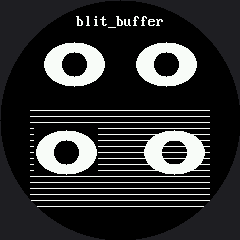
Compare the two bottom eyes carefully. The left one carries a black rectangle with it and punches a hole in the stripes. The right one lets the stripes run right up to the edge of the eye, because every black pixel in the sprite was skipped.
The Sprite Class Is Worth Stealing
Look at what Sprite actually is: an object with hline() and pixel() methods that writes into
a bytearray instead of a display. shapes.ellipse() cannot tell the difference and does not need
to — it just calls hline() on whatever it was handed.
That is a trick worth remembering well beyond this lab. Any drawing function that only talks to an interface can be pointed at something other than a screen.
Transparency Is Not a Property of a Color
 Black is not special here.
 blit_keyed() skips whatever color you point it at, so if you build your sprite on a red background and pass red as the key, red becomes the transparent one. The key is a choice you make, not a fact about the pixel.
Things to Try
- Do the memory arithmetic yourself. Work out the byte cost of the eye sprite (64 × 48 × 2), then a full-screen buffer, and compare both to an RP2040's 264 KB.
- Time the two bottom blits. The plain one sends one command and 6,144 bytes. The keyed one sends a command per run, per row. Measure the gap — that is the price of asking about every pixel.
- Change the sprite's background to
config.REDand pass that as the key. Same behavior, different color skipped. - Blit the eye eight times in a ring around the center. One buffer, eight stamps, and no ellipse math after the first one.
References
- Drawing Ellipses — the function that draws into the sprite buffer
- Color and Bits — what those two bytes per pixel actually contain
- Only Redraw What Changed — the other answer to "how do I avoid sending the whole screen?"