Sleeping Face
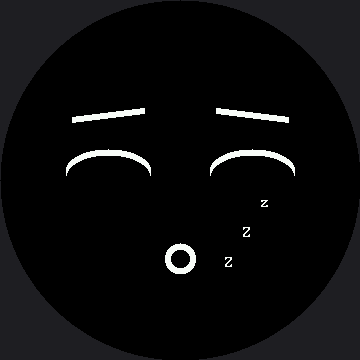
Closed eyes, drooping eyebrows, a small quiet mouth, and three Z characters drifting up and away.
This lab is where the round screen stops being a constraint you work around and starts making
design decisions for you.
Time for a nap
 A sleeping robot is one of the friendliest things a machine can be. It says "I'm fine, I'm just resting" — which is exactly what you want a robot to say when it has nothing to do.
The Zzz Had Nowhere to Go
On the OLED, the Zzz sat in the top-right corner. This screen has no corners, and neither
does its smaller sibling.
The obvious replacement — up beside the right eye, where the OLED put them — is already occupied.
On this 360×360 circle the eyebrow reaches out to x=288 at that height, and the first Z lands
right on top of it. There is no free corner to retreat to.
So the Zs drift up and to the right from beside the mouth, rising into the empty quarter
below the right eye. That is not a stylistic preference; it is the only clear space left, on this
kit exactly as much as on the smaller one.
| Screen shape | Where the Zzz can live |
|---|---|
| 128 × 64 rectangle (OLED) | The top-right corner, away from everything |
| 240 × 240 circle (1.2" smartwatch kit) | Beside the mouth, rising into the gap under the right eye — the eyebrow reaches x=192 |
| 360 × 360 circle (this kit) | Same idea, bigger numbers — the eyebrow reaches x=288 |
Sample Program Code
Only the Zs move, so only the Z box is erased between frames. Everything else is drawn once.
Almost every number below is the smartwatch kit's value times 1.5 — rounded up where needed, like
BOB_RANGE's 5 becoming 8 instead of a fractional 7.5.
1 2 3 4 5 6 7 8 9 10 11 12 13 14 15 16 17 18 19 20 21 22 23 24 25 26 27 28 29 30 31 32 33 34 35 36 37 38 39 40 41 42 43 44 45 46 47 48 49 50 51 52 53 54 55 56 57 58 59 60 61 62 63 64 65 66 67 68 69 70 71 72 73 74 75 76 77 78 79 80 81 82 83 84 85 86 87 88 89 90 91 92 93 94 95 96 97 98 99 100 101 | |
Here's one frame of the animation:
The Erase Box Is Built, Not Scaled
Every position in this file is the smartwatch kit's number times 1.5 — except one. The bitmap font
is a fixed 8×16 glyph baked into lib/, and it cannot get bigger just because the screen did. So
ZZZ_BOX_W and ZZZ_BOX_H are not scaled numbers at all; they are written as an equation built
from ZZZ_STEP_X, ZZZ_STEP_Y, BOB_RANGE, and the font's real FONT_WIDTH and FONT_HEIGHT —
8 and 16, exactly as they are on the smaller kit.
A naive 1.5× scale of the smartwatch kit's 40×70 box would land at 60×105. The real box here is 56×98 — smaller than the naive guess, because the letters living inside it never got any bigger. Multiply the font by 1.5 too, and the box would be sized for characters that do not exist.
Three Signals Saying the Same Thing
Sleep is one of the few expressions where redundancy is the point. Each of these on its own is ambiguous; together there is no mistaking it:
| Feature | On its own it could mean | Together they mean |
|---|---|---|
| Closed eyes (arcs) | Blinking, winking, laughing | |
| Drooping outer brows | Sad, tired, relaxed | Asleep |
| Small round mouth | Surprised, whistling, neutral | |
Drifting Zzz |
Only one thing |
That is a design lesson worth keeping: when an expression has to survive being glanced at, give the viewer more than one clue.
Comment Out the Erase and Watch It Smear
 Take the
 fill_rect() out of draw_zzz() and the Z's pile into a solid white block within seconds. There is no frame buffer here — the glass keeps whatever you last sent it, forever, until you paint over it. That is the bug you will meet most often on this display.
Things to Try
- Break the erase, as in the warning above, and watch how fast it happens. Then put it back and appreciate how much work one rectangle is doing.
- Push the Zzz further out with a bigger
ZZZ_STEP_Xand watch the third one vanish under the bezel. The visible glass is a circle of radius 168 around (180, 180), so a Z is only safe whileconfig.inside_circle()says its far corner is — check the corner, not the anchor, since the anchor is the letter's top-left and it is the top-right that leaves the circle first as the group climbs. - Swap
FONTforconfig.BIG_FONT. The erase box is written in terms ofFONT_WIDTHandFONT_HEIGHT, so it resizes itself — the whole reason to write it that way instead of with the numbers 8 and 16 spelled out. Bigger Z's read better from a distance, but 16×32 glyphs need more room inside the circle than you'd expect, so run step 2's check on the top Z before you trust it. - Slow the bob down from 0.15 to 0.4 seconds. Breathing rate is a personality trait — a fast bob reads as restless, a slow one as deeply asleep.
References
- Blinking — where the closed-eye arc was introduced
- Screen Coordinates — why there is no corner to put the Zzz in
- A Face With a Memory — where falling asleep becomes something the robot decides on its own
- Sleeping Face (1.2" smartwatch kit) — the same lab at 240×240, where the erase box is a plain hard-coded margin instead of the font's real width and height