Skip to content

Lab 21: Sample main.py — Self-Advancing Demo + Button Menu

Rename this file to main.py, copy it to the root of the board's filesystem, and the watch face becomes a standalone device — no computer, no Thonny, just power. MicroPython looks for main.py a few seconds after boot and runs it automatically.

It combines everything so far: the seven emotions from Lab 19, plus Blink, Wink, and Sleepy, auto-advancing every five seconds with no button press, and jumping to whatever mode you pick if you press A or B yourself.

Sample Program Code

The full standalone program — long, because it's the one file meant to run with nobody watching:

  1
  2
  3
  4
  5
  6
  7
  8
  9
 10
 11
 12
 13
 14
 15
 16
 17
 18
 19
 20
 21
 22
 23
 24
 25
 26
 27
 28
 29
 30
 31
 32
 33
 34
 35
 36
 37
 38
 39
 40
 41
 42
 43
 44
 45
 46
 47
 48
 49
 50
 51
 52
 53
 54
 55
 56
 57
 58
 59
 60
 61
 62
 63
 64
 65
 66
 67
 68
 69
 70
 71
 72
 73
 74
 75
 76
 77
 78
 79
 80
 81
 82
 83
 84
 85
 86
 87
 88
 89
 90
 91
 92
 93
 94
 95
 96
 97
 98
 99
100
101
102
103
104
105
106
107
108
109
110
111
112
113
114
115
116
117
118
119
120
121
122
123
124
125
126
127
128
129
130
131
132
133
134
135
136
137
138
139
140
141
142
143
144
145
146
147
148
149
150
151
152
153
154
155
156
157
158
159
160
161
162
163
164
165
166
167
168
169
170
171
172
173
174
175
176
177
178
179
180
181
182
183
184
185
186
187
188
189
190
191
192
193
194
195
196
197
198
199
200
201
202
203
204
205
206
207
208
209
210
211
212
213
214
215
216
217
218
219
220
221
222
223
224
225
226
227
228
229
230
231
232
233
234
235
236
237
238
239
240
241
242
243
244
245
246
247
248
249
250
251
252
253
254
255
256
257
258
259
260
261
262
263
264
265
266
267
268
269
270
271
272
273
274
275
276
277
278
279
280
281
282
283
284
285
286
287
288
289
290
291
292
293
294
295
296
297
298
299
300
301
302
303
304
305
306
307
308
309
310
311
312
313
314
315
316
317
318
319
320
321
322
323
324
325
326
327
328
329
330
331
332
333
334
335
336
337
338
339
340
341
342
343
344
345
346
347
348
349
350
351
352
353
354
355
356
357
358
359
360
361
362
363
364
365
366
367
368
369
370
371
372
373
374
375
# Lab 21: Sample main.py -- Self-Advancing Demo + Button Menu
#
# Rename this file to main.py and copy it to the root of the board's
# filesystem. MicroPython always runs main.py a few seconds after power
# comes on, so once this is main.py the watch face works standalone --
# no computer, no Thonny, just USB power or a battery.
#
# Default behavior: a demo reel that cycles through all ten modes (the
# seven emotions from Lab 19 plus Blink, Wink, and Sleepy) automatically,
# advancing to the next mode after 5 seconds with no button press. Blink
# and Wink are the exception -- a single blink is over in a fraction of a
# second, so those two stay up for 10 seconds and replay themselves every
# 3 seconds, which is what makes them read as a living face instead of a
# still picture. Press button A or B to jump forward or back through the
# modes yourself; any press pushes the next auto-advance out to 30
# seconds, so you have time to look before the demo reel takes over
# again. Uses the non-blocking ticks_ms() pattern from Lab 15 so the
# timers and the button checks all run in the same loop.
#
# TWO RULES THIS FILE FOLLOWS, both from earlier labs, and both of which
# matter more here than anywhere else because this program runs forever:
#
#   A full display.fill(BLACK) happens only when the MODE changes -- a
#   few times a minute. That is cheap enough to be invisible.
#
#   The animations that repeat inside a mode (blink, wink, the drifting
#   Zzz) redraw only their own box. Wipe the whole screen three times a
#   second on this display and the demo becomes a strobe light.

import config
import shapes
from utime import sleep, ticks_ms, ticks_diff

# Give Thonny a window to interrupt (Stop/Restart) before main.py's loop
# takes over the serial port -- without this, a fast-booting board can
# start running before you get a chance to break in.
sleep(1)

display = config.init_display()
button_a, button_b = config.init_buttons()

WHITE = config.WHITE
BLACK = config.BLACK
NO_FILL = config.NO_FILL
FILL = config.FILL
FONT = config.SMALL_FONT

TOP_HALF = 3
BOTTOM_HALF = 12
BOTTOM_LEFT = 4
BOTTOM_RIGHT = 8

WIDTH = config.WIDTH
HALF_WIDTH = WIDTH // 2
EYE_SPACING = 48
LEFT_EYE_X = HALF_WIDTH - EYE_SPACING
RIGHT_EYE_X = HALF_WIDTH + EYE_SPACING
EYE_Y = 102
PUPIL_RADIUS = 8
EYEBROW_HALF_WIDTH = 24
EYEBROW_Y = EYE_Y - 40
MOUTH_Y = 164
LABEL_Y = 30
STROKE = 4

# Geometry for the Blink/Wink/Sleepy modes: a neutral open-eye size plus a
# closed-eye arc (same TOP_HALF-masked ellipse trick as Labs 12, 13, 16).
NEUTRAL_EYE_RADIUS = 26
CLOSED_EYE_HEIGHT = 14
CLOSED_EYE_Y = EYE_Y + 7
EYE_BOX = NEUTRAL_EYE_RADIUS + 6

ZZZ_X = 150
ZZZ_Y = 174            # below the right eye, clear of the eyebrow -- see lab 16
ZZZ_STEP_X = 12
ZZZ_STEP_Y = 20
BOB_RANGE = 5
ZZZ_BOX_X = ZZZ_X - 4
ZZZ_BOX_Y = ZZZ_Y - ZZZ_STEP_Y * 2 - BOB_RANGE - 2
ZZZ_BOX_W = ZZZ_STEP_X * 2 + 16
ZZZ_BOX_H = ZZZ_STEP_Y * 2 + BOB_RANGE * 2 + 20

AUTO_ADVANCE_MS = 5000      # how long a still face stays up on its own
REPEATING_HOLD_MS = 10000   # modes that replay themselves get longer
REPEAT_MS = 3000            # ...and replay this often while they are up
POST_INPUT_DELAY_MS = 30000


def centered(name, y=LABEL_Y):
    x = HALF_WIDTH - (len(name) * FONT.WIDTH) // 2
    display.text(FONT, name, x, y, WHITE, BLACK)


def draw_eye(x, rx, ry, offset=0):
    shapes.ellipse(display, x, EYE_Y, rx, ry, WHITE, FILL)
    shapes.ellipse(display, x + offset, EYE_Y, PUPIL_RADIUS, PUPIL_RADIUS,
                   BLACK, FILL)


def draw_eyes(rx, ry, offset=0):
    draw_eye(LEFT_EYE_X, rx, ry, offset)
    draw_eye(RIGHT_EYE_X, rx, ry, offset)


def draw_eyebrow(x, side, tilt, lift):
    y = EYEBROW_Y - lift
    outer_x = x - (EYEBROW_HALF_WIDTH * side)
    inner_x = x + (EYEBROW_HALF_WIDTH * side)
    for offset in range(STROKE):
        display.line(outer_x, y - tilt + offset,
                     inner_x, y + tilt + offset, WHITE)


def draw_eyebrows(tilt_left, tilt_right, lift=0):
    draw_eyebrow(LEFT_EYE_X, 1, tilt_left, lift)
    draw_eyebrow(RIGHT_EYE_X, -1, tilt_right, lift)


def draw_mouth_curve(radius_x, radius_y, mask):
    for offset in range(STROKE):
        shapes.ellipse(display, HALF_WIDTH, MOUTH_Y - offset,
                       radius_x, radius_y, WHITE, NO_FILL, mask)


def draw_mouth_flat(half_width):
    display.fill_rect(HALF_WIDTH - half_width, MOUTH_Y,
                      half_width * 2, STROKE, WHITE)


def draw_mouth_open(radius_x, radius_y):
    shapes.ellipse(display, HALF_WIDTH, MOUTH_Y, radius_x, radius_y,
                   WHITE, FILL)


def draw_mouth_smirk(half_width, side):
    draw_mouth_flat(half_width)
    corner_x = HALF_WIDTH + (half_width * side)
    mask = BOTTOM_RIGHT if side > 0 else BOTTOM_LEFT
    for offset in range(STROKE):
        shapes.ellipse(display, corner_x, MOUTH_Y - 10 - offset, 14, 14,
                       WHITE, NO_FILL, mask)


def draw_happy():
    draw_eyes(24, 24)
    draw_eyebrows(0, 0, lift=5)
    draw_mouth_curve(50, 24, BOTTOM_HALF)


def draw_sad():
    draw_eyes(22, 22)
    draw_eyebrows(-7, -7, lift=0)
    draw_mouth_curve(40, 20, TOP_HALF)


def draw_angry():
    draw_eyes(24, 12)
    draw_eyebrows(12, 12, lift=-5)
    draw_mouth_flat(26)


def draw_afraid():
    draw_eyes(31, 31)
    draw_eyebrows(-12, -12, lift=7)
    draw_mouth_open(15, 22)


def draw_surprised():
    draw_eyes(32, 32)
    draw_eyebrows(0, 0, lift=14)
    draw_mouth_open(20, 26)


def draw_disgusted():
    draw_eyes(22, 15)
    draw_eyebrows(10, -5, lift=-3)
    for offset in range(STROKE):
        shapes.ellipse(display, HALF_WIDTH - 14, MOUTH_Y - offset, 30, 18,
                       WHITE, NO_FILL, TOP_HALF)


def draw_contempt():
    draw_eyes(24, 24)
    draw_eyebrows(0, 0, lift=0)
    draw_mouth_smirk(34, 1)


EMOTIONS = (
    ("Happy", draw_happy),
    ("Sad", draw_sad),
    ("Angry", draw_angry),
    ("Afraid", draw_afraid),
    ("Surprised", draw_surprised),
    ("Disgusted", draw_disgusted),
    ("Contempt", draw_contempt),
)


def draw_closed_eye(x):
    for offset in range(STROKE):
        shapes.ellipse(display, x, CLOSED_EYE_Y + offset, NEUTRAL_EYE_RADIUS,
                       CLOSED_EYE_HEIGHT, WHITE, NO_FILL, TOP_HALF)


def erase_eye(x):
    display.fill_rect(x - EYE_BOX, EYE_Y - EYE_BOX,
                      EYE_BOX * 2, EYE_BOX * 2, BLACK)


def set_eye(x, closed):
    """Erase one eye's box and redraw it open or shut. This is the only
    thing the blink and wink animations ever touch."""
    erase_eye(x)
    if closed:
        draw_closed_eye(x)
    else:
        draw_eye(x, NEUTRAL_EYE_RADIUS, NEUTRAL_EYE_RADIUS)


def enter_blink(name):
    """Lay down the whole picture once, when the mode starts."""
    display.fill(BLACK)
    draw_mouth_curve(44, 18, BOTTOM_HALF)
    centered(name)
    set_eye(LEFT_EYE_X, False)
    set_eye(RIGHT_EYE_X, False)


def play_blink(name):
    set_eye(LEFT_EYE_X, True)      # both eyes snap shut
    set_eye(RIGHT_EYE_X, True)
    sleep(0.15)                    # a real blink is fast
    set_eye(LEFT_EYE_X, False)     # eyes open again
    set_eye(RIGHT_EYE_X, False)


def play_wink(name):
    set_eye(RIGHT_EYE_X, True)     # right eye closes
    sleep(0.35)                    # hold it long enough to read
    set_eye(RIGHT_EYE_X, False)    # both eyes open, resting


def enter_sleepy(name):
    display.fill(BLACK)
    draw_closed_eye(LEFT_EYE_X)
    draw_closed_eye(RIGHT_EYE_X)
    draw_eyebrows(-5, -5, lift=-5)
    for offset in range(STROKE):
        shapes.circle(display, HALF_WIDTH, MOUTH_Y, 10 - offset,
                      WHITE, NO_FILL)
    centered(name)


def draw_zzz(bob):
    display.fill_rect(ZZZ_BOX_X, ZZZ_BOX_Y, ZZZ_BOX_W, ZZZ_BOX_H, BLACK)
    display.text(FONT, 'Z', ZZZ_X, ZZZ_Y + bob, WHITE, BLACK)
    display.text(FONT, 'Z', ZZZ_X + ZZZ_STEP_X,
                 ZZZ_Y - ZZZ_STEP_Y + bob, WHITE, BLACK)
    display.text(FONT, 'z', ZZZ_X + ZZZ_STEP_X * 2,
                 ZZZ_Y - ZZZ_STEP_Y * 2 + bob, WHITE, BLACK)


def play_sleepy(name):
    for bob in range(-BOB_RANGE, BOB_RANGE + 1):
        draw_zzz(bob)
        sleep(0.08)
    for bob in range(BOB_RANGE, -BOB_RANGE - 1, -1):
        draw_zzz(bob)
        sleep(0.08)


# Name, the function that lays down the mode's static picture, the
# function that plays its animation, how long the mode stays on screen,
# and how often it replays itself while it is up (0 means play once, then
# hold the last frame).
ANIMATED_MODES = (
    ("Blink", enter_blink, play_blink, REPEATING_HOLD_MS, REPEAT_MS),
    ("Wink", enter_blink, play_wink, REPEATING_HOLD_MS, REPEAT_MS),
    ("Sleepy", enter_sleepy, play_sleepy, AUTO_ADVANCE_MS, REPEAT_MS),
)

MODE_COUNT = len(EMOTIONS) + len(ANIMATED_MODES)


def enter_mode(index):
    """Called once, when a mode becomes the current one. This is the only
    place a full display.fill(BLACK) happens."""
    if index < len(EMOTIONS):
        name, draw = EMOTIONS[index]
        display.fill(BLACK)
        draw()
        centered(name)
    else:
        name, enter, play, _, _ = ANIMATED_MODES[index - len(EMOTIONS)]
        enter(name)
        play(name)


def replay_mode(index):
    """Called every REPEAT_MS while an animated mode is up. Touches only
    the boxes that move, never the whole screen."""
    if index < len(EMOTIONS):
        return
    name, enter, play, _, _ = ANIMATED_MODES[index - len(EMOTIONS)]
    play(name)


def hold_ms(index):
    """How long this mode stays up before the demo reel moves on."""
    if index < len(EMOTIONS):
        return AUTO_ADVANCE_MS
    return ANIMATED_MODES[index - len(EMOTIONS)][3]


def repeat_ms(index):
    """How often this mode replays itself; 0 means play once and hold."""
    if index < len(EMOTIONS):
        return 0
    return ANIMATED_MODES[index - len(EMOTIONS)][4]


def pressed(button):
    if button.value() == 1:
        return False
    sleep(0.02)
    return button.value() == 0


def wait_for_release(button):
    while button.value() == 0:
        sleep(0.01)


mode_index = 0
last_change = ticks_ms()
last_repeat = last_change
advance_delay = hold_ms(mode_index)

enter_mode(mode_index)

while True:
    now = ticks_ms()

    if pressed(button_a):
        mode_index = (mode_index + 1) % MODE_COUNT
        enter_mode(mode_index)
        wait_for_release(button_a)
        last_change = ticks_ms()      # cooldown starts when the button comes up
        last_repeat = last_change
        advance_delay = POST_INPUT_DELAY_MS

    elif pressed(button_b):
        mode_index = (mode_index - 1) % MODE_COUNT
        enter_mode(mode_index)
        wait_for_release(button_b)
        last_change = ticks_ms()
        last_repeat = last_change
        advance_delay = POST_INPUT_DELAY_MS

    elif ticks_diff(now, last_change) >= advance_delay:
        mode_index = (mode_index + 1) % MODE_COUNT
        enter_mode(mode_index)
        last_change = now
        last_repeat = now
        advance_delay = hold_ms(mode_index)

    # Blink, Wink and Sleepy land here every REPEAT_MS so they play again
    # instead of freezing on their last frame for the rest of the mode's
    # turn. Note that this calls replay_mode(), not enter_mode() -- the
    # background is already on the glass and redrawing it would flicker.
    elif repeat_ms(mode_index) and ticks_diff(now, last_repeat) >= repeat_ms(mode_index):
        replay_mode(mode_index)
        last_repeat = now

    sleep(0.005)

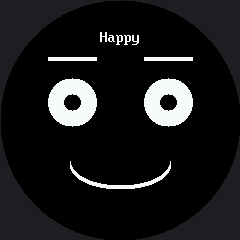
Here's the demo reel's opening mode:

Simulated output of 21-sample-main-demo.py

Only One Full Wipe, and It's the Only One That Matters

Read enter_mode() and replay_mode() as a pair. enter_mode() — called once, whenever the mode actually changes — is the only place in this whole program that calls display.fill(BLACK). replay_mode(), called every few seconds while an animated mode like Blink or Sleepy is up, touches only the boxes that move. Get that split wrong — call enter_mode() on every replay instead — and the demo turns from a smooth loop into a visible strobe, which is exactly the mistake this lab is built to make impossible to miss.