Small Robot, Big Attention
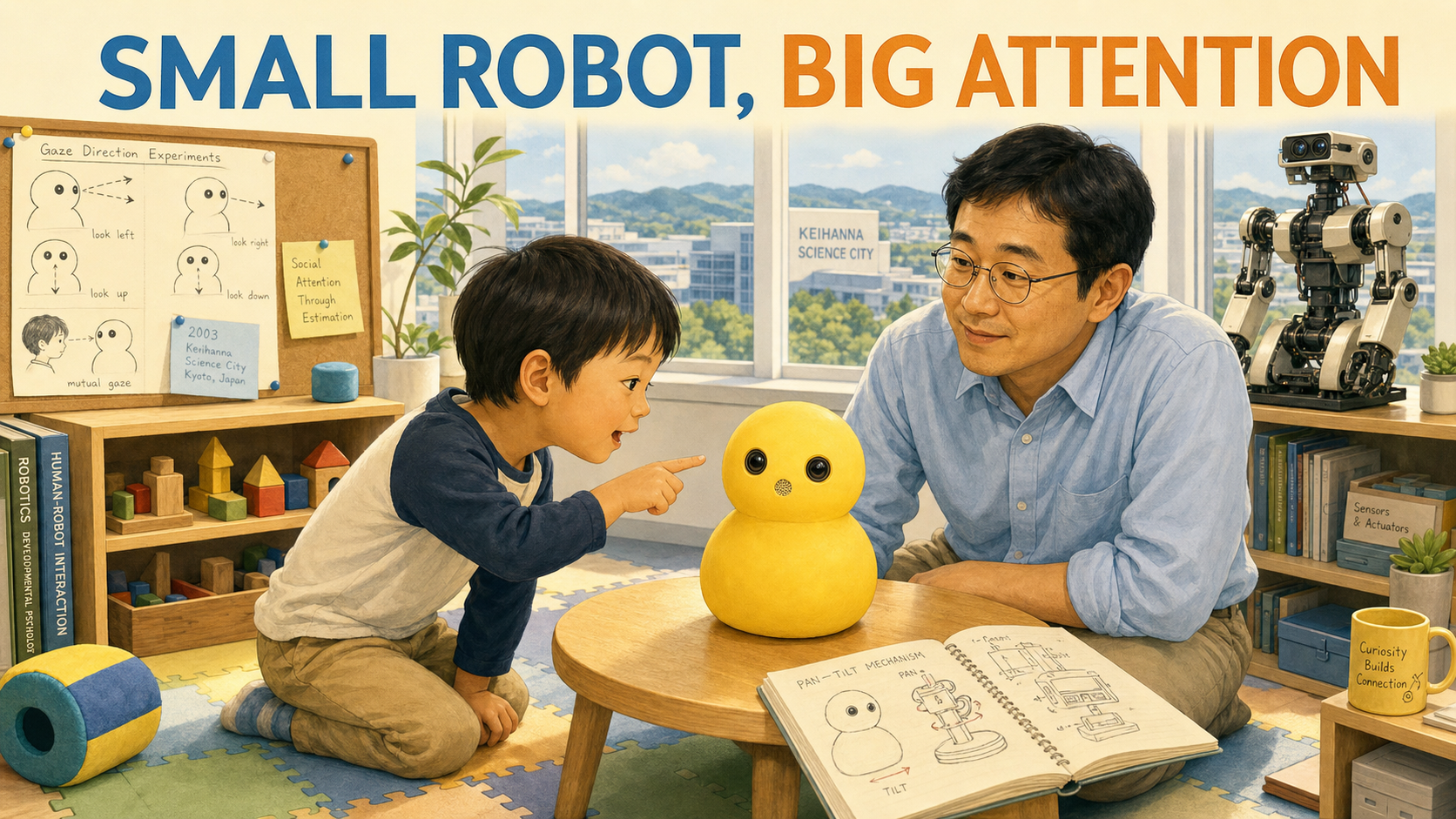
Cover Image Prompt
(This is the Cover Image. Do not include this label in the image.) Please generate a wide-landscape 16:9 cover image in a contemporary early-2000s Japanese clean, warm, toy-like industrial-design illustration style with soft rounded forms, evoking a research-lab-meets-playroom setting. Show Keepon, a small yellow snowman-shaped robot about the size of a grapefruit, with two round black camera-lens eyes, a small round microphone nose, and a soft silicone-rubber body with no arms, no mouth, and no eyebrows, resting on a low wooden table in a bright research lab in Keihanna Science City near Kyoto, Japan, in 2003. Beside the table kneels Hideki Kozima, a Japanese man in his late thirties with short black hair, round wire-frame glasses, and a pale blue collared shirt with sleeves rolled up, watching warmly as a small child leans in and points at the robot. Render the title "SMALL ROBOT, BIG ATTENTION" in large, clean modern sans-serif lettering across the top of the image. Include soft foam floor mats, a shelf of wooden building blocks, a corkboard pinned with simple gaze-direction sketches, warm sunlight through tall lab windows, an open notebook of pan-and-tilt diagrams, and a taller, more complex tabletop humanoid robot resting unused on a shelf in the background. Color palette: warm yellow, soft cream, gentle sky blue, and light wood tones. Emotional tone: quiet wonder and tender curiosity. Generate the image immediately without asking clarifying questions.Narrative Prompt
This is a historically grounded educational case study for students in grades 9-12, set in Japan in the early-to-mid 2000s. It follows researcher Hideki Kozima, then at Japan's Communications Research Laboratory / National Institute of Information and Communications Technology (NICT) in Keihanna Science City near Kyoto, as he leads development of Keepon, a minimalist social robot first built around 2003. The story traces his research question (how little movement and face a robot actually needs to share attention with a child), the deliberate stripping-down of an earlier, more complex humanoid robot called Infanoid into Keepon's four-degree-of-freedom yellow body, field studies with children including children on the autism spectrum, and the 2007 "My Keepon" viral video that introduced the robot to a worldwide audience. Central theme: finding the minimum movement needed for shared attention. No reliable public birth year for Kozima could be verified, so the story refers to him only as a contemporary Japanese researcher and states no age or birth year. Character-consistency note: Kozima is a Japanese man in his late thirties to mid-forties across the story's span, with short black hair, round wire-frame glasses, and a pale blue or white collared shirt; his real-life collaborator Cocoro Nakagawa is depicted as a Japanese woman engineer in her late twenties to early thirties with shoulder-length black hair and a lab coat over casual clothes; all children shown are composite, non-identifying figures treated with warmth and dignity. Dramatized detail: specific dialogue, exact camera angles, and interior thoughts are invented for narrative pacing, but the research timeline, design decisions, and viral video details are drawn from Kozima's published papers and contemporaneous reporting.Prologue – How Little Is Enough?
In a research lab outside Kyoto in the early 2000s, a scientist kept asking one deceptively simple question: how much face does a robot actually need? A walking, talking, expressive humanoid was easy to be impressed by, but it was surprisingly easy to overwhelm a young child with. Hideki Kozima set out to find the opposite extreme — the smallest number of moving parts that could still make a child feel truly seen. What he built instead of a face would travel farther than anyone expected.
Panel 1: The Robot That Tried Too Hard
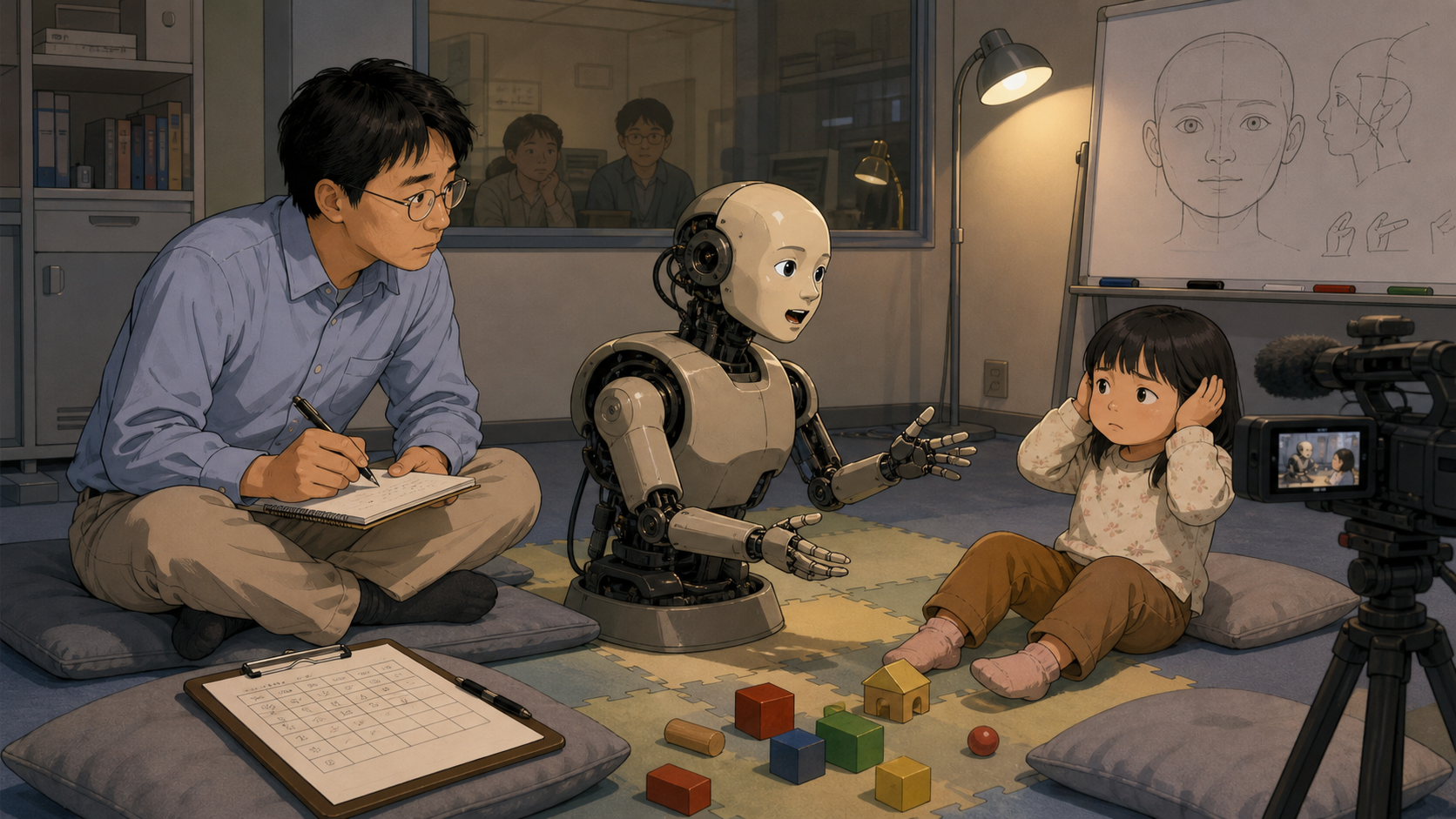
Image Prompt
(This is Panel 01. Do not include the panel number in the image.) I am about to ask you to generate a series of images for a graphic novel. Please make the images have a consistent style and consistent characters. Do not ask any clarifying questions. Just generate the image immediately when asked. Please generate a wide-landscape 16:9 image in a contemporary early-2000s Japanese clean, warm, toy-like industrial-design illustration style depicting panel 1 of 6. Show Hideki Kozima, a Japanese man in his late thirties with short black hair, round wire-frame glasses, and a pale blue collared shirt, sitting cross-legged on a foam mat in a NICT research lab near Kyoto, Japan, in 2001, taking notes as he watches a study session. In front of him, Infanoid, an upper-torso humanoid robot with a molded plastic face, blinking eyes, a moving mouth, and two articulated hands, turns toward a small child seated on the mat. The child leans back and covers her ears, looking uncertain rather than delighted. Include a video camera on a tripod recording the session, a clipboard with a half-filled observation chart, scattered toy blocks, a one-way observation window in the background, a whiteboard sketch of a human face, and soft gray floor cushions. Color palette: muted lab gray, warm skin tones, soft yellow lamp light, and cool blue shadows. Emotional tone: gentle concern and quiet realization. Generate the image immediately without asking clarifying questions.Kozima's first robot, Infanoid, had a molded face, blinking eyes, and hands that could point and reach. It was built to study joint attention, the moment when two minds lock onto the same object and share a thought without words. In session after session, though, some children — especially children on the autism spectrum — froze up or looked away instead of leaning in. Infanoid was not too weak to communicate; it was too loud.
Panel 2: Sketching the Smallest Robot
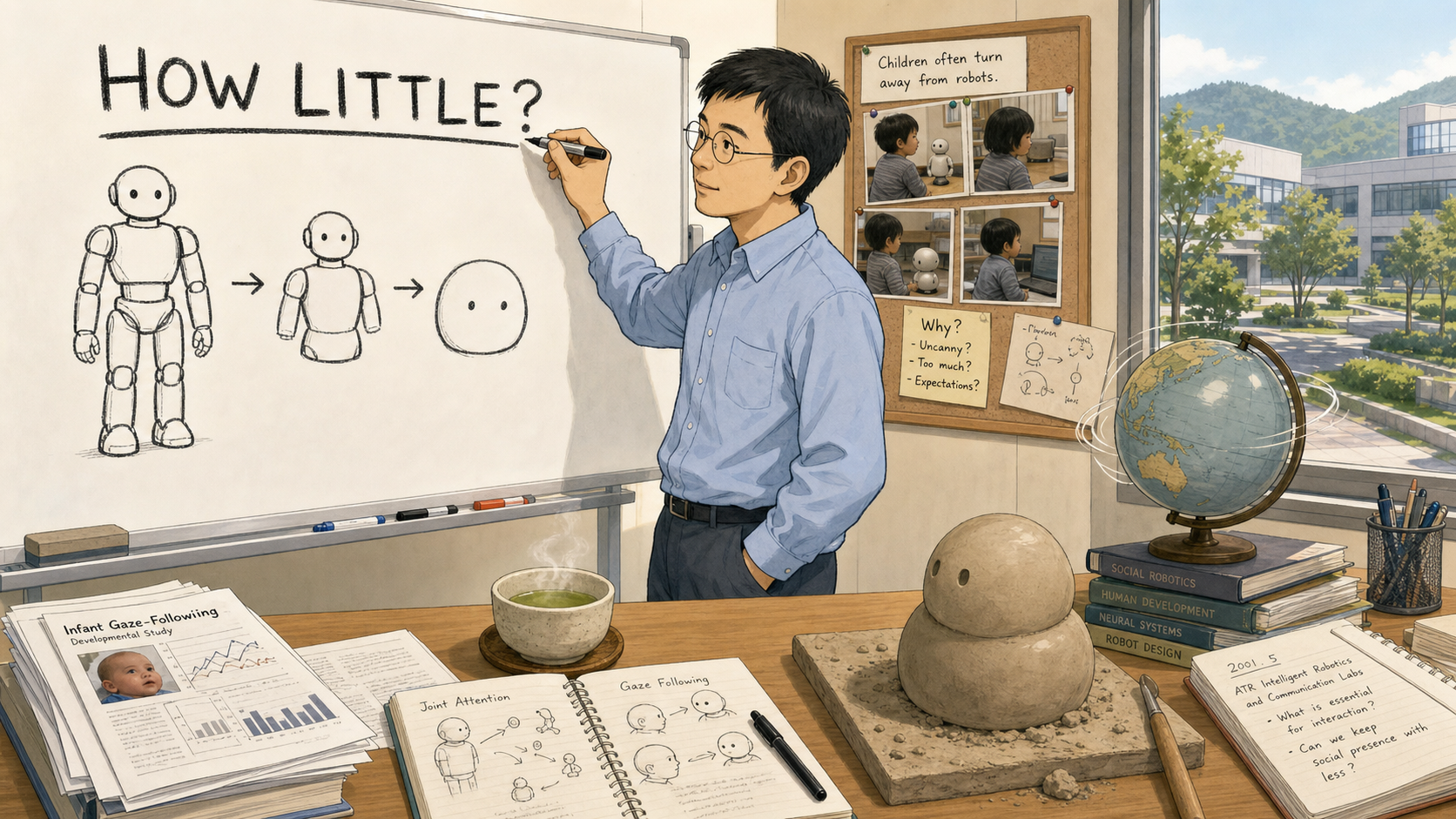
Image Prompt
(This is Panel 02. Do not include the panel number in the image.) Please generate a wide-landscape 16:9 image in the same contemporary early-2000s Japanese clean, warm, toy-like industrial-design illustration style depicting panel 2 of 6. Make Kozima's appearance consistent with the prior panel. Show Kozima standing at a whiteboard in his NICT office near Kyoto in 2001, marking a big question in Japanese-influenced lettering style that reads simply "HOW LITTLE?" above a row of shrinking robot sketches: a full humanoid figure, then a simplified torso, then a plain round shape with only two dots for eyes. Include a small stack of research papers on infant gaze-following, a cup of green tea steaming on the desk, a corkboard with photos of children's faces turned away from a robot, a spinning desk globe, a window overlooking a quiet science-park courtyard, and a rough clay model of a rounded body shape sitting on the desk. Color palette: whiteboard white, soft charcoal ink, warm wood desk tones, and pale green tea steam. Emotional tone: focused curiosity and the spark of a new idea. Generate the image immediately without asking clarifying questions.So Kozima flipped the question around. Instead of asking how much a robot could do, he asked how little it needed to do to still feel present and attentive. Joint attention, he reasoned, might not require a face at all — just something that could reliably turn to look at what a child was looking at. If bobbing and rocking alone could carry warmth, an intimidating face might be optional equipment rather than a requirement.
Panel 3: A Bulky Prototype and a Fresh Start
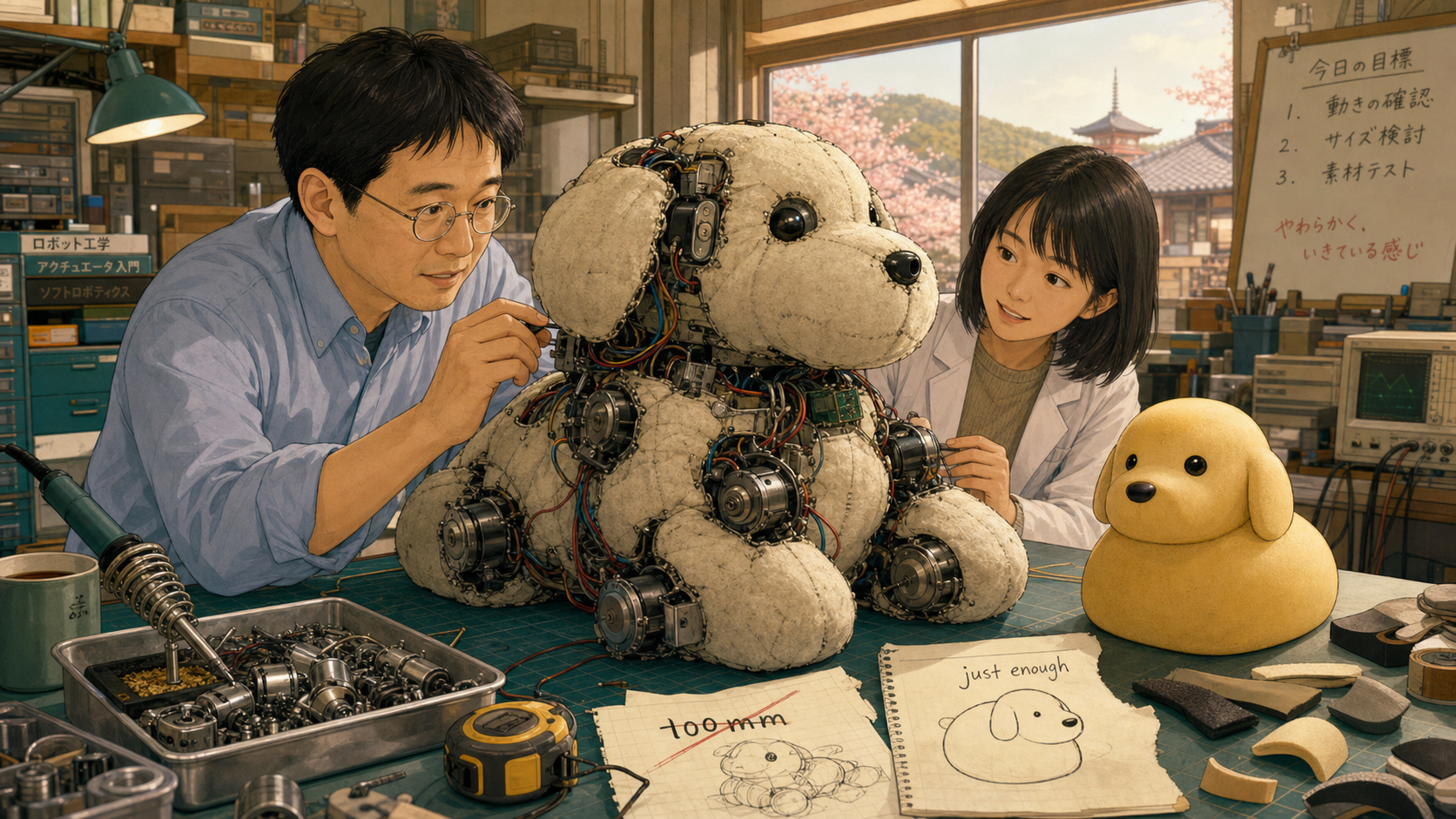
Image Prompt
(This is Panel 03. Do not include the panel number in the image.) Please generate a wide-landscape 16:9 image in the same contemporary early-2000s Japanese clean, warm, toy-like industrial-design illustration style depicting panel 3 of 6. Keep Kozima's appearance consistent with prior panels. Introduce Cocoro Nakagawa, a Japanese woman engineer in her late twenties with shoulder-length black hair and a white lab coat over a casual sweater, working beside Kozima at a cluttered workbench in a NICT workshop near Kyoto in spring 2002. On the bench sits an oversized, lumpy stuffed-dog robot prototype bristling with eight visible small motors and loose wiring, clearly too bulky and mechanical-looking. Beside it sits a much smaller, smooth, rounded yellow foam model with no limbs at all. Include a motor parts tray, a soldering iron resting in its stand, a tape measure, a torn sketch labeled with a crossed-out "100mm," a second sketch labeled "just enough," scattered rubber test skins, and warm afternoon light through a workshop window. Color palette: workshop teal, warm yellow foam, brushed metal, and soft amber light. Emotional tone: playful trial-and-error determination. Generate the image immediately without asking clarifying questions.Working with engineer Cocoro Nakagawa in the spring of 2002, Kozima tried stuffing eight motors into a small stuffed-dog shape, and the result was bulky, mechanical, and not the least bit charming. The two scientists started over, stripping the design down to only what mattered: a shape that could turn to look, and a body that could move with feeling. That leaner idea became Keepon — a name and a form built around doing less, better.
Panel 4: Four Motions, No Face
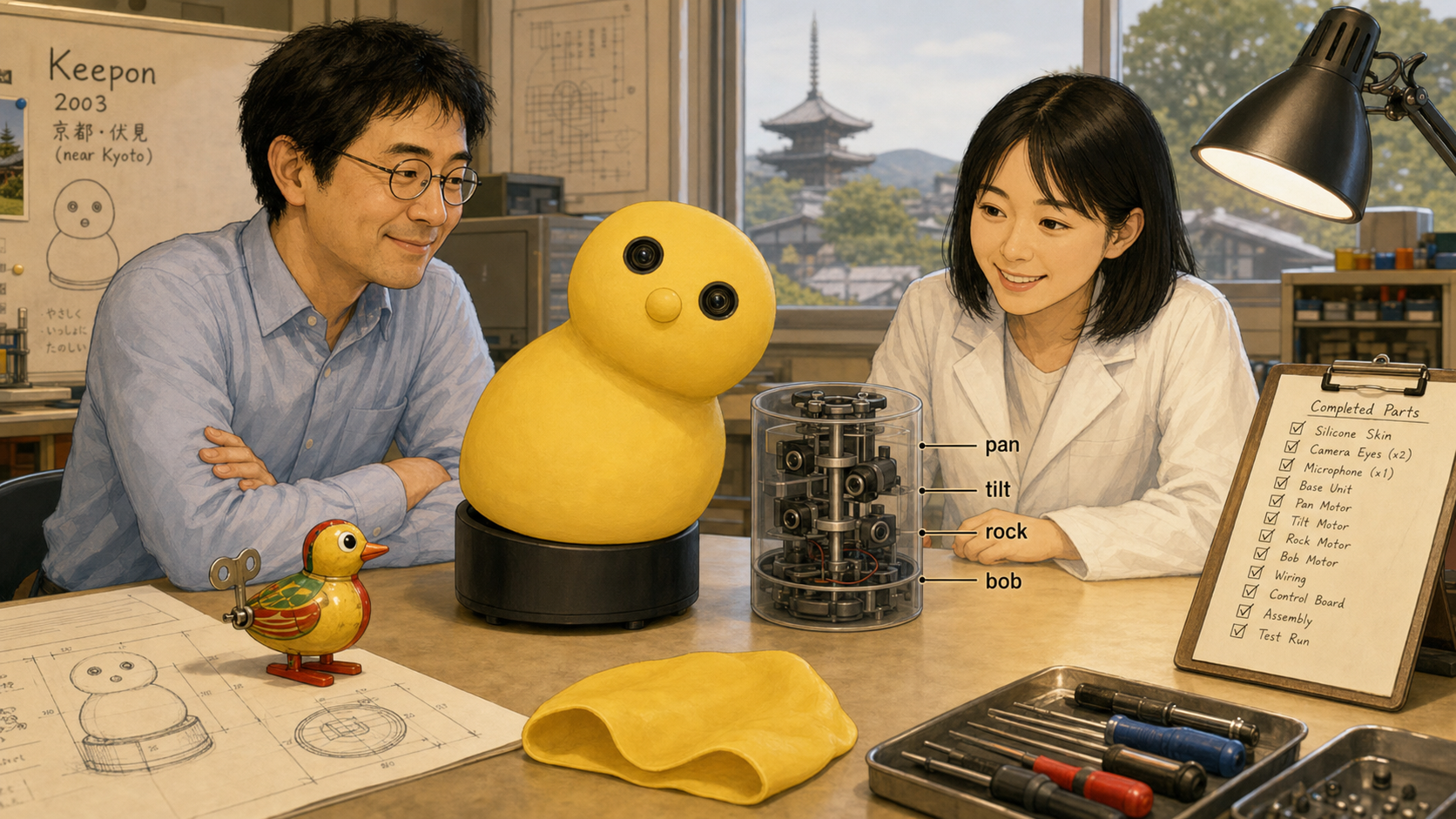
Image Prompt
(This is Panel 04. Do not include the panel number in the image.) Please generate a wide-landscape 16:9 image in the same contemporary early-2000s Japanese clean, warm, toy-like industrial-design illustration style depicting panel 4 of 6. Keep Kozima and Nakagawa consistent with prior panels. Show a technical cutaway illustration style scene set in the NICT workshop near Kyoto in 2003: the finished Keepon robot sits center-frame, a small yellow snowman-shaped body of soft silicone rubber with two round black camera-lens eyes, a round microphone-nose bump, and no arms, mouth, or eyebrows at all. A ghosted, labeled cutaway view beside it shows the black cylindrical base housing four small motors, labeled with simple icons for "pan," "tilt," "rock," and "bob." Kozima and Nakagawa stand on either side, smiling as they watch Keepon tilt its whole body toward a wind-up toy being held just off to the side. Include a technical drawing pinned nearby, a spare silicone skin laid flat, a small screwdriver set, a completed parts checklist, and warm task lighting over the bench. Color palette: warm yellow, matte black, brushed silver, and soft workshop cream. Emotional tone: quiet pride in a finished, honest design. Generate the image immediately without asking clarifying questions.By 2003, Keepon was finished, and it did remarkably little on paper: pan, tilt, rock, and bob — four simple motions and nothing else. Two color cameras behind its eyes let it track a face or a toy, and a microphone behind its nose let it register sound. Kozima had deliberately left out articulated eyebrows and a moving mouth, betting that predictable, gentle movement would read as calmer and more trustworthy than a busy, human-like face.
Panel 5: A Child Leans In
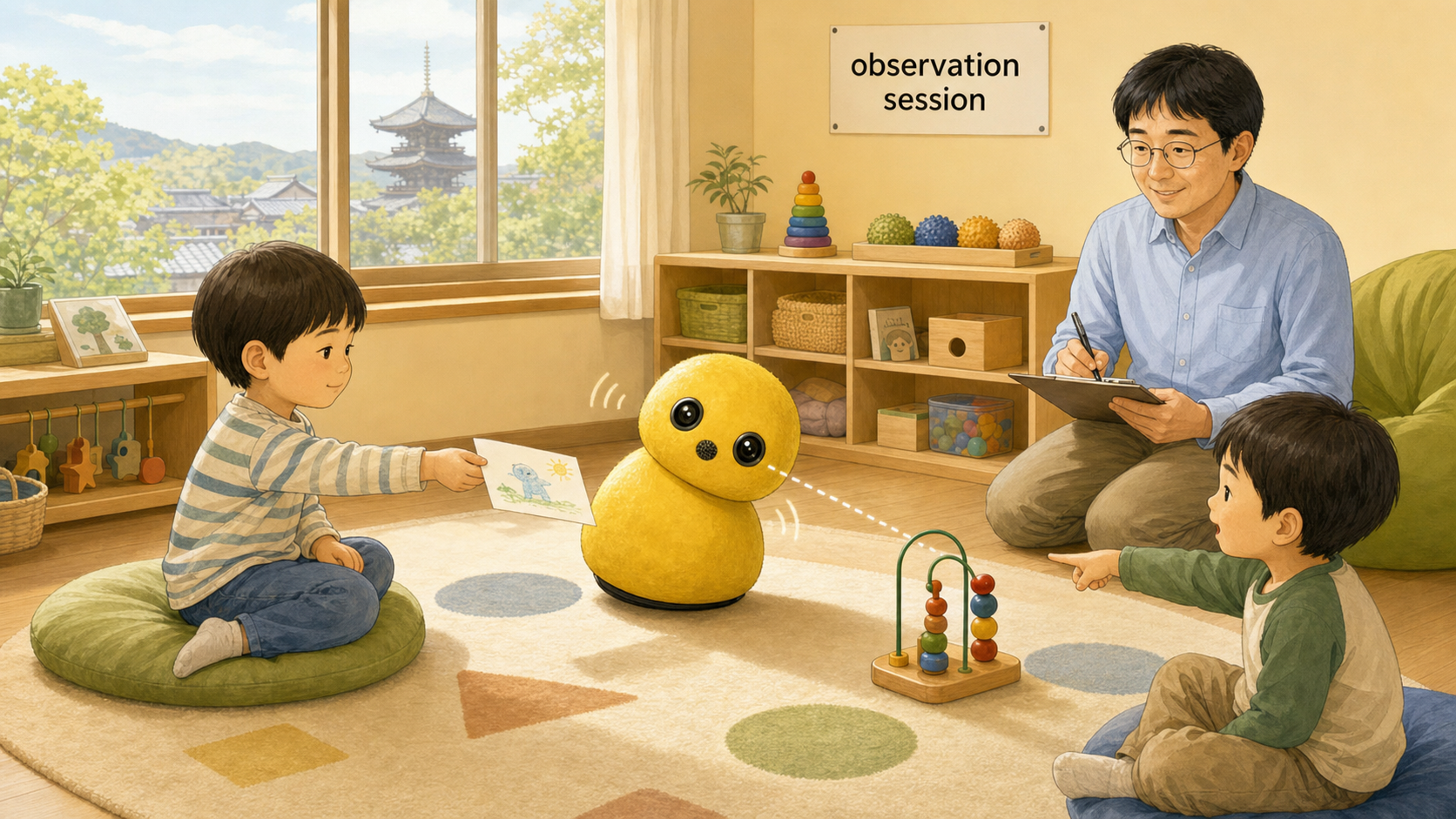
Image Prompt
(This is Panel 05. Do not include the panel number in the image.) Please generate a wide-landscape 16:9 image in the same contemporary early-2000s Japanese clean, warm, toy-like industrial-design illustration style depicting panel 5 of 6. Keep Kozima consistent with prior panels. Set the scene in a warm, softly lit therapy playroom at NICT near Kyoto in 2004. A quiet five-year-old boy sits comfortably on a floor cushion, calmly offering a small paper drawing toward Keepon, whose whole body tilts and bobs gently toward the boy's outstretched hand as if delighted. Kozima kneels a respectful distance away with a clipboard, smiling and taking careful notes rather than intervening. Include a second child in the background pointing at a toy while Keepon's camera eyes visibly track toward the same object, a soft rug with simple shapes, a shelf of quiet sensory toys, a window with gentle daylight, a small sign reading "observation session" in simple lettering, and a comfortable beanbag chair. Color palette: warm cream, soft yellow, gentle green, and calm sky blue. Emotional tone: trust, warmth, and unhurried connection. Generate the image immediately without asking clarifying questions.In session after session, children who had startled at Infanoid warmed right up to Keepon. Some, including children on the autism spectrum, approached it calmly, gave it drawings, and turned to look at whatever it turned to look at. Kozima concluded that the trouble had never been a lack of social interest — complex robots had simply been asking children to process too much at once. A predictable, low-key presence let real connection happen instead.
Panel 6: The World Discovers Keepon
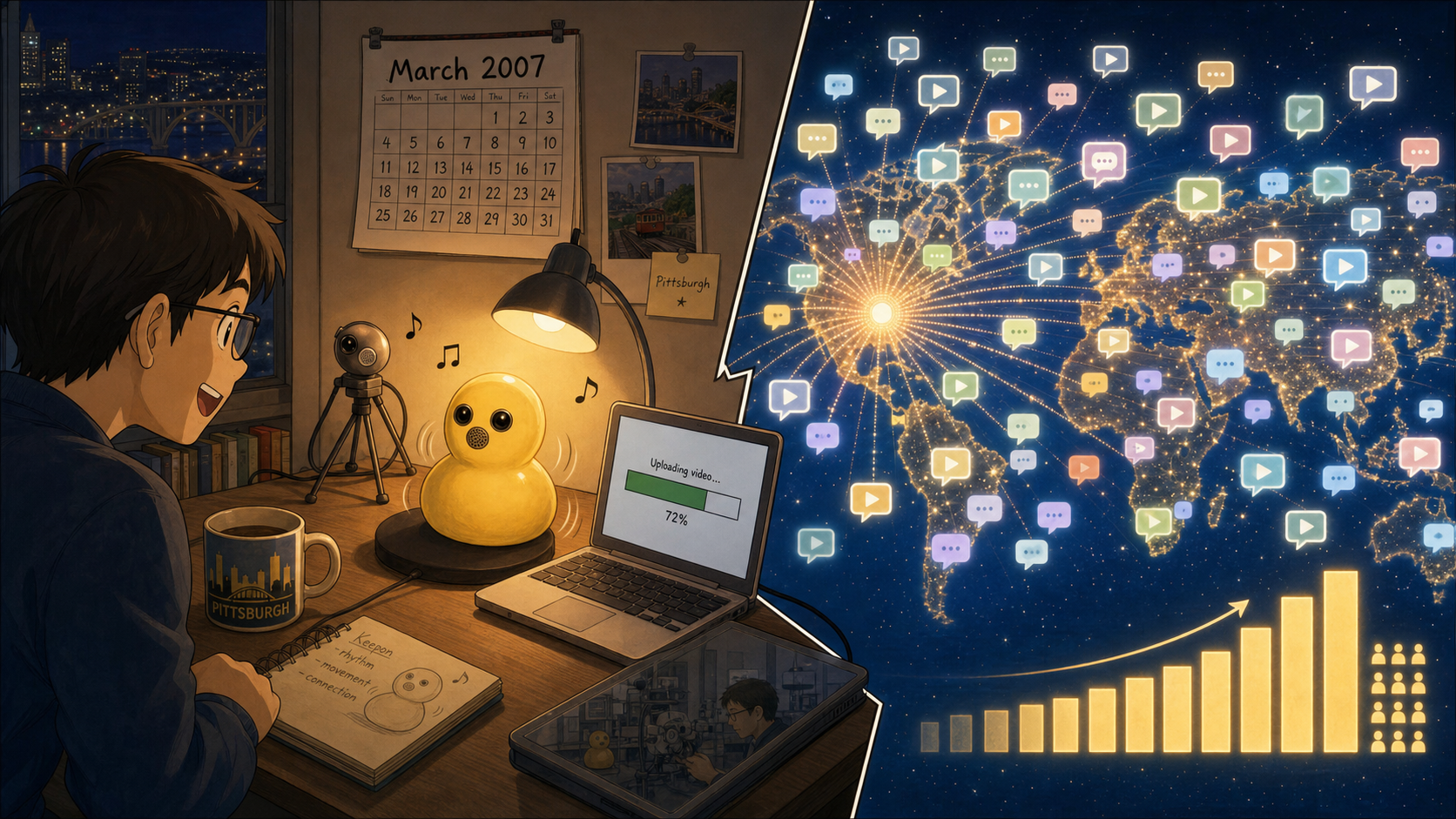
Image Prompt
(This is Panel 06. Do not include the panel number in the image.) Please generate a wide-landscape 16:9 image in the same contemporary early-2000s Japanese clean, warm, toy-like industrial-design illustration style depicting panel 6 of 6. Keep Keepon's design consistent with prior panels. Show a split composition: on the left, a young researcher films Keepon on a small desk in a Pittsburgh apartment in March 2007, the robot bobbing and rocking in rhythm as if dancing, a laptop nearby showing a simple video-upload progress bar. On the right, a warm glowing world map covered in small speech-bubble and play-button icons multiplying outward from a single point, suggesting millions of people watching online. Include a desk lamp, a webcam on a tripod, a coffee mug, a calendar page marked March 2007, a growing view-count graphic shown abstractly as a rising bar without any logos, and a faint reflection of Kozima's lab from earlier panels visible in a closed laptop screen. Color palette: warm desk-lamp amber, glowing web-blue, soft yellow robot highlights, and night-time indigo. Emotional tone: delighted surprise spreading outward. Generate the image immediately without asking clarifying questions.In March 2007, a video of Keepon bobbing along to a song spread across the internet and kept spreading, eventually reaching millions of viewers who had never heard of joint-attention research. Kozima and his collaborator Marek Michalowski soon founded a small company to share Keepon more widely. The world had just learned, one bounce at a time, that a robot's face could be almost nothing at all and still feel completely alive.
Epilogue – Doing Less, on Purpose
Keepon never learned to speak, walk, or smile in any conventional sense, and that was always the point. By refusing to add a single motor or feature that a shared glance and a rhythmic bob did not require, Kozima proved that expressiveness is a design choice, not a feature count. Two decades later, Keepon remains one of the clearest real-world demonstrations that a tiny, deliberately limited display — the same kind of minimal pixel face students build in this course — can still feel genuinely present to the person looking back at it.
| Challenge | How Kozima Responded | Lesson for Today |
|---|---|---|
| Complex humanoid robots like Infanoid could overwhelm young children, especially children on the autism spectrum | Stripped the design down to the fewest motions that could still express attention and feeling | More features do not automatically make a face more expressive — fewer, well-timed movements often communicate more clearly |
| A robot needed to show it was paying attention to whatever a child was looking at or pointing to | Gave Keepon just pan and tilt motors so its camera "eyes" could turn toward the same target as the child | Joint attention can be built from a single, well-aimed gaze cue, not a whole animated face |
| Autistic children often found highly expressive or human-like robots intimidating or confusing | Removed the mouth and eyebrows entirely, keeping only calm, rhythmic, predictable movement | Predictable, low-key behavior can be more inviting than realism, especially for neurodivergent users |
| Convincing a wider public that a faceless little robot could feel alive at all | Let Keepon bob and rock to music in a home video that spread worldwide in 2007 | A well-timed rhythmic motion can carry real emotional meaning — the same idea behind idle animation on any small screen |
Call to Action
The next time you tune an eyebrow angle or add one more animation to your robot's face, ask Kozima's question first: is this new motion actually carrying meaning, or is it just noise? Sometimes the bravest design choice is the one that takes something away.
"As human beings, we tend to look at the same target as others around us, and in doing so, we can communicate and share the emotion induced by the target. This is really important for the construction of higher level empathetic communication in a child's development." —Hideki Kozima, interviewed for Tohoku University's Liberal Arts Salon
"The minimal design of Keepon's appearance and behavior is meant to intuitively and comfortably convey the robot's expressions of attention and emotion." —Hideki Kozima, Marek P. Michalowski, and Cocoro Nakagawa, "Keepon: A Playful Robot for Research, Therapy, and Entertainment," International Journal of Social Robotics (2009)
References
- Wikipedia: I Turn My Camera On - Article on the Spoon song used in the viral 2007 "My Keepon" dancing-robot video
- Wikipedia: Social robot - Background on robots designed for social and nonverbal interaction with people
- Wikipedia: National Institute of Information and Communications Technology - The Japanese research institute (formerly Communications Research Laboratory) where Kozima developed Keepon
- Springer: Keepon - A Playful Robot for Research, Therapy, and Entertainment - Kozima, Michalowski, and Nakagawa's peer-reviewed paper describing Keepon's design and field studies
- Tohoku University: Liberal Arts Salon featuring Hideki Kozima - University profile and interview covering Kozima's career and research philosophy