Choosing a Capstone Track
You can embed this MicroSim in your own course page with the following iframe:
<iframe src="https://dmccreary.github.io/cybersecurity/sims/capstone-track-chooser/main.html"
        width="100%" height="600" scrolling="no"></iframe>
About this MicroSim
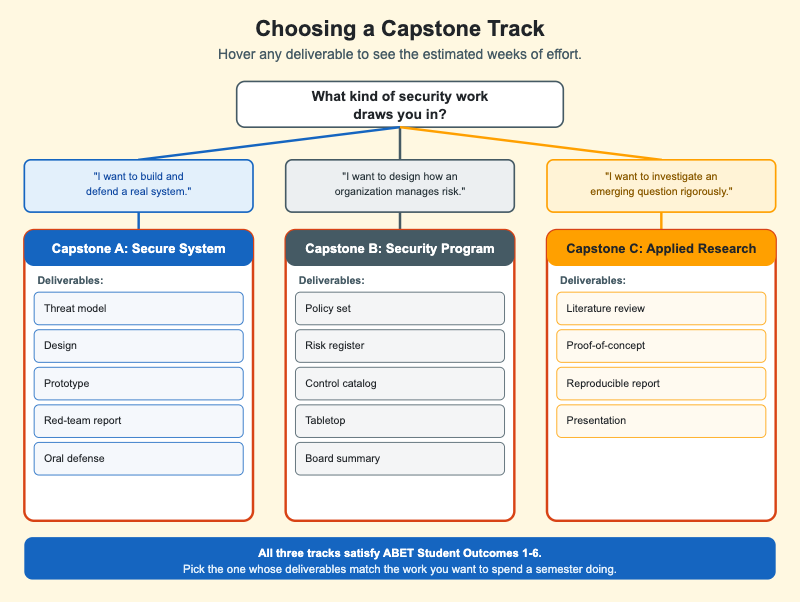
This infographic frames the capstone decision as a single question — "What kind of security work draws you in?" — that branches into three tracks. The left branch (cybersecurity blue) leads to Capstone A: Secure System, for students who want to build and defend a real system. The center branch (slate steel) leads to Capstone B: Security Program, for students who want to design how an organization manages risk. The right branch (alert amber) leads to Capstone C: Applied Research, for students who want to investigate an emerging question rigorously. Each card lists its concrete deliverables inside a rust-orange-bordered panel.
Hover (or tap on a tablet) any deliverable to see a tooltip with its estimated weeks of effort, so you can compare the shape and pace of each track before you commit a semester to it. A banner across the bottom reminds you that all three tracks satisfy ABET Student Outcomes 1-6 — the choice is about the work you want to do, not about which track "counts" more. The diagram scales to its container width so it remains readable when embedded in a chapter page.
Lesson Plan
Learning objective (Bloom: Understand): Given the three capstone tracks, students will identify which track's deliverables best match the kind of security work they want to do and justify the choice from the deliverable timeline.
Suggested classroom use: Show this MicroSim at the capstone-planning meeting. Ask each student to hover all deliverables across the three cards and privately tally the rough total weeks per track. Then have them pair up and explain to a partner which track they are drawn to and why, using at least two specific deliverables as evidence.
Discussion questions:
- Two tracks each spend their largest single block of weeks on a "build" deliverable (Prototype, Proof-of-concept). How are those two builds different in purpose?
- Capstone B has no "prototype" deliverable. What does that tell you about the kind of evidence a security-program capstone produces?
- If all three tracks satisfy the same ABET outcomes, what should drive your choice between them?
References
- ABET Cybersecurity Program Criteria — the Student Outcomes 1-6 referenced in the banner.
- Wikipedia: Capstone course — background on the capstone-project model.
- Wikipedia: Threat model — the first deliverable of the Secure System track.
- NIST SP 800-53 Security and Privacy Controls — the control framework referenced by the Security Program track.
Specification
The full specification below is extracted from Chapter 16: "Emerging Topics and Capstone Pathways".
Type: infographic
**sim-id:** capstone-track-chooser
**Library:** Static SVG with hover tooltips

A clean three-branch decision tree starting from the question "What kind of
security work draws you in?" Three branches descend to cards: Capstone A Secure
System (blue), Capstone B Security Program (slate), Capstone C Applied Research
(amber). Hover tooltips on each deliverable show estimated weeks of effort. A
banner notes all three satisfy ABET Student Outcomes 1-6. Cards have rust-orange
accent borders. Responsive; branches reflow on narrow viewports.