PICERL Incident Response Lifecycle
You can include this MicroSim on your own page with the following iframe:
<iframe src="https://dmccreary.github.io/cybersecurity/sims/picerl-lifecycle/main.html" height="252" width="100%" scrolling="no"></iframe>
About this MicroSim
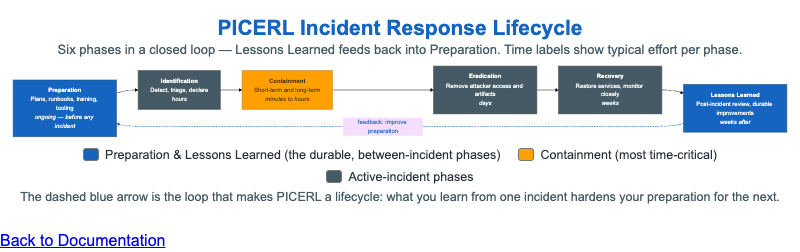
PICERL is the classic six-phase incident-response lifecycle: Preparation, Identification, Containment, Eradication, Recovery, and Lessons Learned. This diagram lays the six phases out left to right and, crucially, closes the loop with a dashed blue arrow that returns from Lessons Learned back to Preparation — that feedback edge is what makes PICERL a lifecycle rather than a one-time checklist.
The colors encode role. The two blue phases — Preparation and Lessons Learned — are the durable, between-incident work that happens when no alarm is ringing. Containment is amber because it is the most time-critical phase: it is where you stop the bleeding before deciding how to clean up. The remaining phases (Identification, Eradication, Recovery) are the active-incident work shown in slate.
Each box also carries a typical time/effort label, from "ongoing" preparation through "hours" to identify, "minutes to hours" to contain, "days" to eradicate, "weeks" to recover, and "weeks after" for the review. Those labels are deliberately rough — they exist to build intuition that containment is fast and decisive while recovery and review are slow and thorough.
Lesson Plan
Learning objective (Bloom: Understand). Students will name the six PICERL phases in order, explain what happens in each, and describe how the Lessons Learned → Preparation feedback loop improves the organization's response to future incidents.
Suggested classroom use. Walk a short tabletop scenario (e.g., a ransomware detection) through all six phases, asking students what specific action belongs in each phase and roughly how long they would expect to spend there.
Discussion questions:
- Why is Containment treated as the most time-critical phase, and what is the difference between short-term and long-term containment?
- What concrete artifacts should the Lessons Learned phase produce so that the feedback loop into Preparation is real and not just a meeting?
- Eradication and Recovery are sometimes rushed under business pressure. What goes wrong if you start Recovery before Eradication is complete?
References
- Incident response (computer security) — Wikipedia
- Computer security incident management — Wikipedia
- SANS Institute — Wikipedia
Specification
The full specification below is extracted from Chapter 15: "Offensive and Defensive Security Operations".
Type: workflow-diagram
sim-id: picerl-lifecycle
Library: Mermaid
Status: Specified

A closed-loop diagram of the six PICERL phases: Preparation (blue), Identification
(slate), Containment (amber, time-critical), Eradication (slate), Recovery (slate),
Lessons Learned (blue). Arrows form the cycle and a dashed arrow returns from
Lessons Learned to Preparation, emphasizing the feedback loop. Each phase carries a
relative-time annotation (hours to identify, minutes-hours to contain, days to
eradicate, weeks to recover, weeks-after to review).

Color: cybersecurity blue, slate steel, alert accent amber for the time-critical
phase. Background white. Responsive via Mermaid useMaxWidth.