A TOCTOU Race Condition
Run the TOCTOU Race Condition MicroSim Fullscreen
You can include this MicroSim on your own website with the following iframe:
<iframe src="https://dmccreary.github.io/cybersecurity/sims/toctou-race/main.html" height="820" width="100%" scrolling="no"></iframe>
About this MicroSim
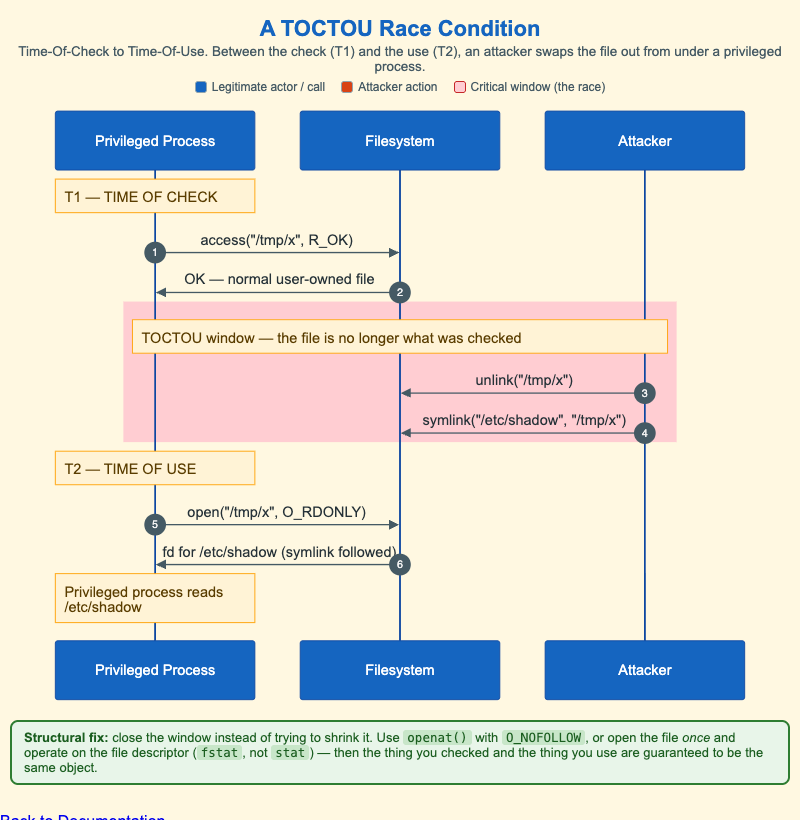
This sequence diagram shows a classic TOCTOU bug — Time-Of-Check to Time-Of-Use — one of the more counterintuitive software vulnerabilities because the buggy code often looks defensive. Three lifelines run top to bottom: a Privileged Process (left), the Filesystem (center), and an Attacker (right).
At T1 (time of check) the privileged process calls access("/tmp/x", R_OK)
and the filesystem replies that /tmp/x is a normal, user-owned file — so far so
good. The danger is the gap that follows. Inside the red-tinted TOCTOU window,
the attacker unlinks /tmp/x and re-creates it as a symlink pointing at
/etc/shadow. Then at T2 (time of use) the privileged process opens the same
path, follows the symlink, and is handed a file descriptor for /etc/shadow — a
file it should never have read. The check and the use referred to two different
objects, and that is the whole bug.
The green box below the diagram states the structural fix: don't try to make
the window smaller — close it. Use openat() with O_NOFOLLOW, or open the file
once and operate on the resulting file descriptor (fstat rather than re-running
stat on the path), so the thing you checked and the thing you use are guaranteed
to be the same object. The diagram is read top to bottom and simplifies to a
single vertical sequence on narrow screens.
Lesson Plan
Learning objective (Bloom — Understand / explain): Students can explain how the interval between a check and a use creates an exploitable race, trace a symlink-swap TOCTOU attack against a privileged process, and identify the structural fix.
Suggested classroom use: Project the diagram and read it as a story. Cover the red window first and ask "this code checks the file before using it — what could go wrong?" Then reveal the attacker's two calls inside the window. Finish on the fix box and stress the principle: re-resolving a path is re-checking; operating on a file descriptor is not.
Discussion questions:
- The developer "fixes" the bug by moving the
open()call to the line right afteraccess(). Why does shrinking the window fail to eliminate the vulnerability? - What property of a file descriptor (versus a path string) makes the
openat()/fstat()approach safe? - TOCTOU bugs are a kind of race condition. What makes them especially dangerous when the checking code runs with elevated privilege?
References
- Time-of-check to time-of-use (Wikipedia)
- Race condition (Wikipedia)
- CWE-367: Time-of-check Time-of-use (TOCTOU) Race Condition
- Symbolic link (Wikipedia)
Specification
The full specification below is extracted from Chapter 5: "Software Vulnerabilities and Secure Coding".
Type: workflow-diagram
**sim-id:** toctou-race<br/>
**Library:** Mermaid<br/>
**Status:** Specified

A sequence diagram with three actors: Privileged Process (left), Filesystem (center), Attacker (right).

Time flows top-to-bottom. Steps:

1. Privileged Process → Filesystem: `access("/tmp/x", R_OK)` (T1: check)
2. Filesystem → Privileged Process: returns OK (file is a normal user-owned file)
3. **CRITICAL WINDOW** (annotated with a red dashed box around steps 4-5):
4. Attacker → Filesystem: `unlink("/tmp/x")`
5. Attacker → Filesystem: `symlink("/etc/shadow", "/tmp/x")`
6. Privileged Process → Filesystem: `open("/tmp/x", O_RDONLY)` (T2: use)
7. Filesystem → Privileged Process: returns file descriptor for /etc/shadow (because the privileged process followed the symlink)
8. Privileged Process reads /etc/shadow

A side note labels the window between T1 and T2 as "TOCTOU window".

Below the sequence diagram, a small box shows the structural fix: "Use openat() with O_NOFOLLOW, or open the file once and operate on the file descriptor — eliminates the window."

Color: cybersecurity blue for legitimate actors, rust orange (`#d84315`) for attacker actions, alert amber for the critical window box.

Responsive: simplifies to vertical sequence below 600px.

Implementation: Mermaid sequenceDiagram with rect-bordered critical window.