The Purdue Model — IT/OT Network Layers
Run the Purdue Model MicroSim Fullscreen
You can include this MicroSim on your own website with the following iframe:
<iframe src="https://dmccreary.github.io/cybersecurity/sims/purdue-model-layers/main.html" height="977" width="100%" scrolling="no"></iframe>
About this MicroSim
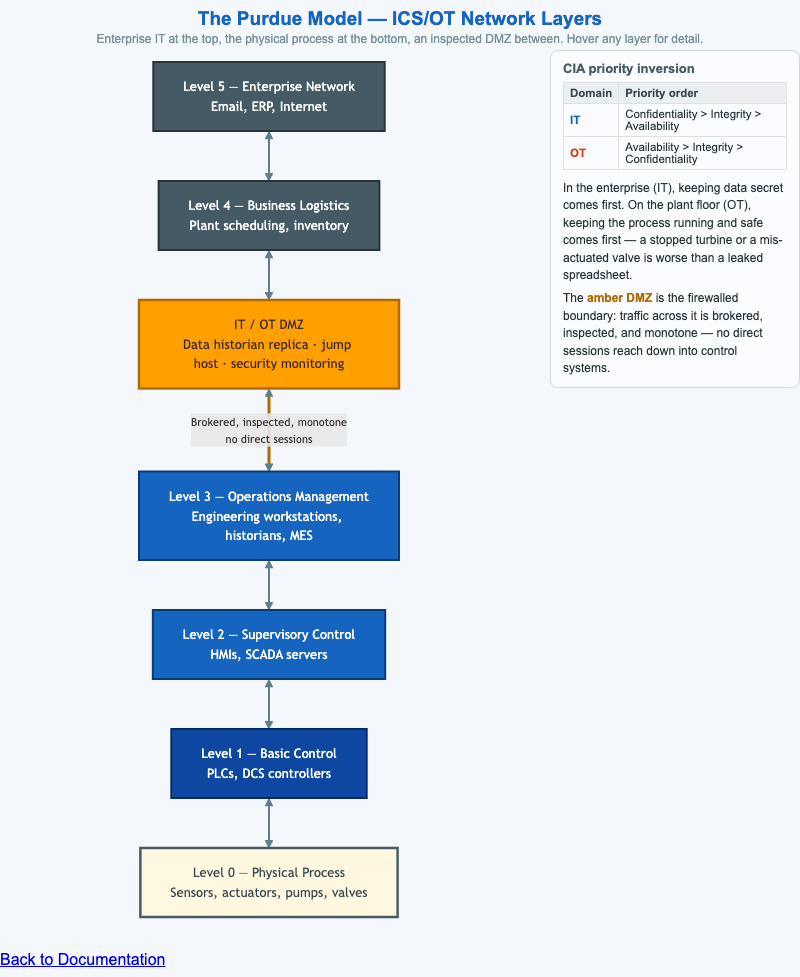
The Purdue model (the Purdue Enterprise Reference Architecture) is the standard way to reason about the network architecture of an industrial control system. This diagram stacks its layers the way the standard draws them: ordinary enterprise IT at the top (Level 5 email/ERP/internet, Level 4 plant logistics), the physical process at the bottom (Level 0 sensors, actuators, pumps, valves), and the operational technology layers in between — Level 3 operations management, Level 2 SCADA/HMIs, Level 1 PLCs and controllers. Between the IT and OT worlds sits the amber IT/OT DMZ: a controlled boundary holding a data-historian replica, jump hosts, and security monitoring.
The single most important detail is the boundary crossing into Level 3, annotated "brokered, inspected, monotone — no direct sessions." Nothing on the enterprise side opens a session straight into the control network; traffic is mediated and inspected at the DMZ. The right-hand legend shows the CIA priority inversion that makes OT different from IT: in the enterprise, confidentiality comes first, but on the plant floor availability does — a stopped turbine or a mis-actuated valve is a safety event far worse than a leaked spreadsheet. Hover any layer for detail.
Lesson Plan
Learning objective (Bloom — Understand): Students can identify the seven layers of the Purdue model from the enterprise network to the physical process and explain the IT/OT DMZ boundary and why the CIA priority order inverts between IT and OT.
Suggested classroom use: Read the stack top-down, hovering each layer. Stop at the DMZ and ask why a direct remote-desktop session from an engineer's corporate laptop to a PLC would violate the model. Then compare the two CIA orderings in the legend.
Discussion questions:
- Why does the IT/OT DMZ forbid direct sessions from the enterprise into the control systems rather than just firewalling specific ports?
- Why does availability outrank confidentiality on the plant floor when the opposite holds in enterprise IT?
- An attacker lands on the Level 5 enterprise network. What does the Purdue architecture force them to do before they can reach a Level 1 PLC?
References
- Purdue Enterprise Reference Architecture (Wikipedia)
- Industrial control system (Wikipedia)
- SCADA (Wikipedia)
Specification
The full specification below is extracted from Chapter 14: "Societal Security: Law, Forensics, and Ethics".
Type: diagram
**sim-id:** purdue-model-layers<br/>
**Library:** Mermaid<br/>
**Status:** Specified

Mermaid `flowchart TB` with seven horizontal layers stacked top to bottom, each a colored band:

- **Level 5 — Enterprise Network** (slate steel #455a64) — "Email, ERP, Internet"
- **Level 4 — Business Logistics** (slate steel) — "Plant scheduling, inventory"
- **(IT/OT DMZ)** (alert accent #ffa000, dashed border) — "Data historian replica, jump host, security monitoring"
- **Level 3 — Operations Management** (cybersecurity blue #1565c0) — "Engineering workstations, historians, MES"
- **Level 2 — Supervisory Control** (cybersecurity blue) — "HMIs, SCADA servers"
- **Level 1 — Basic Control** (cybersecurity blue, darker) — "PLCs, DCS controllers"
- **Level 0 — Physical Process** (cream #fff8e1 with slate border) — "Sensors, actuators, pumps, valves"

Vertical arrows between levels are bidirectional, but the arrow crossing the IT/OT DMZ is annotated **"Brokered, inspected, monotone — no direct sessions"** to emphasize the firewalled boundary.

A right-side legend explains the **CIA priority inversion**: IT (Confidentiality > Integrity > Availability) versus OT (Availability > Integrity > Confidentiality).

Implementation: Mermaid `flowchart TB` with subgraph layers and color classes; legend rendered alongside.