Purdue Model Attack Paths
You can include this MicroSim on your own page with the following iframe:
<iframe src="https://dmccreary.github.io/cybersecurity/sims/purdue-model-attack-paths/main.html" height="642" width="100%" scrolling="no"></iframe>
About this MicroSim
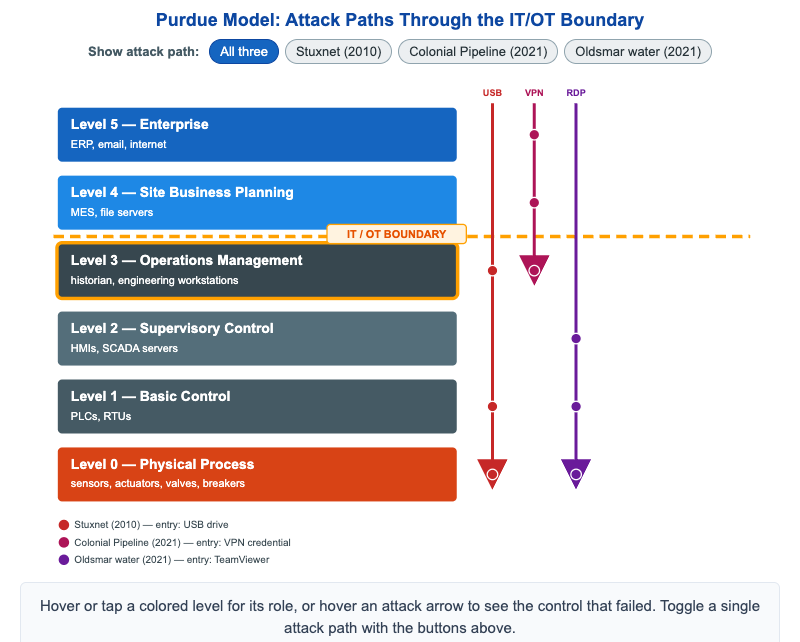
This diagram stacks the six Purdue model levels — from the Enterprise (Level 5) at the top down to the Physical Process (Level 0) at the bottom — with the IT/OT boundary drawn as a thick amber dashed line between Level 4 and Level 3. Over the levels run three real industrial-control-system attacks as colored arrows: Stuxnet (2010), Colonial Pipeline (2021), and the Oldsmar water plant (2021). Each arrow descends through the levels it actually touched, ending where the impact landed.
Hover over (or tap) any level to read its role, hover an attack arrow to read how the intrusion moved and — crucially — the control that failed at each hop, or use the buttons to isolate a single attack path. The lessons are pointed: Stuxnet crossed an assumed air gap because USB media was still allowed; Colonial caused an operational shutdown entirely from the IT side because MFA was missing on a VPN, never touching a controller; and Oldsmar reached a chemical-dosing setpoint through a remote-access tool with a shared password. Together they show that the IT/OT boundary is only as strong as the weakest control crossing it.
Lesson Plan
Learning objective (Bloom: Understand). Students will identify the six Purdue levels and the IT/OT boundary, trace three real ICS attacks through those levels, and name the specific control that failed in each.
Suggested classroom use. Project the diagram and isolate one attack at a time with the buttons. For each, have students state the entry point, the levels crossed, the impact, and the single control whose absence enabled it. Then ask which control would have stopped each attack earliest.
Discussion questions:
- Stuxnet defeated an air gap. What does that tell you about treating physical isolation as a complete control, and what would you add?
- Colonial Pipeline never reached Level 1 or 0, yet caused a shutdown. How can an IT-only compromise produce operational impact across the IT/OT boundary?
- All three attacks crossed the IT/OT boundary differently. What is the common theme in the controls that failed, and how does least privilege apply?
References
- Purdue Enterprise Reference Architecture — Wikipedia
- Stuxnet — Wikipedia
- Colonial Pipeline ransomware attack — Wikipedia
- Oldsmar water treatment attack — Wikipedia
Specification
The full specification below is extracted from Chapter 16: "Emerging Topics and Capstone".
Type: infographic
sim-id: purdue-model-attack-paths
Library: Static SVG with hover tooltips
Status: Specified

A vertical stack of horizontal bands, each a Purdue level (Level 0 physical
process up to Level 5 enterprise), with the IT/OT boundary drawn as a thick
dashed line (amber) between Level 3 and Level 4. Three labeled attack paths drawn
as red arrows descend through the levels with hover tooltips:
- Stuxnet (2010): USB -> Level 3 workstation -> Level 1 PLC -> Level 0 centrifuge.
- Colonial Pipeline (2021): VPN credential -> Level 4 IT -> operational impact via
  shutdown of Level 3 systems.
- Oldsmar water (2021): TeamViewer -> HMI at Level 2 -> setpoint change at Level 1
  -> Level 0 chemical dosing.
Each arrow is annotated with the control that failed.

Color: cybersecurity blue, alert accent for boundary, slate steel and rust orange
for OT levels. Responsive; tooltips are tap targets on touch screens.

Implementation: Static SVG with CSS hover and a small JavaScript tooltip layer.