Vendor Risk Tiers
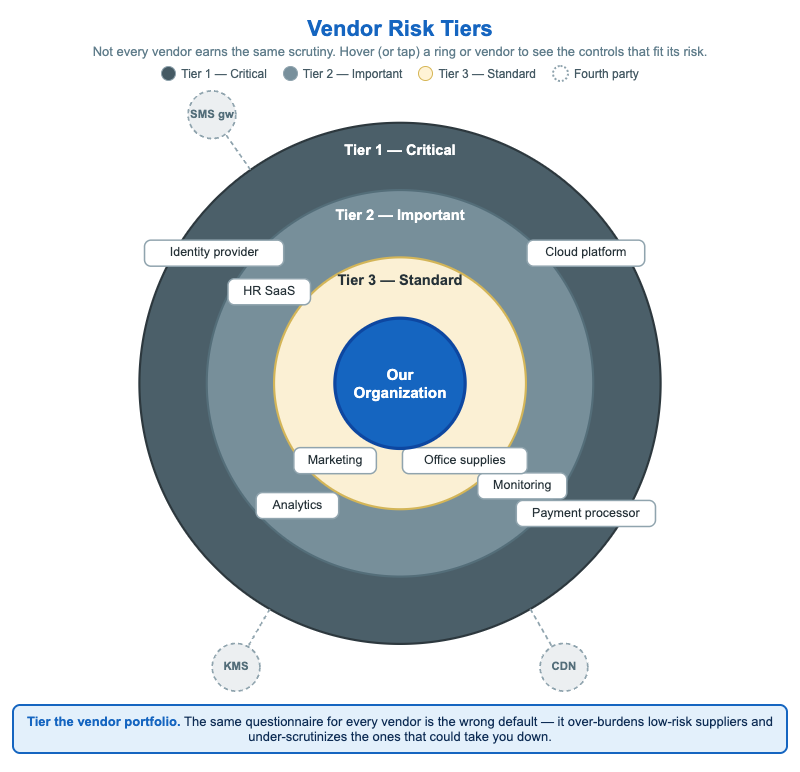
Run the Vendor Risk Tiers MicroSim Fullscreen
You can include this MicroSim on your own website with the following iframe:
<iframe src="https://dmccreary.github.io/cybersecurity/sims/vendor-risk-tiers/main.html" height="772" width="100%" scrolling="no"></iframe>
About this MicroSim
This infographic answers a question every security program eventually faces: how much scrutiny does each vendor deserve? Your organization sits at the center; vendors orbit it in three concentric rings ordered by the damage their failure or breach could do. Tier-1 critical vendors (cloud platform, identity provider, payment processor) sit closest because a problem there can halt the business or expose customer data. Tier-2 important vendors (HR SaaS, monitoring, analytics) carry real but contained impact. Tier-3 standard vendors (office supplies, marketing tools with no sensitive data) sit on the outer ring with the lightest oversight.
Hover (or tap on touch devices) any ring, vendor chip, or the center to reveal a tooltip with the typical due-diligence controls for that tier — from annual SOC 2 reviews and joint incident-response runbooks at Tier-1, down to self-attestation and lightweight onboarding at Tier-3. Outside the rings, a small fourth-party cluster (a CDN, a key-management service, an SMS gateway) is joined to the Tier-1 vendors by dotted lines: these are subprocessors of your vendors — your data flows to them even though you never signed a contract with them, so their risk is inherited and is usually disclosed in a vendor's data processing agreement. The diagram is responsive: below about 640px wide the rings flatten into a stacked list with the same tooltips.
Lesson Plan
Learning objective (Bloom — Understand / classify): Students can classify a vendor into the correct risk tier based on the impact of its failure, match the depth of due-diligence controls to that tier, and explain why fourth-party (subprocessor) risk is inherited.
Suggested classroom use: Project the diagram and give students a list of real-sounding vendors (a backup provider, a graphic-design tool, an email marketing service, a code-signing key vault). Have them place each in a ring and defend the placement using the tooltip controls. Then reveal the fourth-party cluster and ask which of their placements actually depends on an undisclosed subprocessor.
Discussion questions:
- Why does applying the same security questionnaire to every vendor produce a worse outcome than tiering — for both the low-risk and the high-risk vendors?
- A vendor you rated Tier-3 quietly starts storing customer PII to add a new feature. What tier are they now, and what process should have caught the change?
- Your payment processor uses a third-party fraud-scoring service you have never heard of. How is that service classified, and where would you expect to find it disclosed before you signed?
References
- Third-party risk management (Wikipedia)
- SOC 2 — System and Organization Controls (Wikipedia)
- Supply chain attack (Wikipedia)
- NIST SP 800-161 — Cybersecurity Supply Chain Risk Management
Specification
The full specification below is extracted from Chapter 13: "Organizational Security: Governance, Risk, and Compliance".
Type: infographic-svg
**sim-id:** vendor-risk-tiers<br/>
**Library:** Static SVG with hover tooltips<br/>
**Status:** Specified

A concentric-ring diagram on a 900x600 canvas, with the organization at the center.

Center: "Our Organization" — cybersecurity blue circle.

Ring 1 (Tier-1 Critical Vendors) — closest ring, slate steel:
- Examples: cloud platform, identity provider, payment processor.
- Tooltip: "Annual SOC 2 review, executive escalation path, contractual SLAs, joint incident response runbook."

Ring 2 (Tier-2 Important Vendors) — middle ring, lighter slate:
- Examples: HR SaaS, monitoring tools, analytics platforms.
- Tooltip: "Annual security questionnaire, quarterly review of public incidents, contract review."

Ring 3 (Tier-3 Standard Vendors) — outer ring, cream:
- Examples: office supplies, marketing tools without sensitive data.
- Tooltip: "Self-attestation, lightweight onboarding."

Beyond Ring 3 — small "Fourth-party" cluster, drawn as small circles outside the rings, connected by dotted lines to the Tier-1 vendors:
- Tooltip: "Subprocessors of our vendors. Inherited risk; usually disclosed in DPAs."

Each ring has hover tooltips listing typical controls. Caption beneath: "Tier the vendor portfolio. The same questionnaire for every vendor is the wrong default."

Responsive: SVG scales with container; below 600px, rings flatten to a vertical stacked list with controls beside each tier. Window-resize listener re-renders.

Implementation: Inline SVG with `<title>` tooltips and a small resize handler.