The Three Layers of Software Assurance
You can include this MicroSim on your own page with the following iframe:
<iframe src="https://dmccreary.github.io/cybersecurity/sims/software-assurance-layers/main.html" height="562" width="100%" scrolling="no"></iframe>
About this MicroSim
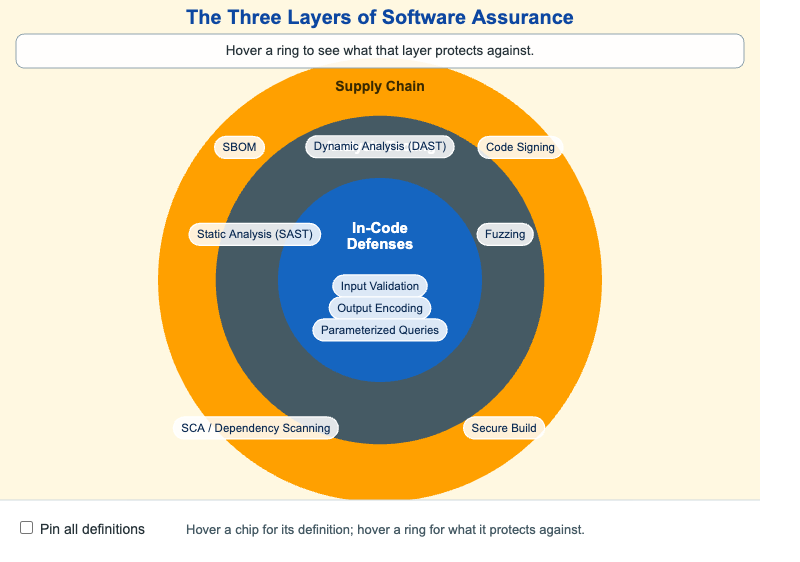
This infographic shows software assurance as three concentric layers that compose to defend a system, drawn from the inside out. At the center, in cybersecurity blue, are the In-Code Defenses — input validation, output encoding, and parameterized queries — controls that live inside the program and stop abuse right at the trust boundary. Surrounding them, in slate steel, is the Analysis Tooling ring: static analysis (SAST), dynamic analysis (DAST), and fuzzing, which find the defects a developer missed. The outermost amber ring is the Supply Chain layer: dependency scanning (SCA), the SBOM, code signing, and a secure build pipeline — the controls that defend the code you did not write.
The concentric arrangement is deliberate. Each outer ring is a backstop for the one inside it: if a developer forgets to parameterize a query, analysis tooling should catch it; if a vulnerable dependency slips past review, supply-chain scanning should flag it. No single ring is sufficient on its own.
Hover any chip to read its one-line definition, or hover a ring to update the caption at the top with what that layer protects against. Toggle Pin all definitions to study every control at once. Because the goal here is to understand how the layers relate — not to tune a parameter — the MicroSim is hover-driven rather than animated.
Lesson Plan
Learning objective (Bloom: Understand). Students will explain how the three layers of software assurance compose to defend a system, match each control to its layer, and articulate which layer fails when a particular incident occurs.
Suggested classroom use. Describe three incidents — "a SQL injection returned the whole users table," "a shipped release contained a dependency with a known CVE," "an attacker tampered with an artifact between build and deploy." For each, have students point to the ring whose control should have prevented it, then name a second ring that could have served as a backstop.
Discussion questions:
- Why are these layers drawn as concentric rings instead of a flat list? What does the nesting communicate that a checklist would not?
- A team has excellent SAST coverage but no SBOM. Which incidents are they still exposed to, and why does the missing outer ring matter?
- In-code defenses and analysis tooling both target the code the team wrote. What makes the supply-chain ring fundamentally different?
References
- Software assurance — Wikipedia
- Static application security testing — Wikipedia
- Dynamic application security testing — Wikipedia
- SQL injection — Wikipedia
Specification
The full specification below is extracted from Chapter 6: "Software Assurance and Supply Chain Security".
Type: infographic
**sim-id:** software-assurance-layers
**Library:** p5.js
**Status:** Specified

Three concentric circles on a 720x480 responsive canvas (resizes to container width).

- Inner circle (cybersecurity blue #1565c0, label "In-Code Defenses"): three chips: "Input Validation", "Output Encoding", "Parameterized Queries"
- Middle ring (slate steel #455a64, label "Analysis Tooling"): three chips: "Static Analysis (SAST)", "Dynamic Analysis (DAST)", "Fuzzing"
- Outer ring (amber alert accent #ffa000, label "Supply Chain"): four chips: "SCA / Dependency Scanning", "SBOM", "Code Signing", "Secure Build"

Hovering on any chip shows a 1-line tooltip with the definition (matching the glossary). A small "What this layer protects against" caption updates as the user hovers a ring.

Learning objective (Bloom - Understand): explain how the three layers compose to defend a software system, and articulate which layer fails when a particular incident occurs.

Responsive: collapses to vertical stack of three labeled bands below 600px viewport.

Implementation: p5.js sketch with updateCanvasSize() first in setup(), canvas.parent(document.querySelector('main')), mouse-hover tooltips drawn on top.