IAM Request Flow
Run the IAM Request Flow MicroSim Fullscreen
You can include this MicroSim on your own website with the following iframe:
<iframe src="https://dmccreary.github.io/cybersecurity/sims/iam-request-flow/main.html" height="622" width="100%" scrolling="no"></iframe>
About this MicroSim
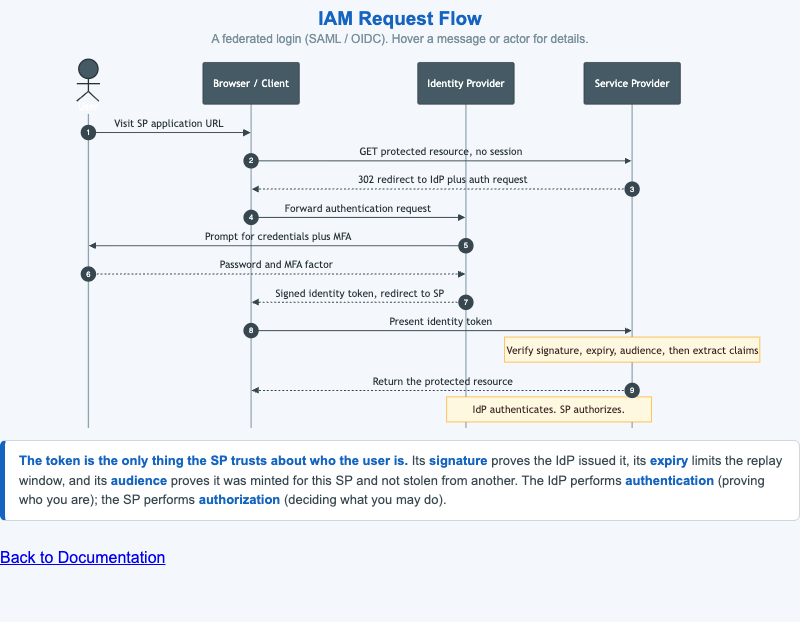
This sequence diagram traces a federated login — the pattern behind "Sign in with your company account," SAML, and OpenID Connect — across four lanes: the User, their Browser, the Identity Provider (IdP), and the Service Provider (SP) they are trying to reach. Read the numbered messages top to bottom: the browser asks the SP for a protected page, the SP redirects to the IdP, the IdP (and only the IdP) collects the password and MFA factor, then mints a signed identity token and sends the browser back to the SP. The SP verifies that token and serves the resource.
The central idea is the division of trust: the IdP authenticates (it proves who you are) and the SP authorizes (it decides what you may do), and the two communicate only through a token the SP can cryptographically verify. Hover any message arrow to see why that step exists, or hover an actor lane to see what it is and is not trusted with. The note over the SP lane explains the three checks that make the token trustworthy — signature, expiry, and audience — each of which closes off a specific attack.
Lesson Plan
Learning objective (Bloom — Understand): Students can describe the sequence of messages in a federated authentication flow and explain why the Service Provider trusts a signed identity token rather than handling credentials itself.
Suggested classroom use: Walk the numbered steps as a class, pausing at step 3 (the redirect) to ask "why does the SP hand the user off instead of asking for the password?" Then hover the SP verification note and name the attack each of the three token checks prevents.
Discussion questions:
- Why is it safer for the SP to never see the user's password, even though it ultimately decides whether to grant access?
- What attack does checking the token's audience prevent that checking only the signature would miss?
- The IdP is a single point of trust for many applications. What is the blast radius if the IdP's signing key is stolen?
References
- Identity and access management (Wikipedia)
- Security Assertion Markup Language (SAML) (Wikipedia)
- OpenID Connect (Wikipedia)
Specification
The full specification below is extracted from Chapter 12: "Human Security: Identity, Authentication, and Social Engineering".
Type: workflow-diagram
**sim-id:** iam-request-flow<br/>
**Library:** Mermaid<br/>
**Status:** Specified

A horizontal sequence diagram with four lanes: User, Browser/Client, Identity Provider (IdP), Service Provider (SP).

1. User → Browser: Visits SP application URL.
2. Browser → SP: GET /protected-resource (no session).
3. SP → Browser: 302 redirect to IdP with an authentication request.
4. Browser → IdP: Authentication request.
5. IdP ↔ User: Prompts for credentials (password + MFA).
6. IdP → Browser: Issues signed identity token; redirects back to SP.
7. Browser → SP: Presents identity token.
8. SP: Verifies token signature, extracts claims (user id, groups, expiry).
9. SP → Browser: Returns the protected resource.

Annotations on the side: "IdP authenticates. SP authorizes. The token is the only thing the SP trusts about who the user is — so its signature, expiry, and audience all matter."

Color: cybersecurity blue (#1565c0) for IdP lane, slate (#455a64) for SP lane, white for user/browser. Responsive: vertical stacking under 700px viewport.

Implementation: Mermaid sequenceDiagram with custom theme colors.