Privacy-Enhancing Technologies Compared
You can include this MicroSim on your own page with the following iframe:
<iframe src="https://dmccreary.github.io/cybersecurity/sims/privacy-tech-compare/main.html" height="527" width="100%" scrolling="no"></iframe>
About this MicroSim
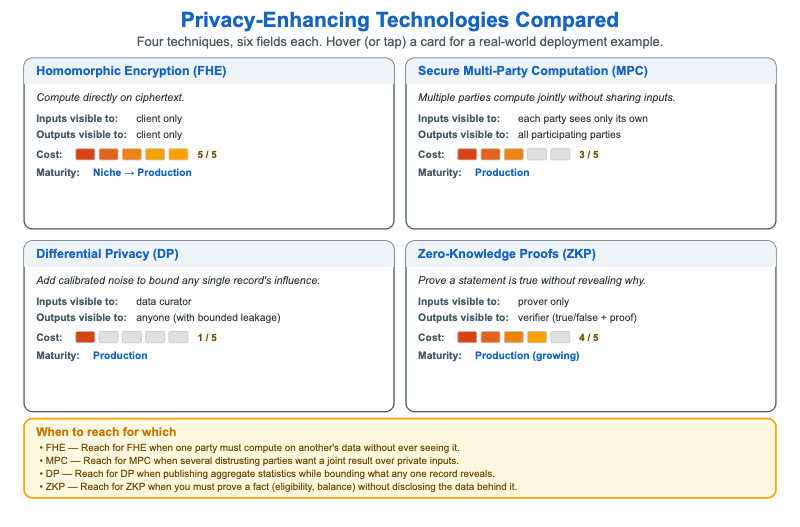
Four modern privacy-enhancing technologies are laid out as a 2x2 grid of cards, each described with the same six fields so they can be compared head to head: Homomorphic Encryption (FHE), Secure Multi-Party Computation (MPC), Differential Privacy (DP), and Zero-Knowledge Proofs (ZKP).
Every card answers the questions that actually drive a design decision: a one-line definition, who can see the inputs, who can see the outputs, the computational cost (visualized as a 1–5 bar that runs from rust to gold), and the technique's maturity (research, niche, or production). Reading down the cost column alone is revealing: differential privacy is cheap (1/5) while fully homomorphic encryption is expensive (5/5), which is why they show up in very different places.
Hover or tap any card for a real-world example — the U.S. 2020 Census for DP, Zcash for ZKP, threshold signatures for MPC, privacy-preserving ML inference for FHE. The amber footer band summarizes when to reach for which: each technique answers a different privacy question, so the goal is to match the tool to the requirement rather than defaulting to the most powerful (and most expensive) option.
Lesson Plan
Learning objective (Bloom: Analyze). Students will compare four privacy-enhancing technologies across the same six fields and select the appropriate technique for a given privacy requirement, justifying the choice with the input/output visibility and cost dimensions.
Suggested classroom use. Present three short scenarios — "publish neighborhood income statistics", "two hospitals study a shared cohort without sharing records", "prove you are over 18 without revealing your birthdate" — and have students name the best-fit technique and defend it using the card fields.
Discussion questions:
- DP and FHE sit at opposite ends of the cost scale. How does that cost difference explain where each one is actually deployed today?
- In MPC, every participant learns the output but not the others' inputs; in ZKP, only the verifier learns a true/false result. Why does that distinction matter when choosing between them?
- "Privacy" is not one property. For each technique, who exactly is being protected from whom?
References
- Homomorphic encryption — Wikipedia
- Secure multi-party computation — Wikipedia
- Differential privacy — Wikipedia
- Zero-knowledge proof — Wikipedia
Specification
The full specification below is extracted from Chapter 4: "Cryptography in Practice: PKI, TLS, and Data Protection".
Type: infographic-svg
sim-id: privacy-tech-compare
Library: Static SVG with hover tooltips
Status: Specified

A 2x2 grid of cards, each describing one technique with the same six fields:
header (technique name), one-line definition, inputs visible to whom, outputs
visible to whom, computational cost (1-5 bars), maturity, and a real-world example
in a hover tooltip.

Card 1 — Homomorphic Encryption (FHE): compute on ciphertext; inputs/outputs client
only; cost 5/5; maturity niche→production. Card 2 — MPC: parties compute jointly
without sharing inputs; cost 3/5; production. Card 3 — Differential Privacy: add
calibrated noise; cost 1/5; production. Card 4 — Zero-Knowledge Proofs: prove a
statement without revealing why; cost 4/5; production (growing).

A footer band lists "when to reach for which". Color: cybersecurity blue and slate
for headers, rust→gold gradient for the cost bars. Responsive: the SVG scales to its
container.