Threat Modeling Methodology Comparison
You can include this MicroSim on your own website with the following iframe:
<iframe src="https://dmccreary.github.io/cybersecurity/sims/threat-modeling-methods/main.html" height="702" width="100%" scrolling="no"></iframe>
About this MicroSim
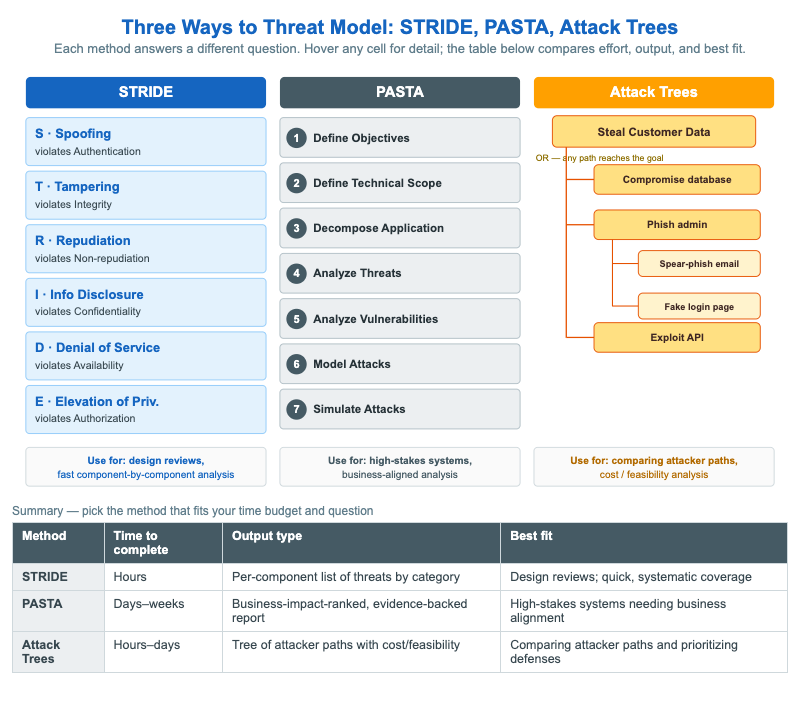
This infographic places three of the most widely used threat-modeling methods side by side so you can see, at a glance, how their questions and outputs differ. The STRIDE column lists the six threat categories — Spoofing, Tampering, Repudiation, Information Disclosure, Denial of Service, and Elevation of Privilege — and maps each one to the security property it violates. The PASTA column walks the seven stages of the Process for Attack Simulation and Threat Analysis, a business-driven, risk-centric method. The Attack Trees column shows a worked example: a root goal of "Steal Customer Data" branching into three attacker paths, one of which is expanded into two concrete sub-techniques. Hover (or tap, on touch screens) over any cell to read a one-line explanation, and use the summary table below the diagram to compare time-to-complete, output type, and best fit. The MicroSim is a static SVG with hover reveals — there is no animation, so you control the pace of exploration.
Lesson Plan
Learning objective: Given a system to secure and a fixed time budget, the student can compare STRIDE, PASTA, and Attack Trees and select the method whose question and output best match the situation.
Suggested classroom use: Project the infographic and ask students to predict, before hovering, which security property each STRIDE letter violates. Then reveal the tooltips to check. Next, give students a short system description (for example, a customer-data API behind a login) and have them argue which of the three methods they would reach for first and why. Finish with the summary table to ground the discussion in real effort and output trade-offs.
Discussion questions:
- STRIDE finishes in hours and PASTA can take weeks. What does PASTA buy you for that extra effort, and when is it worth it?
- The attack tree shows three OR-branches to the same goal. As a defender, how does enumerating attacker paths change which control you fund first?
- Could you use more than one method on the same system? Where would STRIDE hand off to an attack tree?
Specification
The full specification below is extracted from Chapter 1: "Security Foundations: Properties, Mindset, and Risk".
Type: infographic-svg
**sim-id:** threat-modeling-methods<br/>
**Library:** Static SVG or Mermaid<br/>
**Status:** Specified

Three vertical columns of equal width:

**Column 1 — STRIDE** (header in cybersecurity blue #1565c0)
- Six rows, one per letter, each showing: letter, name, property violated
- Footer: "Use for: design reviews, fast component-by-component analysis"

**Column 2 — PASTA** (header in slate steel #455a64)
- Seven numbered stages from "Define Objectives" to "Simulate Attacks"
- Footer: "Use for: high-stakes systems, business-aligned analysis"

**Column 3 — Attack Trees** (header in amber #ffa000)
- A small attack tree showing root "Steal Customer Data" branching to three children: "Compromise database", "Phish admin", "Exploit API"; one child further expanded to two grandchildren
- Footer: "Use for: comparing attacker paths, cost/feasibility analysis"

Below all three columns: a single-line summary table showing time-to-complete (STRIDE: hours, PASTA: days–weeks, attack trees: hours–days), output type, and best fit. Responsive: columns stack vertically below 800px.

Implementation: Static SVG built once, or three small Mermaid diagrams in a CSS grid.
References
- STRIDE (security) — Wikipedia
- Threat model — Wikipedia
- Attack tree — Wikipedia
- OWASP Threat Modeling Process