DNSSEC Validation Chain
Run the DNSSEC Chain of Trust MicroSim Fullscreen
You can include this MicroSim on your own website with the following iframe:
<iframe src="https://dmccreary.github.io/cybersecurity/sims/dnssec-chain-of-trust/main.html" height="672" width="100%" scrolling="no"></iframe>
About this MicroSim
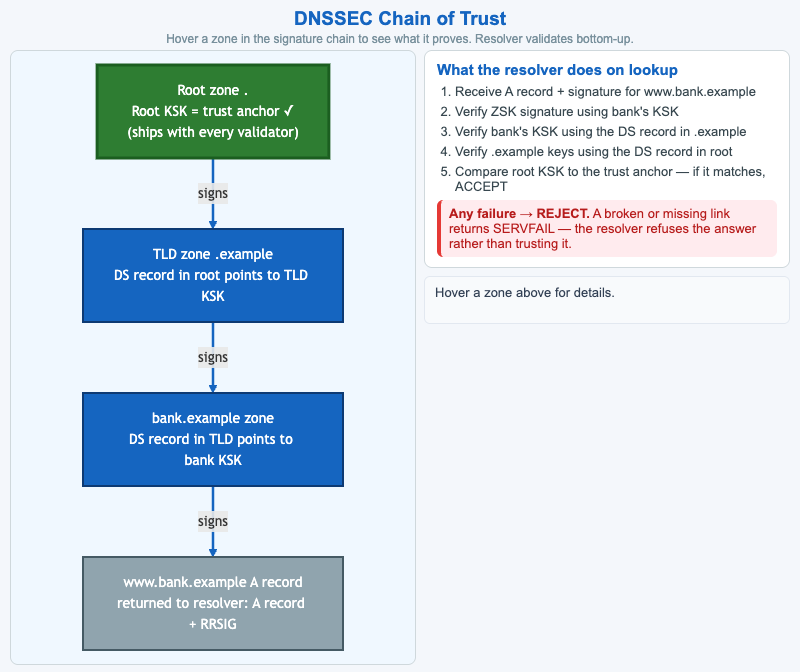
This diagram shows how DNSSEC turns ordinary DNS answers into ones a resolver
can cryptographically trust. The left panel is the chain of trust: the root
zone signs a delegation to the .example TLD, which signs a delegation to
bank.example, which signs the final www.bank.example A record. Each parent
publishes a DS record — a hash of its child's Key Signing Key — so that one
signed link points to the next. Hovering any zone reveals what that link
contributes.
The green root node is the trust anchor: every validator ships with the root
KSK out of band, so the chain ultimately reduces to "does this match the anchor I
already trust?" The right panel lists what the resolver actually does on a lookup
— and it runs bottom-up, the opposite direction from how the chain is built:
verify the leaf signature, then the bank's key, then .example, then root, then
compare to the anchor. The red callout names the failure mode: any broken or
missing link returns SERVFAIL rather than a trusted-looking but unverified answer.
The layout reflows to a single column on narrow screens.
Lesson Plan
Learning objective (Bloom — Understand): Students can trace the DNSSEC chain of trust and explain how DS records link each zone to its parent, and why any broken link causes the resolver to return SERVFAIL.
Suggested classroom use: Trace the chain top-down (how it is built), then walk the resolver steps to show validation goes bottom-up (how it is checked). Pose a broken-link scenario (a stale DS record) and have students predict the resolver's response.
Discussion questions:
- Why does the security of the entire chain reduce to a single value — the root KSK trust anchor that validators ship with?
- The chain is built top-down but validated bottom-up. Why does the resolver start from the leaf record?
- DNSSEC fails closed (SERVFAIL) rather than open. What is the operational cost of that choice, and why is it the right default for integrity?
References
- Domain Name System Security Extensions (Wikipedia)
- ICANN — DNSSEC and the root zone trust anchor
- IETF RFC 4033 — DNS Security Introduction and Requirements
Specification
The full specification below is extracted from Chapter 9: "Advanced Network Defense: Wireless, DNS, and Zero Trust".
Type: tree-diagram
**sim-id:** dnssec-chain-of-trust<br/>
**Library:** Mermaid<br/>
**Status:** Specified

A vertical tree diagram showing the chain of signatures from the root zone to a leaf record:

1. **Root zone (`.`)** — labeled with "Root KSK (stored in trust anchor)". A green checkmark denotes the trust anchor that all DNSSEC validators ship with.
2. ↓ "signs" → **TLD zone (`.example`)** — labeled with "DS record in root zone points to TLD KSK"
3. ↓ "signs" → **`bank.example` zone** — labeled with "DS record in TLD points to bank's KSK"
4. ↓ "signs" → **`www.bank.example` A record** — labeled with "Returned to resolver: A record + RRSIG"

A side panel on the right shows what a resolver does on lookup:

- "Step 1: Receive A record + signature for `www.bank.example`"
- "Step 2: Fetch and verify ZSK signature using bank's KSK"
- "Step 3: Verify bank's KSK using DS record in `.example`"
- "Step 4: Verify `.example` keys using DS record in root"
- "Step 5: Compare root KSK to trust anchor — if match, ACCEPT"
- "Any failure → REJECT (resolver returns SERVFAIL)"

Color the trust path in cybersecurity blue (`#1565c0`); use a green checkmark on the root anchor; use red X annotations on what happens if any link fails.

Responsive: collapses to a vertical list with indented chain on viewport widths below 700px.

Implementation: Mermaid graph TD with custom node styling and side annotations.