DDoS Mitigation Explorer
You can include this MicroSim on your own page with the following iframe:
<iframe src="https://dmccreary.github.io/cybersecurity/sims/ddos-mitigation-explorer/main.html" height="527" width="100%" scrolling="no"></iframe>
About this MicroSim
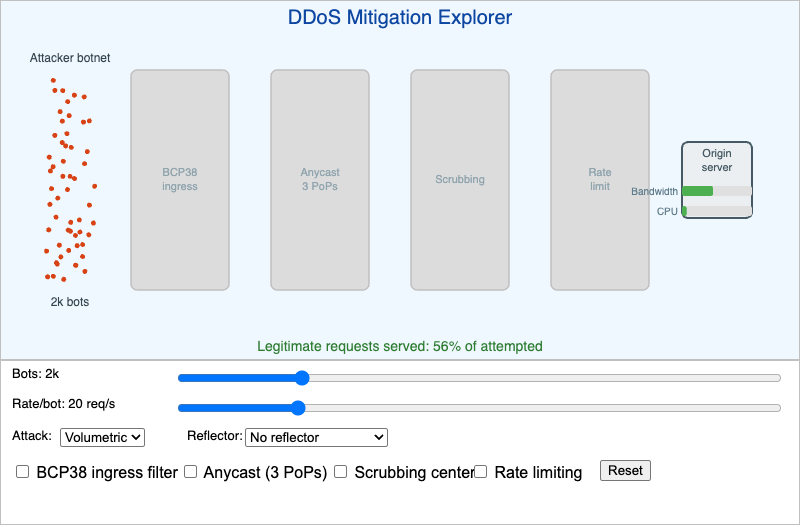
An attacker botnet on the left fires traffic toward an origin server on the right, passing through up to four optional defense layers in the middle. Amber dots are attack traffic; the steady green stream along the bottom is legitimate requests. The origin has two health bars — bandwidth (loaded by volumetric attacks) and CPU (loaded by application-layer attacks) — and turns red when overwhelmed. A ticker reports the percentage of legitimate requests served.
Use the sliders to set the number of bots and the per-bot request rate, and the dropdowns to choose the attack type and (for volumetric attacks only) an amplification reflector. Then analyze each defense in isolation: BCP38 ingress filtering strips spoofed/amplified volumetric traffic; anycast splits the load across three points of presence; the scrubbing center absorbs most identified attack traffic at the cost of latency; and rate limiting caps per-IP request rates but weakens as the botnet grows more diverse.
The pedagogical payoff is seeing that no single defense is sufficient: a defense that crushes one attack type may do nothing against another. Move your mouse over the canvas to animate the traffic.
Lesson Plan
Learning objective (Bloom: Analyze). Students will analyze how different DDoS mitigation strategies reduce the impact of volumetric versus application-layer attacks by manipulating attack parameters and defense settings and observing the change in traffic reaching the origin.
Suggested classroom use. Assign each student an attack type and have them find the minimal set of defenses that keeps legitimate-requests-served above 50%. Then have them try a Memcached-amplified volumetric attack with and without BCP38 and explain the dramatic difference.
Discussion questions:
- Why does BCP38 ingress filtering help enormously against an amplified volumetric attack but not at all against an L7-CPU attack?
- Rate limiting works well against a small botnet but degrades as you raise the bot count. What real-world property of large botnets does this model?
- Scrubbing absorbs ~95% of attack traffic but adds latency. When is that trade-off worth it, and when is anycast a better first move?
References
- Denial-of-service attack — Wikipedia
- BCP 38 / ingress filtering — Wikipedia
- Anycast — Wikipedia
- DDoS mitigation — Wikipedia
Specification
The full specification below is extracted from Chapter 9: "Advanced Network Defense: Wireless, DNS, and Zero Trust".
Type: microsim
sim-id: ddos-mitigation-explorer
Library: p5.js
Status: Specified

Learning objective (Bloom's: Analyze): Students will analyze how different DDoS
mitigation strategies (ingress filtering, anycast, scrubbing, rate limiting)
reduce the impact of volumetric vs. application-layer attacks.

Layout: attacker botnet (left), defense layers (center: ingress filter, anycast,
scrubbing, rate limiter), origin server with bandwidth and CPU health bars
(right), and a ticker for legitimate requests served.

Controls: sliders for bot count (10-10,000) and attack rate per bot (1-100 req/s);
selects for attack type (Volumetric, L7-CPU, L7-DB) and amplification reflector
(None, DNS 50x, NTP 500x, Memcached 50,000x, volumetric only); checkboxes for
BCP38, anycast, scrubbing, rate limiting; reset button.

Behavior: defenses absorb a fraction of attack traffic by type; volumetric maxes
bandwidth, L7 maxes CPU; legitimate traffic shown alongside attack traffic.

Color palette: cybersecurity blue defense layers, amber attack traffic, green
legitimate traffic, red overwhelmed origin. Responsive via updateCanvasSize().