IDS/IPS Decision Flow
You can include this MicroSim on your own page with the following iframe:
<iframe src="https://dmccreary.github.io/cybersecurity/sims/ids-ips-decision-flow/main.html" height="702" width="100%" scrolling="no"></iframe>
About this MicroSim
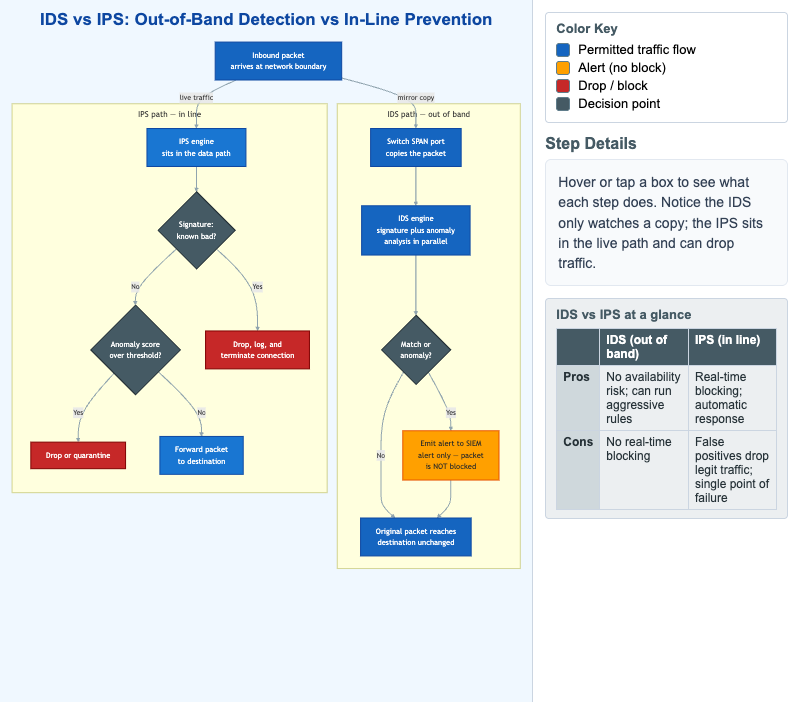
This diagram follows a single inbound packet down two very different paths. On the IDS (out-of-band) branch, a switch SPAN port copies the packet to a detection engine that runs signature and anomaly analysis in parallel; if it matches, the IDS emits an alert to the SIEM — but the original packet reaches its destination unchanged. The IDS observes and records; it never blocks. On the IPS (in-line) branch, the packet must pass through the engine in the live data path: a signature match is dropped, logged, and the connection terminated, while a high anomaly score is dropped or quarantined. Only clean traffic is forwarded.
Hover over (or tap, on a touch screen) any box to read a one-paragraph explanation in the right-hand panel, and consult the comparison table beneath it to weigh the trade-offs. The color key separates permitted flow (blue), alert-only events (amber), drops (red), and decision points (slate). The core insight is the trade between control and availability: an IDS carries no availability risk but cannot stop an attack in flight, while an IPS can block in real time but becomes a single point of failure and a source of false-positive outages.
Lesson Plan
Learning objective (Bloom: Understand). Students will distinguish out-of-band intrusion detection from in-line intrusion prevention and explain why placement in (or beside) the data path determines whether a sensor can block traffic.
Suggested classroom use. Project the diagram and trace one malicious packet down both branches, pausing at each decision diamond to ask students what happens next. Then assign two short scenarios — a hospital network that must never drop legitimate traffic, and a payment gateway that must stop known exploits instantly — and have students argue for IDS, IPS, or both.
Discussion questions:
- A SPAN-port IDS detects a live exploit. Why can it not stop the connection, and what compensating control would you pair it with?
- An in-line IPS rule starts dropping legitimate traffic during a traffic spike. What is the blast radius, and how does "fail open" vs "fail closed" change your answer?
- When would you deliberately run aggressive, noisy rules on an IDS that you would never enable on an IPS?
References
- Intrusion detection system — Wikipedia
- Intrusion prevention system — Wikipedia
- Port mirroring (SPAN) — Wikipedia
- NIST SP 800-94: Guide to Intrusion Detection and Prevention Systems
Specification
The full specification below is extracted from Chapter 8: "Network Security Foundations: Protocols, Firewalls, and Detection".
Type: workflow-diagram
sim-id: ids-ips-decision-flow
Library: Mermaid
Status: Specified

A flowchart starting at the top with "Inbound packet" entering the network boundary.

Branch 1: IDS path (out-of-band)
- Packet -> Switch SPAN port -> IDS engine (signature engine + anomaly engine in parallel)
- If match -> emit alert to SIEM (orange annotation: "alert only — packet is not blocked")
- Original packet continues to destination unchanged

Branch 2: IPS path (in-line)
- Packet enters IPS engine in the data path
- Signature check: if known-bad -> drop, log, terminate connection
- Anomaly check: if score above threshold -> drop or quarantine
- Otherwise -> forward packet to destination

Below the two branches, a comparison panel:
- IDS pros: no availability risk, can run aggressive rules
- IDS cons: no real-time blocking
- IPS pros: real-time blocking, automatic response
- IPS cons: false positives drop legitimate traffic; single point of failure

Color: cybersecurity blue for permitted-traffic flow, amber for alerts, red for
drops, slate for the comparison panel. Responsive: stacks vertically below 700px.

Implementation: Mermaid flowchart TD with custom node styling and subgraphs for the two branches.