Risk Treatment Decision Tree
You can include this MicroSim on your own page with the following iframe:
<iframe src="https://dmccreary.github.io/cybersecurity/sims/risk-treatment-decision-tree/main.html" height="882" width="100%" scrolling="no"></iframe>
About this MicroSim
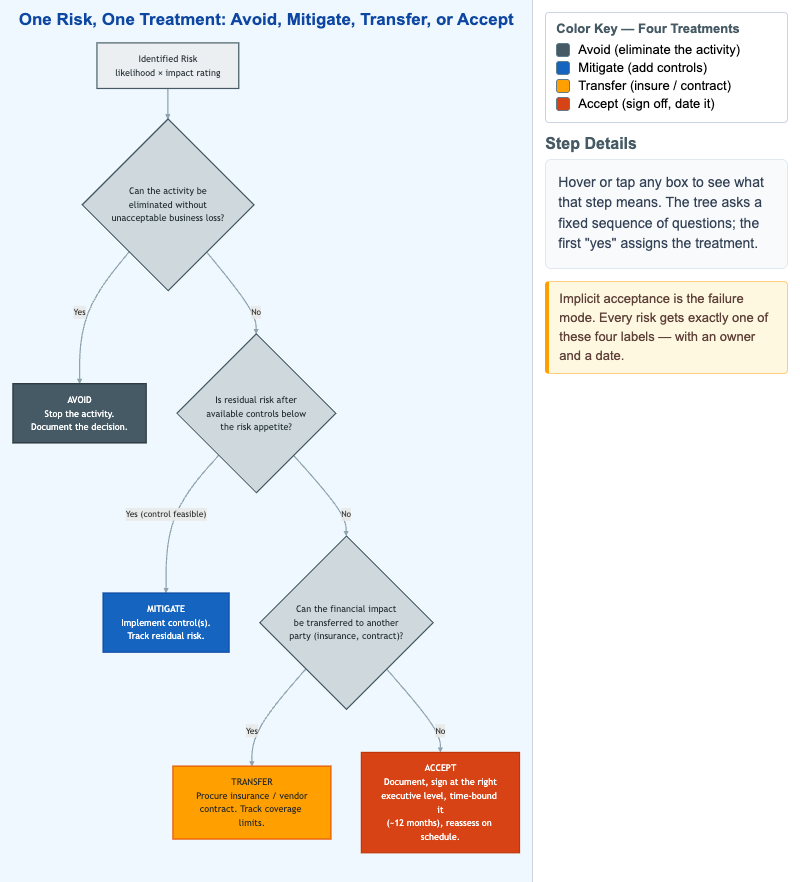
This diagram takes a single risk — already rated by likelihood × impact — and walks it through a fixed sequence of questions until it lands on exactly one treatment. The first question asks whether the activity can simply be eliminated without an unacceptable business loss; if so, the answer is AVOID. If not, the tree asks whether available controls can drive the residual risk below the organization's risk appetite, which leads to MITIGATE. Failing that, it asks whether the financial impact can be shifted to another party through insurance or contract — that is TRANSFER. When none of those apply, the only remaining option is ACCEPT, and acceptance must be a deliberate, signed, time-bound decision rather than a silent default.
Hover over (or tap, on a touch screen) any box to read a one-paragraph explanation in the right-hand panel. The four terminal nodes are color-coded — slate for Avoid, cybersecurity blue for Mitigate, amber for Transfer, and rust orange for Accept — so the chosen treatment is visible at a glance. The amber caption beneath the panel states the central lesson: implicit acceptance is the failure mode, and every risk must carry exactly one of these four labels with a named owner and a review date.
Lesson Plan
Learning objective (Bloom: Apply). Given a described risk, students will apply the four-option risk-treatment model to select and justify the appropriate treatment — avoid, mitigate, transfer, or accept — and identify the owner and review date that the decision requires.
Suggested classroom use. Project the tree and present three or four short risk scenarios (a legacy VPN appliance past end-of-life, a marketing feature that collects unnecessary personal data, a low-likelihood regional outage, a ransomware exposure). For each, have students walk the diamonds aloud and stop at the first "yes." Then ask who must sign and when the next reassessment falls.
Discussion questions:
- Two teams treat the "same" risk differently — one transfers it, one accepts it. What difference in risk appetite or cost of control explains that, and is either wrong?
- Why does transferring a risk to an insurer not reduce the operational impact of the event itself? What does it actually change?
- A risk was "accepted" two years ago and never revisited. Why is an undated, unsigned acceptance arguably worse than no decision at all?
References
- Risk management — Wikipedia
- IT risk management — Wikipedia
- ISO/IEC 27005 (information security risk management) — Wikipedia
- NIST SP 800-39: Managing Information Security Risk
Specification
The full specification below is extracted from Chapter 13: "Organizational Security: Governance, Risk, and Compliance".
Type: workflow-diagram
sim-id: risk-treatment-decision-tree
Library: Mermaid
Status: Specified

A flowchart starting from a single root box: "Identified Risk: likelihood × impact rating".

Branches:

1. First decision diamond: "Can the activity be eliminated without unacceptable business loss?"
   - Yes -> terminal node "AVOID — Stop the activity. Document the decision."
   - No -> continue to next decision.

2. Second decision diamond: "Is residual risk after available controls below the organization's risk appetite?"
   - Yes (and a control is feasible) -> terminal node "MITIGATE — Implement control(s). Track residual risk."
   - No -> continue.

3. Third decision diamond: "Can the financial impact be transferred to another party (insurance, contract)?"
   - Yes -> terminal node "TRANSFER — Procure insurance / vendor contract. Track coverage limits."
   - No -> continue.

4. Final terminal: "ACCEPT — Document, sign at appropriate executive level, time-bound (typically 12 months), reassess on schedule."

Color: each terminal node colored distinctly — Avoid (slate steel), Mitigate (cybersecurity blue), Transfer (amber), Accept (rust orange).

Caption beneath: "Implicit acceptance is the failure mode. Every risk gets exactly one of these four labels, with an owner and a date."

Responsive: Mermaid graph TD; renders to container width. Caption wraps below 500px.

Implementation: Mermaid flowchart with classDef styling for the four terminal types.