Digital Signature: Sign and Verify Flow
You can include this MicroSim on your own page with the following iframe:
<iframe src="https://dmccreary.github.io/cybersecurity/sims/digital-signature-flow/main.html" height="432" width="100%" scrolling="no"></iframe>
About this MicroSim
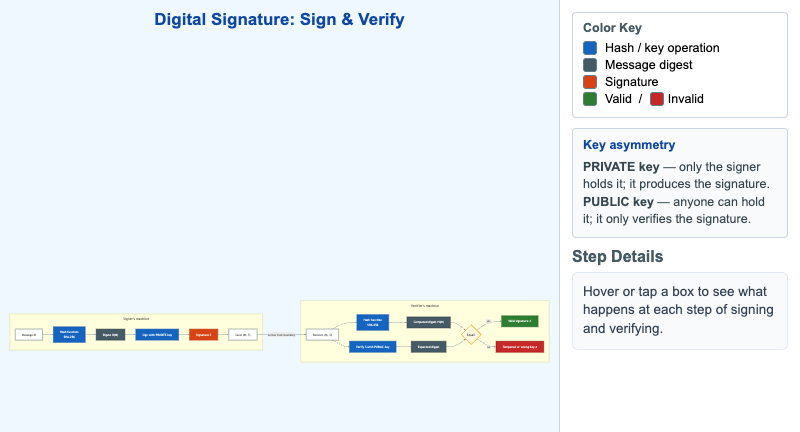
This diagram shows the two halves of a digital signature, separated by the trust boundary between the signer's machine and the verifier's machine. On the signer side, the message M is hashed with SHA-256 to a digest, and the digest is signed with the signer's private key to produce signature S; the pair (M, S) is then sent. On the verifier side, the received M is hashed again, the public key is applied to S to recover the expected digest, and the two digests are compared.
The comparison diamond is the heart of the idea: if the computed digest equals the expected digest, the signature is valid — the message is intact and was signed by the holder of the matching private key. If they differ, the message was tampered with or signed with the wrong key, and it is rejected.
Hover over (or tap) any box to read what happens at that step. The right-hand panel also calls out the key asymmetry — the private key signs and is held only by the signer, while the public key verifies and can be held by anyone. The layout stacks to a single column on narrow screens.
Lesson Plan
Learning objective (Bloom: Understand). Students will explain the signing path and the verification path of a digital signature, and distinguish the role of the private key (signs) from the public key (verifies).
Suggested classroom use. Have students hover the signer column top-to-bottom, then the verifier column, and articulate why both sides compute a SHA-256 digest. Then pose a "what if": the attacker changes one character of M in transit — walk the diagram to the rejection outcome.
Discussion questions:
- Why does the signer hash the message before signing instead of signing the whole message directly?
- The verifier never has the private key. How can it still confirm the signer's identity?
- Trace what happens at the "Equal?" diamond if (a) the message is altered, or (b) an impostor signs with a different private key.
References
- Digital signature — Wikipedia
- Public-key cryptography — Wikipedia
- SHA-2 — Wikipedia
- Cryptographic hash function — Wikipedia
Specification
The full specification below is extracted from Chapter 4: "Cryptography in Practice: PKI, TLS, and Data Protection".
Type: workflow-diagram
sim-id: digital-signature-flow
Library: Mermaid
Status: Specified

Two parallel vertical flows separated by a trust boundary (signer's machine |
verifier's machine).

Left flow (Signer): Message M -> Hash (SHA-256) -> Digest H(M) -> Sign with
PRIVATE key -> Signature S -> Send (M, S).

Right flow (Verifier): Receive (M, S) splits into: hash M -> computed digest; and
verify S with PUBLIC key -> expected digest. Both digests feed a comparison
diamond "Equal?" with outputs "Valid signature" (green) or "Tampered or wrong key"
(red).

A small inset shows the asymmetry: PRIVATE key only the signer holds; PUBLIC key
anyone can hold.

Color: cybersecurity blue, slate steel, rust orange. Responsive: stacks vertically
below 800px viewport.

Implementation: Mermaid graph with two subgraphs and styled nodes.