Hardening, Baselines, and Drift
Run the Hardening Baselines Loop MicroSim Fullscreen
You can include this MicroSim on your own website with the following iframe:
<iframe src="https://dmccreary.github.io/cybersecurity/sims/hardening-baselines-loop/main.html" height="722" width="100%" scrolling="no"></iframe>
About this MicroSim
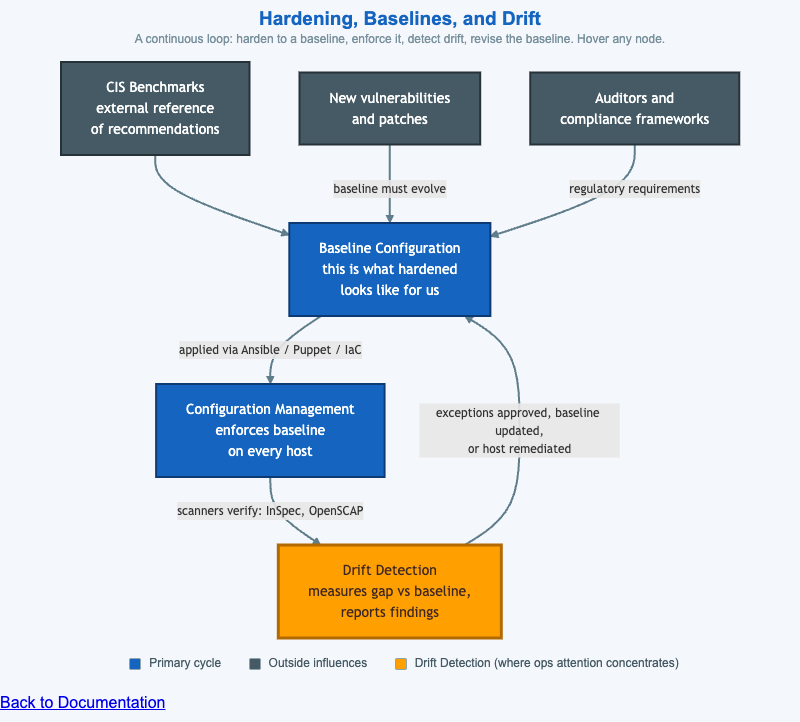
This causal-loop diagram shows that system hardening is a cycle, not a one-time task. A public reference — the CIS Benchmarks — seeds a tailored Baseline Configuration ("this is what hardened looks like for us"). Configuration Management (Ansible, Puppet, infrastructure-as-code) enforces that baseline on every host. Drift Detection scanners (InSpec, OpenSCAP) then measure the gap between each host's real state and the baseline and report findings — and those findings feed back into the baseline, closing the loop. Hovering any node reveals its role.
Two outside influences keep the loop turning: new vulnerabilities and patches force the baseline to evolve, and auditors and compliance frameworks feed in regulatory requirements. Drift Detection is highlighted in amber because that is where ongoing operational attention concentrates — every finding is either an exception to approve, a baseline to update, or a host to remediate. The arrows carry the real-world tools and decisions at each transition, and the cycle reflows to a vertical sequence on narrow screens.
Lesson Plan
Learning objective (Bloom — Understand): Students can explain the continuous loop among baselines, configuration management, and drift detection, and identify how outside influences force the baseline to evolve.
Suggested classroom use: Trace the clockwise cycle once, then introduce each outside influence and ask what it changes about the baseline. Spend time on Drift Detection: for a sample finding, have students decide among approve-exception, update-baseline, and remediate-host.
Discussion questions:
- Why can a hardening baseline never be considered "finished"?
- When drift is detected, three responses are possible. What evidence would push you toward each one?
- CIS Benchmarks are a starting point, not the final baseline. Why is blindly applying every benchmark setting sometimes the wrong move?
References
- CIS Benchmarks (Wikipedia)
- Configuration management (Wikipedia)
- NIST SP 800-128 — Security-Focused Configuration Management of Information Systems
Specification
The full specification below is extracted from Chapter 11: "Cloud Security and Operations Monitoring".
Type: causal-loop-diagram
**sim-id:** hardening-baselines-loop<br/>
**Library:** Mermaid<br/>
**Status:** Specified

A cyclic diagram with four primary nodes and two outside influences.

**Primary cycle (clockwise, with arrows):**

1. **CIS Benchmarks** (top) — external reference of recommendations
2. → **Baseline Configuration** (right) — codified, named "this is what hardened looks like for us"
3. → **Configuration Management** (bottom) — enforces baseline on every host
4. → **Drift Detection** (left) — measures gap between actual and baseline; reports findings
5. → back into **Baseline Configuration** (the cycle: findings revise baseline)

**Outside influences:**

- **New vulnerabilities / patches** → arrow into **Baseline Configuration** ("baseline must evolve")
- **Auditors / compliance frameworks** → arrow into **Baseline Configuration** ("regulatory requirements feed in")

**Annotations on arrows:**

- Baseline → Config Mgmt: "applied via Ansible/Puppet/IaC"
- Config Mgmt → Drift: "scanners verify (e.g., InSpec, OpenSCAP)"
- Drift → Baseline: "exceptions approved, baseline updated, or host remediated"

Color: cybersecurity blue for the four primary nodes, slate steel for influences, amber #ffa000 highlight on Drift Detection (the place where ops attention concentrates). Responsive: cycle reflows to a vertical sequence below 700px.

Implementation: Mermaid graph TD with curved arrows.