Symmetric Encryption and Decryption Flow
You can include this MicroSim on your own page with the following iframe:
<iframe src="https://dmccreary.github.io/cybersecurity/sims/encryption-decryption-flow/main.html" height="402" width="100%" scrolling="no"></iframe>
About this MicroSim
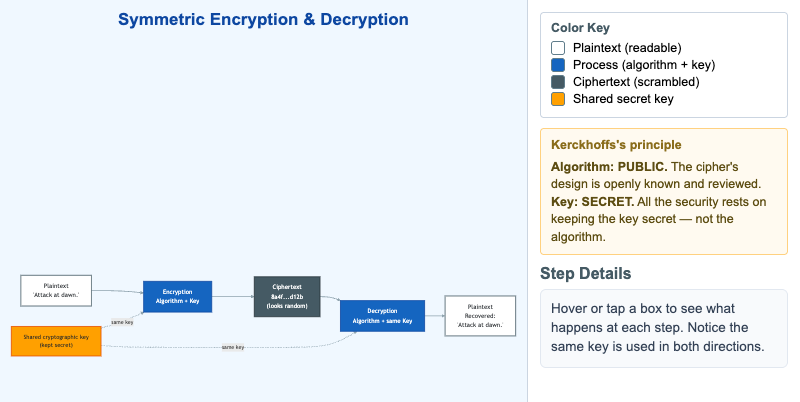
This diagram follows a message through symmetric encryption and back. The readable plaintext ("Attack at dawn.") goes into the encryption box, which combines it with a secret key to produce ciphertext that looks like random bytes. The ciphertext then enters the decryption box, which uses the same key to recover the original plaintext exactly.
The single amber shared key node feeds both the encryption and decryption boxes with a "same key" arrow — that is the defining feature of symmetric cryptography and the reason safely distributing that one key is the hard problem it leaves behind. The right-hand panel also states Kerckhoffs's principle: the algorithm is public and openly reviewed, while all of the security rests on keeping the key secret.
Hover over (or tap) any box to read what happens at that step. The layout stacks to a single column on narrow screens.
Lesson Plan
Learning objective (Bloom: Understand). Students will explain how plaintext becomes ciphertext and back using an algorithm plus a key, recognize that the same secret key is used in both directions, and state Kerckhoffs's principle.
Suggested classroom use. Have students trace the flow left to right, then ask them to find the one node that touches both the encryption and decryption boxes. Use the Kerckhoffs callout to discuss why "security through obscurity" of the algorithm is discouraged.
Discussion questions:
- Why must the encryption box and the decryption box use the same key in symmetric cryptography? What problem does that create when two strangers want to communicate?
- Kerckhoffs's principle says the algorithm should be assumed public. Why is a publicly reviewed algorithm considered stronger, not weaker?
- The ciphertext "looks random." Why is "looks random" an important property, and what would it mean for security if patterns from the plaintext leaked through?
References
- Symmetric-key algorithm — Wikipedia
- Kerckhoffs's principle — Wikipedia
- Encryption — Wikipedia
- Advanced Encryption Standard — Wikipedia
Specification
The full specification below is extracted from Chapter 3: "Cryptography Fundamentals: Symmetric Ciphers and Hashing".
Type: workflow-diagram
sim-id: encryption-decryption-flow
Library: Mermaid
Status: Specified

A horizontal flow:
1. Plaintext (input, white) - "The original message: 'Attack at dawn.'"
2. -> Encryption (process, blue) - "Algorithm + Key"
3. -> Ciphertext (intermediate, slate) - "8a4f...d12b (looks random)"
4. -> Decryption (process, blue) - "Algorithm + same Key"
5. -> Plaintext (output, white) - "Recovered: 'Attack at dawn.'"

Above the encryption and decryption boxes, a key icon connects both, labeled
"Shared cryptographic key (kept secret)". The diagram emphasizes that the same key
must be used in both directions for symmetric crypto.

A small inset shows Kerckhoffs's principle: "Algorithm: PUBLIC. Key: SECRET."

Color: cybersecurity blue, white, slate steel. Responsive: stacks vertically below
700px viewport.

Implementation: Mermaid graph LR with custom node styling.