The Forensic Investigation Workflow
Run the Forensic Workflow MicroSim Fullscreen
You can include this MicroSim on your own website with the following iframe:
<iframe src="https://dmccreary.github.io/cybersecurity/sims/forensic-workflow/main.html" height="1622" width="100%" scrolling="no"></iframe>
About this MicroSim
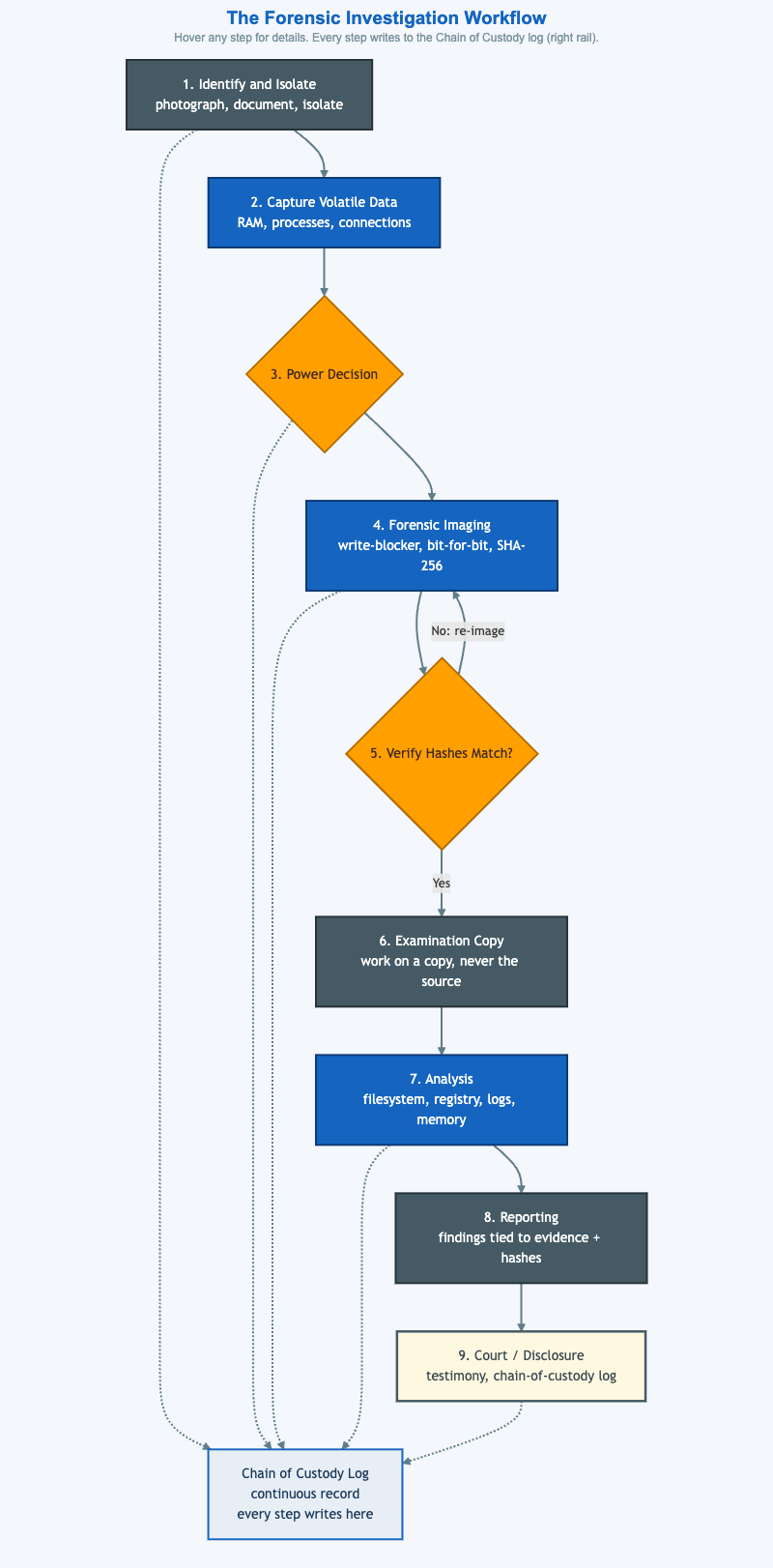
This flowchart lays out the digital forensic investigation process as a single vertical pipeline, from the moment a device is identified through to its disclosure in court. Read it top to bottom: identify and isolate the device, capture volatile data (RAM and live connections that vanish at power-off), make a power decision, take a write-blocked bit-for-bit forensic image, and verify its SHA-256 hash. Only after the hash verifies does the investigator work on an examination copy — never the source — then analyze, report, and disclose. Hovering any step reveals what it involves and why it matters.
Two amber decision diamonds mark the branch points: the Power Decision (live-image-then-power-off versus pull-the-plug) and the Verify Hashes Match gate, which loops back to re-image on a mismatch. Running alongside the whole pipeline is the Chain of Custody Log — the dashed arrows from several steps show that every action writes to this continuous, tamper-evident record. That log is what makes the evidence defensible: a gap in it can render otherwise-sound evidence inadmissible.
Lesson Plan
Learning objective (Bloom — Understand): Students can sequence the steps of a digital forensic investigation and explain why analysis is performed on a verified copy and why every step writes to the chain-of-custody log.
Suggested classroom use: Trace the flow top-down, hovering each step. Stop at the two decision diamonds and have students justify each branch. Then ask which single step, if skipped, would most damage the case in court.
Discussion questions:
- Why must volatile data be captured before the disk is imaged, and what is lost if the order is reversed?
- The hash-verification diamond loops back to re-image on a mismatch. What kinds of problems would a mismatch reveal?
- The chain-of-custody log runs parallel to every step rather than being a final document. Why is "continuous" the load-bearing word here?
References
- Digital forensics (Wikipedia)
- Chain of custody (Wikipedia)
- NIST SP 800-86 — Guide to Integrating Forensic Techniques into Incident Response
Specification
The full specification below is extracted from Chapter 14: "Societal Security: Law, Forensics, and Ethics".
Type: workflow-diagram
**sim-id:** forensic-workflow<br/>
**Library:** Mermaid<br/>
**Status:** Specified

A vertical Mermaid flowchart with the following ordered nodes (each a rounded rectangle):

1. **Identify and Isolate** (slate steel #455a64) — "Photograph in place; document state; isolate from network"
2. **Capture Volatile Data** (cybersecurity blue #1565c0) — "RAM image, running processes, open connections"
3. **Power Decision** (decision diamond) — "Live image first, then power off, OR pull plug per policy"
4. **Forensic Imaging** (cybersecurity blue) — "Write-blocker; bit-for-bit copy; SHA-256 hash"
5. **Verify Hashes Match** (decision diamond) — Yes → continue; No → re-image
6. **Examination Copy** (slate steel) — "Work on a copy of the image, never the source"
7. **Analysis** (cybersecurity blue) — "Filesystem, registry, logs, memory, network artifacts"
8. **Reporting** (slate steel) — "Findings tied to evidence with hashes; reproducible"
9. **Court / Disclosure** (cream #fff8e1 with slate-steel border) — "Testimony; produce chain-of-custody log"

A parallel rail on the right shows **Chain of Custody Log** as a continuous record alongside steps 1–9, indicating that every step writes to the log.

Implementation: Mermaid `flowchart TD` with subgraphs and color classes matching the textbook palette.