Secure Boot vs. Measured Boot
Run the Secure Boot vs. Measured Boot MicroSim Fullscreen
You can include this MicroSim on your own website with the following iframe:
<iframe src="https://dmccreary.github.io/cybersecurity/sims/secure-vs-measured-boot/main.html" height="542" width="100%" scrolling="no"></iframe>
About this MicroSim
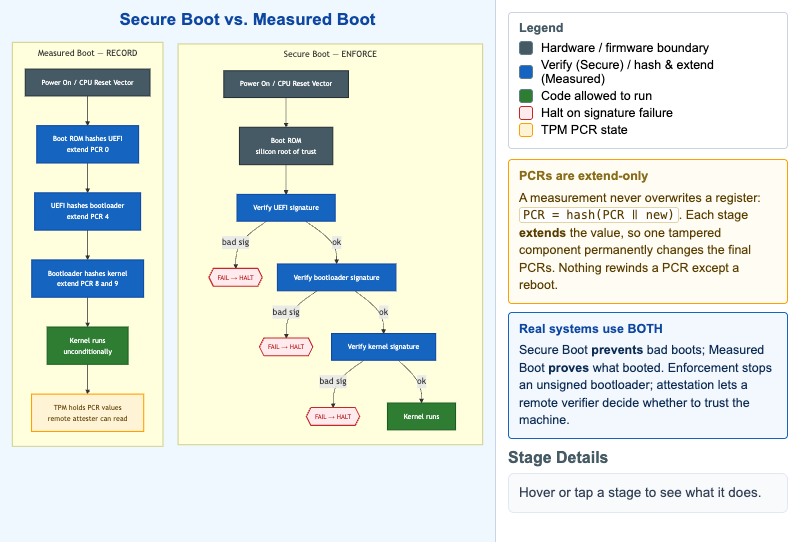
This diagram places the two TPM-era boot integrity mechanisms side by side so their fundamentally different jobs are obvious. Both start identically at power-on and the CPU reset vector, and both root their trust in the immutable Boot ROM baked into the silicon.
The left column — Secure Boot is enforcement. Each stage verifies the cryptographic signature of the next before handing off control: Boot ROM checks UEFI, UEFI checks the bootloader, the bootloader checks the kernel. A bad signature at any step hits a red FAIL → HALT diamond and the machine refuses to continue — fail-secure, not fail-open.
The right column — Measured Boot is recording. Each stage hashes the next
and extends a TPM Platform Configuration Register (PCR[0], PCR[4], PCR[8/9]),
then lets the boot continue unconditionally. After boot the TPM holds a set
of PCR values that fingerprint exactly what ran, which a remote attester can read
to decide whether to trust the machine. Hover (or tap) any stage to read what it
does. The amber callout explains why PCRs are extend-only — PCR = hash(PCR ‖
new) — so one tampered component permanently changes the result. The closing
caption is the key takeaway: real systems use both — Secure Boot prevents bad
boots, Measured Boot proves what booted. Below 700px the two columns stack.
Lesson Plan
Learning objective (Bloom — Understand): Students can compare Secure Boot with Measured Boot, explain what a PCR's extend-only property guarantees, and say why production platforms run both.
Suggested classroom use: Walk the left column first and pause at each FAIL diamond — ask "what does the machine do here, and why is halting the safe choice?" Then walk the right column and ask the inverse: "why is it useful to let a possibly-bad component run, as long as you measure it?" Land on the caption.
Discussion questions:
- Measured Boot lets an unsigned kernel run. How is the resulting PCR set still useful to a remote verifier?
- An attacker swaps in a malicious bootloader. Trace how Secure Boot and Measured Boot each respond.
- Why must the root of trust live in immutable silicon rather than in reflashable firmware?
References
- Unified Extensible Firmware Interface — Secure Boot (Wikipedia)
- Trusted Platform Module (Wikipedia)
- Trusted boot / measured boot (Wikipedia)
Specification
The full specification below is extracted from Chapter 7: "Component and Hardware Security".
Type: workflow-diagram
**sim-id:** secure-vs-measured-boot<br/>
**Library:** Mermaid<br/>
**Status:** Specified

Two parallel vertical flows side by side, both starting from "Power On" at the top.

**Left column: Secure Boot (enforcement)**

1. Power On → CPU Reset Vector
2. Boot ROM (immutable, the silicon root of trust)
3. Verifies signature of UEFI firmware → if FAIL, halt (red diamond)
4. UEFI verifies signature of bootloader → if FAIL, halt (red diamond)
5. Bootloader verifies kernel signature → if FAIL, halt (red diamond)
6. Kernel runs

Each step is colored cybersecurity blue with a green "verify" annotation; failure paths show a red halt diamond.

**Right column: Measured Boot (recording)**

1. Power On → CPU Reset Vector
2. Boot ROM hashes UEFI firmware → extends PCR[0]
3. UEFI hashes bootloader → extends PCR[4]
4. Bootloader hashes kernel/initrd → extends PCR[8/9]
5. Kernel runs (unconditionally)
6. After boot: TPM holds PCR values that fingerprint the boot

Each step shows a small "PCR" register box on the right that accumulates hash values; the final state can be read by a remote attester.

Below both columns: a caption "Real systems use BOTH — Secure Boot prevents bad boots; Measured Boot proves what booted."

Color: cybersecurity blue for trusted stages, slate steel for hardware/firmware boundaries, amber for the warning that PCRs are extend-only.

Responsive: two columns collapse to stacked sequence below 700px.

Implementation: Mermaid two flowcharts side by side via `flowchart TB` with subgraphs.