Diffie-Hellman Key Exchange
You can embed this MicroSim in your own course page with the following iframe:
<iframe src="https://dmccreary.github.io/cybersecurity/sims/diffie-hellman-exchange/main.html"
        width="100%" height="902" scrolling="no"></iframe>
About this MicroSim
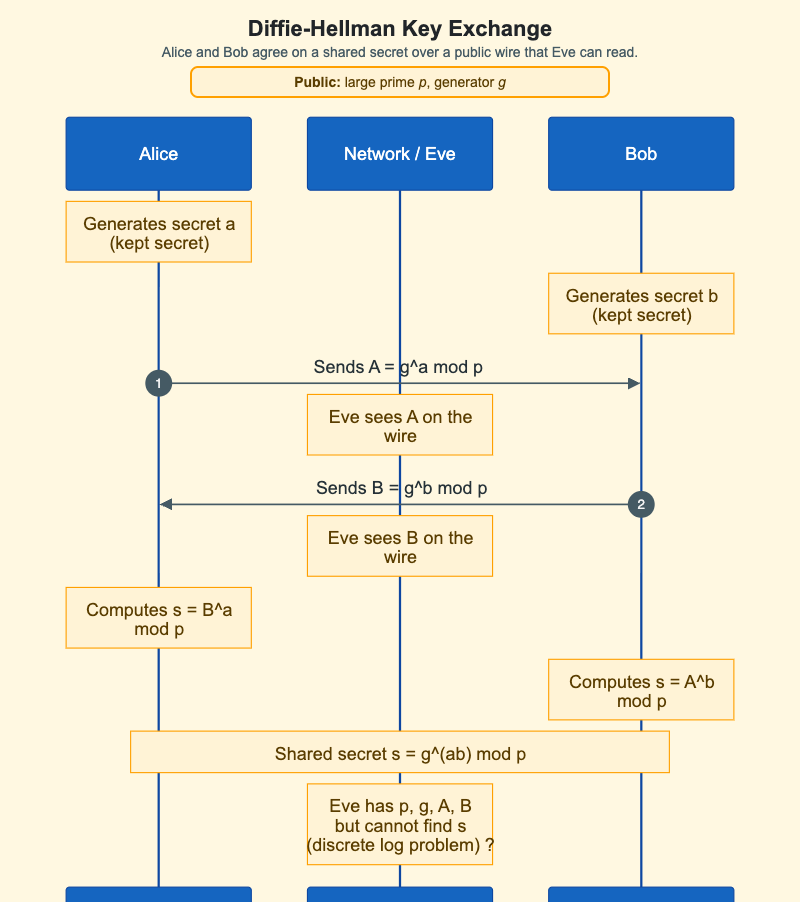
This sequence diagram walks through the Diffie-Hellman key exchange step by step. Alice and Bob first agree on two public parameters — a large prime p and a generator g — shown in the amber box above the diagram. Each party then generates a private exponent (a for Alice, b for Bob) that never leaves their machine; the diagram marks these "kept secret" in notes over each actor.
Alice sends A = g^a mod p across the wire, and Bob sends back B = g^b mod p.
The center lifeline is the network, where Eve sits and can read every value
that crosses it. Alice then computes s = B^a mod p and Bob computes
s = A^b mod p; both arrive at the same shared secret s = g^(ab) mod p. The
final note shows Eve's predicament: she has p, g, A, and B, yet she
cannot recover s without solving the discrete logarithm problem, which is
believed to be computationally infeasible for large p. That asymmetry — easy to
combine, hard to reverse — is the whole point of the protocol. The diagram scales
to its container width.
Lesson Plan
Learning objective (Bloom: Understand): Students will explain why two parties can establish a shared secret over a channel an eavesdropper fully observes.
Suggested classroom use: Run the small-number version by hand first (for example p = 23, g = 5, a = 6, b = 15) so students see both sides reach the same s. Then display this diagram and map each hand-computed value onto the corresponding step, emphasizing which values were ever transmitted.
Discussion questions:
- List everything Eve knows after watching the entire exchange. Why is it not enough to compute s?
- Diffie-Hellman by itself does not authenticate Alice or Bob. What attack does that omission enable, and what is usually added to prevent it?
- Why must p be large? What happens to the discrete-log difficulty if p is small?
References
- Wikipedia: Diffie-Hellman key exchange — the protocol shown in this diagram.
- Wikipedia: Discrete logarithm — the hard problem that protects the shared secret.
- Wikipedia: Man-in-the-middle attack — why unauthenticated DH is vulnerable.
- RFC 7919: Negotiated Finite Field Diffie-Hellman Ephemeral Parameters — standardized DH groups used in practice.
Specification
The full specification below is extracted from Chapter 3: "Cryptography Fundamentals: Symmetric Ciphers and Hashing".
Type: workflow-diagram
**sim-id:** diffie-hellman-exchange
**Library:** Mermaid

A sequence diagram with three actors: Alice (left), Network/Eve (center), Bob
(right). Public parameters p and g are shown in a box above. Alice and Bob each
generate a secret exponent (kept secret), exchange A = g^a mod p and B = g^b mod
p, then compute the same shared secret s = g^(ab) mod p. Eve observes A and B but
cannot derive s without solving the discrete log problem (shown with a "?").
Responsive sequence diagram via Mermaid.