Kernel / User Mode Boundary
You can include this MicroSim on your own page with the following iframe:
<iframe src="https://dmccreary.github.io/cybersecurity/sims/kernel-user-boundary/main.html" height="477" width="100%" scrolling="no"></iframe>
About this MicroSim
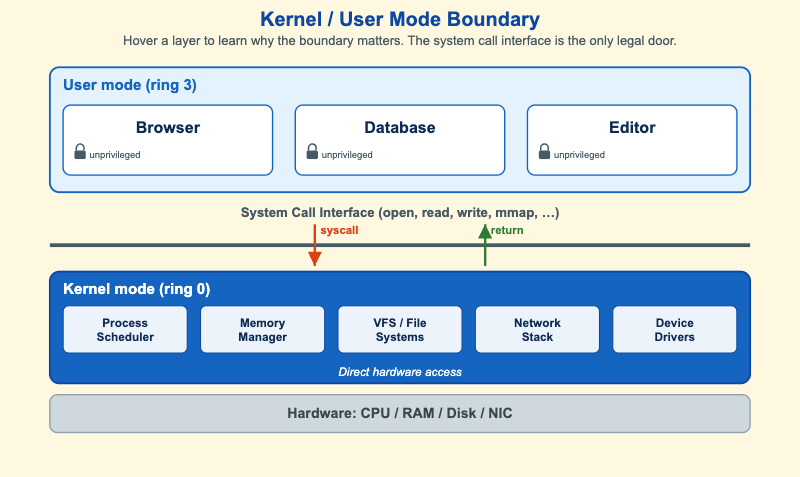
This diagram shows the single most important security boundary in an operating system: the line between user mode (ring 3) and kernel mode (ring 0). At the top, three ordinary applications — a browser, a database, and an editor — run unprivileged, each marked with a small lock. None of them can address the CPU, RAM, disk, or network card directly.
The thick slate line in the middle is the system call interface. It is the
only legal way for user code to enter the kernel: a syscall traps down into
ring 0 and a return brings control back up. Below it sits the kernel itself —
process scheduler, memory manager, file systems, network stack, and device drivers
— which alone has direct hardware access. At the very bottom is the hardware the
kernel mediates.
Hover (or tap on a touch screen) any layer to reveal why the boundary matters. The key insight the tooltips reinforce: a bug in a user application is contained by ring 3, but a bug in the kernel is total compromise — there is no higher authority to stop it. That asymmetry is why operating systems work so hard to keep the attack surface of the syscall interface small and well validated.
Lesson Plan
Learning objective (Bloom: Understand). Students will explain why user-mode processes cannot touch hardware directly, identify the system call interface as the only legal path between privilege rings, and reason about why a kernel bug is far more dangerous than a user-process bug.
Suggested classroom use. Project the diagram and have students trace a single
file read — open() then read() — from the editor application, down through the
syscall boundary, into the VFS subsystem, and out to the disk. Ask them to name the
privilege transition at each crossing.
Discussion questions:
- Why does the operating system force every hardware request through a small set of system calls instead of letting applications talk to devices directly?
- A sandboxed browser tab is compromised. Why is that less catastrophic than a vulnerability in a device driver running in ring 0?
- The syscall interface is the kernel's main attack surface. What does that imply about how carefully it must validate its arguments?
References
- Protection ring — Wikipedia
- System call — Wikipedia
- User space and kernel space — Wikipedia
- Kernel (operating system) — Wikipedia
Specification
The full specification below is extracted from Chapter 10: "System Security: OS, Memory, and Access Control".
Type: drawing
sim-id: kernel-user-boundary
Library: Static SVG with hover tooltips
Status: Specified

A horizontal stack diagram with three layers, top to bottom: a user-mode (ring 3,
light blue) layer with three unprivileged application boxes (Browser, Database,
Editor); a kernel-boundary line (slate steel) labeled "System Call Interface
(open, read, write, mmap, ...)" with a downward "syscall" arrow and an upward
"return" arrow; a kernel-mode (ring 0, cybersecurity blue) layer subdivided into
Process Scheduler, Memory Manager, VFS / File Systems, Network Stack, and Device
Drivers, labeled "Direct hardware access"; and a thinner gray hardware layer
labeled "CPU / RAM / Disk / NIC".

Hover tooltips per layer explain that user apps cannot touch hardware directly, the
system call interface is the only legal way into kernel mode, and a kernel bug is a
total compromise.

Color: cybersecurity blue (kernel), slate steel (boundary), light blue (user mode),
gray (hardware). Responsive: the SVG scales to its container.