Layers of Access Control on a Modern Linux Box
Run the Linux Access-Control Layers MicroSim Fullscreen
You can include this MicroSim on your own website with the following iframe:
<iframe src="https://dmccreary.github.io/cybersecurity/sims/linux-ac-layers/main.html" height="832" width="100%" scrolling="no"></iframe>
About this MicroSim
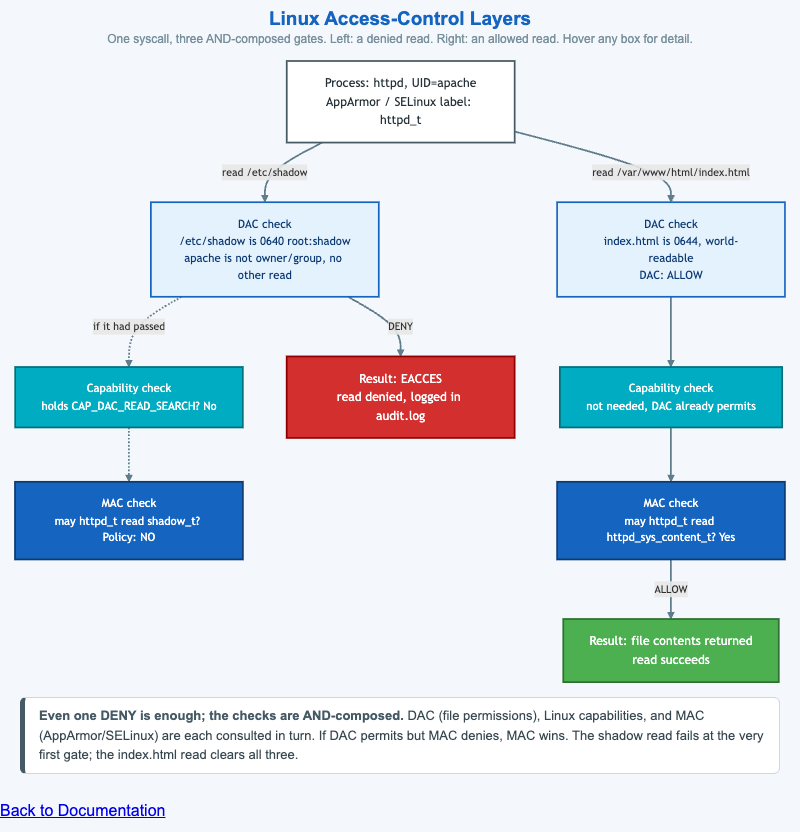
This diagram follows a single read() syscall as it passes through the three
access-control gates a modern Linux kernel enforces, and it does so twice — once
for a read that is denied and once for a read that is allowed — so you can
compare them side by side. The acting process is the Apache web server, running
as UID apache under the security label httpd_t. On the left, it tries to
read /etc/shadow; on the right, it reads a normal web file.
The three gates are DAC (discretionary access control — the familiar
owner/group/other permission bits), the capability check (privileged
overrides like CAP_DAC_READ_SEARCH), and MAC (mandatory access control via
AppArmor or SELinux). The crucial idea is that the gates are AND-composed:
access is granted only if every gate permits it, so a single DENY ends the
request. The shadow read fails at the very first gate (DAC), never reaching the
others; the web-file read clears all three and returns the file contents. Note
the asymmetry the side note calls out: if DAC permits but MAC denies, MAC
wins — the file's owner cannot override mandatory policy. Hover any box for
detail.
Lesson Plan
Learning objective (Bloom — Understand): Students can trace a single read()
syscall through the DAC, capability, and MAC gates and explain why the gates are
AND-composed and why a single DENY is decisive.
Suggested classroom use: Walk the two chains in parallel, hovering each gate. Ask students to predict the result at each gate before revealing it, and to name which gate the attacker would have to defeat to read the shadow file.
Discussion questions:
- The shadow read is denied at DAC and never reaches MAC. Why is "fail at the earliest gate" both efficient and safe?
- Why can mandatory access control (MAC) deny a read that the file's own permission bits (DAC) would have allowed?
CAP_DAC_READ_SEARCHlets a process bypass DAC file-read checks. Why is handing that capability to a network-facing service like a web server dangerous?
References
- Mandatory access control (Wikipedia)
- Discretionary access control (Wikipedia)
- Capability-based security (Wikipedia)
Specification
The full specification below is extracted from Chapter 10: "System Security: OS, Memory, and Access Control".
Type: drawing
**sim-id:** linux-ac-layers<br/>
**Library:** Mermaid<br/>
**Status:** Specified

A vertical flow showing a single `read(/etc/shadow)` syscall traveling through each access-control gate.

Top to bottom:
1. **Process** (white box, top): "httpd, UID=apache, current AppArmor profile: usr.sbin.apache2"
2. Arrow labeled `read("/etc/shadow")` going down
3. **DAC check** (light blue box): "Is UID `apache` in shadow's owner/group, or does it have read for other? `/etc/shadow` is `0640 root:shadow` — DAC: DENY for non-root non-shadow."
4. **Capability check** (cyan box): "Does process hold `CAP_DAC_READ_SEARCH`? No. Skip."
5. **MAC check** (cybersecurity blue box): "Is `httpd_t` allowed to read `shadow_t`? Policy: NO. MAC: DENY."
6. **Result** (red box): "EACCES — read denied. Logged in audit.log."

A side note in slate steel: "Even one DENY is enough; checks are AND-composed. If DAC permits but MAC denies, MAC wins."

Alongside the diagram, a small alternate path shown to the right where DAC permits a `read("/var/www/html/index.html")` and the process does hold the right MAC label, leading to a green ALLOW result.

Color: cybersecurity blue `#1565c0` for MAC layer, slate steel `#455a64` for capability layer, light blue `#e3f2fd` for DAC layer, red `#d32f2f` for DENY, green `#4caf50` for ALLOW. Responsive: vertical orientation on narrow screens.

Implementation: Mermaid flowchart TD with custom node styling.