MITM via ARP Spoofing
You can include this MicroSim on your own page with the following iframe:
<iframe src="https://dmccreary.github.io/cybersecurity/sims/mitm-arp-spoofing/main.html" height="847" width="100%" scrolling="no"></iframe>
About this MicroSim
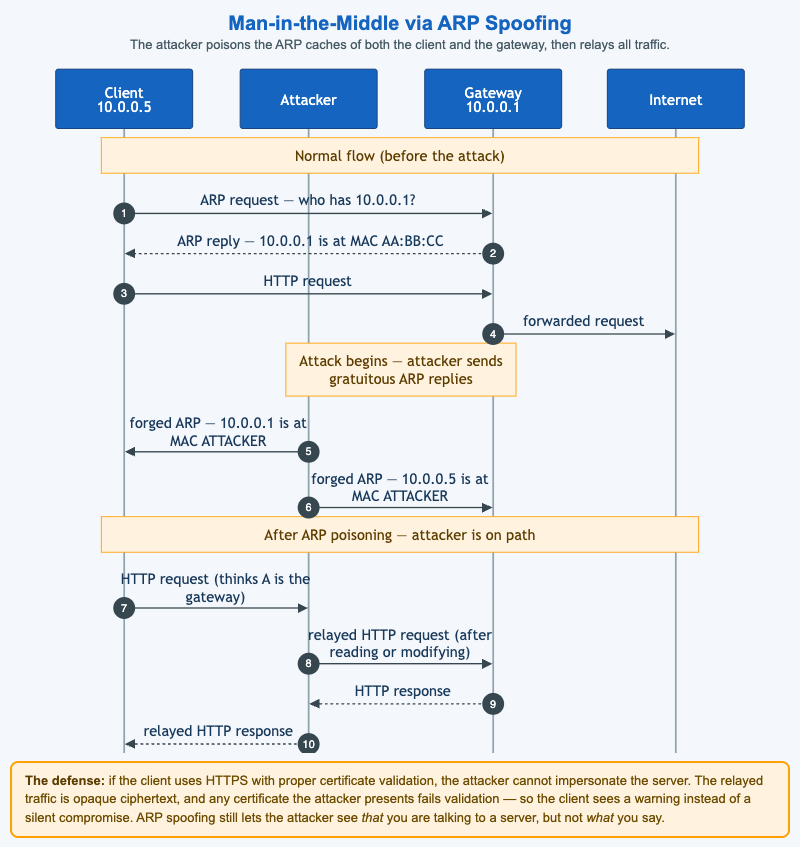
This sequence diagram walks top to bottom through a classic man-in-the-middle (MITM) attack via ARP spoofing, with four actors: the Client, the Attacker, the Gateway, and the Internet beyond it. The autonumbered messages and the phase notes let you read the attack as a story.
The first phase shows the normal flow: the client ARPs for the gateway's MAC address, gets the real reply, and sends HTTP traffic that the gateway forwards. The second phase, marked by an amber note, is where the attack begins — the attacker sends gratuitous (unsolicited) ARP replies. Because ARP has no authentication, both the client and the gateway accept them and update their caches to point at the attacker's MAC. The third phase shows the poisoned flow: the client's traffic now goes to the attacker, who reads or modifies it and relays it to the real gateway, then relays the response back. The client never notices.
The amber callout below the diagram states the defense. With HTTPS and proper certificate validation, the attacker can still see that the client is talking to a server, but the payload is opaque ciphertext, and any certificate the attacker substitutes fails validation — so the user sees a warning instead of a silent compromise. Trust, but verify.
Lesson Plan
Learning objective (Bloom: Understand). Students will describe how gratuitous ARP replies poison the client and gateway caches, trace how the attacker ends up on path, and explain why HTTPS with certificate validation defeats the impersonation.
Suggested classroom use. Walk the class through the diagram one numbered message at a time, pausing at the "attack begins" note to ask what property of ARP makes the forged replies succeed. Then connect the defense note to the TLS material from the cryptography chapters.
Discussion questions:
- ARP has no authentication. How do the forged replies in messages 6 and 7 exploit that, and why must the attacker poison both the client and the gateway?
- After poisoning, the attacker can read and modify plaintext HTTP. What exactly changes when the client switches to HTTPS — what can the attacker still see?
- What network-layer or switch-layer defenses (e.g., dynamic ARP inspection, static ARP entries) could detect or prevent this attack?
References
- ARP spoofing — Wikipedia
- Address Resolution Protocol — Wikipedia
- Man-in-the-middle attack — Wikipedia
- Dynamic ARP inspection — Wikipedia
Specification
The full specification below is extracted from Chapter 8: "Network Security Foundations: Protocols, Firewalls, and Detection".
Type: workflow-diagram
sim-id: mitm-arp-spoofing
Library: Mermaid
Status: Specified

A sequence diagram with four actors: Client, Attacker, Gateway, Internet.

Phase 1 (normal flow): Client ARPs for the gateway, gets the real reply, sends an
HTTP request the gateway forwards to the internet.

Phase 2 (attack begins): the attacker sends gratuitous ARP replies.

Phase 3 (after ARP poisoning): forged ARP replies tell the client the gateway is at
the attacker's MAC and tell the gateway the client is at the attacker's MAC; the
client's HTTP request goes to the attacker, who relays it to the gateway and relays
the response back.

A callout states that HTTPS with proper certificate validation prevents the
attacker from impersonating the server — the relayed traffic is opaque ciphertext.

Color: cybersecurity blue client, slate gateway, fur orange attacker, amber
attack-begins separator. Responsive via Mermaid useMaxWidth.