802.1X / EAP-TLS Authentication Flow
You can embed this MicroSim in your own course page with the following iframe:
<iframe src="https://dmccreary.github.io/cybersecurity/sims/dot1x-eap-tls-flow/main.html"
        width="100%" height="902" scrolling="no"></iframe>
About this MicroSim
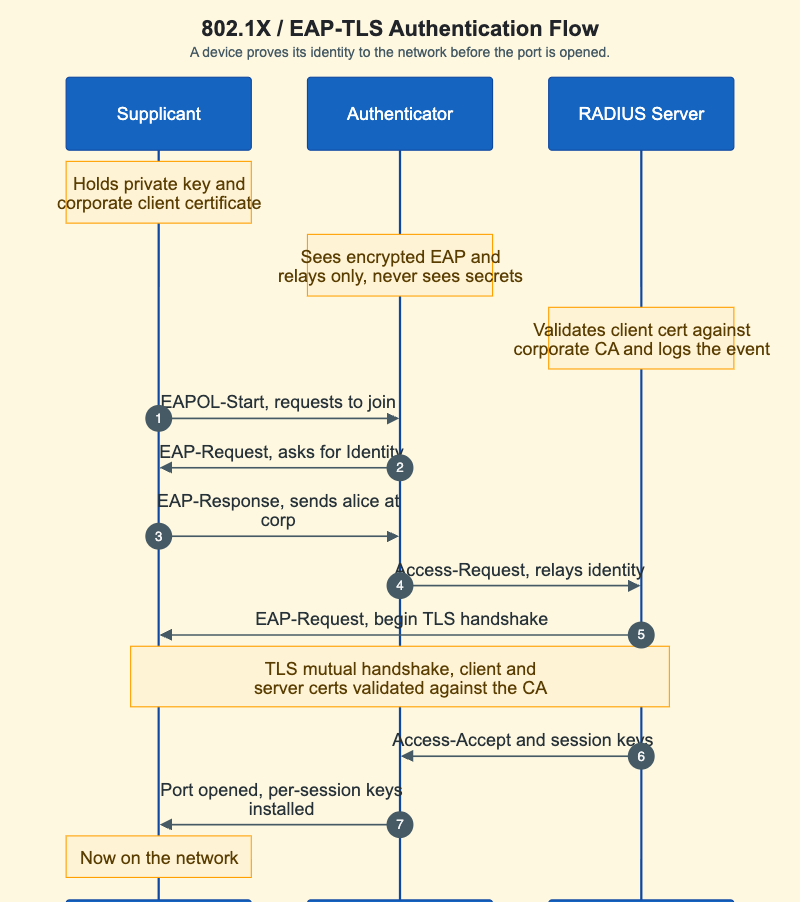
This sequence diagram shows how 802.1X port-based network access control authenticates a device before the network port is opened, using EAP-TLS. Three parties take part: the Supplicant (the laptop trying to join, which holds a private key and a corporate-issued client certificate), the Authenticator (the Wi-Fi access point or switch, which sees only encrypted EAP and relays it), and the RADIUS Server (which validates the client certificate against the corporate certificate authority and logs the authentication event).
Follow the numbered steps from the EAPOL-Start through the identity exchange, the relay to RADIUS, and the highlighted mutual TLS handshake where the client and server certificates are exchanged and validated against the corporate CA. Only after the RADIUS server returns Access-Accept with session keys does the authenticator open the port and install per-session keys, putting the supplicant on the network. The key insight, called out in the side notes, is that the authenticator never sees the secrets — it is a relay, and the actual trust decision is made by the RADIUS server against the CA. The diagram scales to its container width.
Lesson Plan
Learning objective (Bloom: Understand): Students will explain the roles of the supplicant, authenticator, and RADIUS server in an 802.1X / EAP-TLS exchange and identify where the trust decision is actually made.
Suggested classroom use: Walk the numbered steps aloud, pausing at step 4 to ask "who is talking to whom now, and who can read what?" Highlight that the AP relays without decrypting, then reach the TLS-handshake box and connect it to the TLS material from the cryptography chapter.
Discussion questions:
- The authenticator relays EAP but never sees the client's secrets. Why is that a security advantage rather than a limitation?
- Where in this flow is the client certificate actually validated, and against what?
- What would change in this diagram if the network used username/password (PEAP-MSCHAPv2) instead of EAP-TLS client certificates?
References
- Wikipedia: IEEE 802.1X — the port-based network access control standard shown here.
- Wikipedia: Extensible Authentication Protocol (EAP) — the EAP-TLS method used in this flow.
- Wikipedia: RADIUS — the authentication server protocol.
- RFC 5216: The EAP-TLS Authentication Protocol — the specification for EAP-TLS.
Specification
The full specification below is extracted from Chapter 9: "Advanced Network Defense: Wireless, DNS, and Zero Trust".
Type: workflow-diagram
**sim-id:** dot1x-eap-tls-flow
**Library:** Mermaid

A sequence diagram with three actors: Supplicant (laptop), Authenticator
(AP/switch), RADIUS Server. Steps: EAPOL-Start; EAP Identity request/response;
Access-Request relay; begin TLS handshake; mutual TLS handshake (client + server
certs validated against corporate CA, highlighted); Access-Accept + session keys;
open port + install keys; now on network. Side notes: supplicant holds private
key + client cert; authenticator relays only and never sees secrets; RADIUS
validates client cert against corporate CA and logs the event. Responsive.