TLS 1.3 Handshake
Run the TLS 1.3 Handshake MicroSim Fullscreen
You can include this MicroSim on your own website with the following iframe:
<iframe src="https://dmccreary.github.io/cybersecurity/sims/tls13-handshake-sequence/main.html" height="1092" width="100%" scrolling="no"></iframe>
About this MicroSim
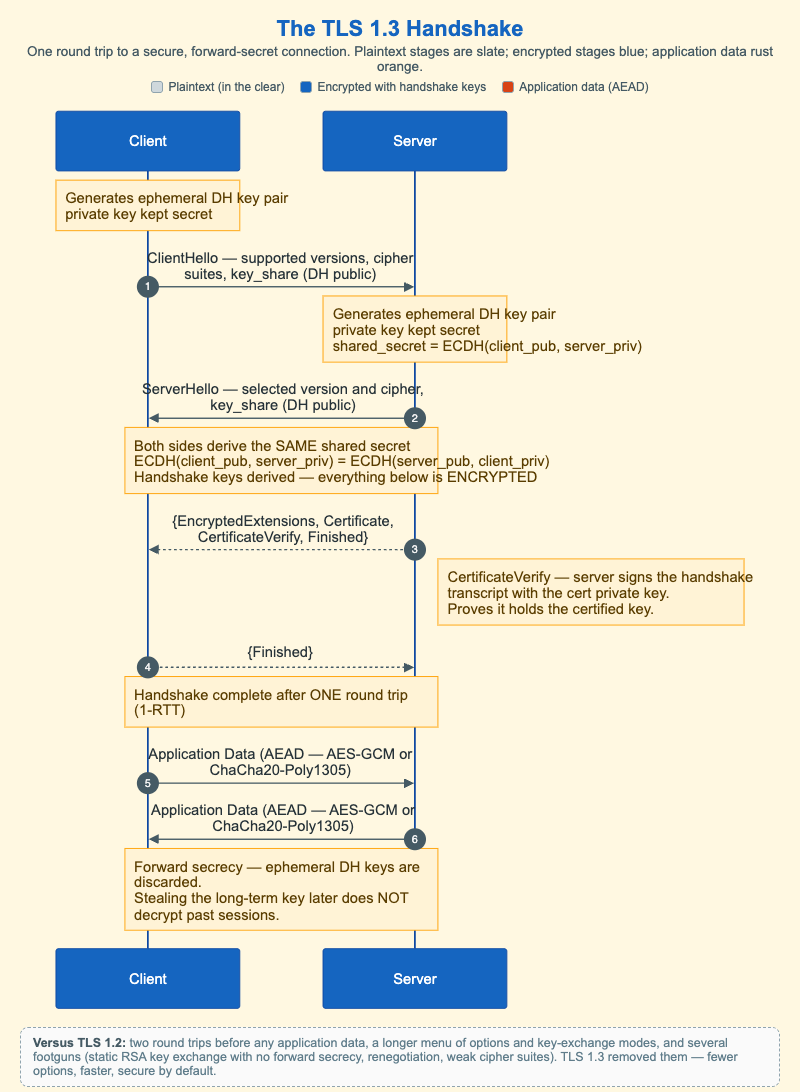
This sequence diagram walks the TLS 1.3 handshake from the first packet to a secure, forward-secret connection — and TLS 1.3 reaches that state in a single round trip (1-RTT). Read it top to bottom.
The ClientHello and ServerHello travel in the clear (slate) and each
carries an ephemeral Diffie-Hellman public key (the key_share). Once both
sides have exchanged public keys, each computes the same shared secret using
its own private key and the peer's public key — the note over both lifelines
shows the symmetry ECDH(client_pub, server_priv) = ECDH(server_pub,
client_priv). From that point the handshake keys exist and everything below is
encrypted (blue): the server's certificate, its CertificateVerify (a
signature over the handshake transcript that proves the server holds the certified
private key), and the Finished messages.
After the handshake, application data flows in rust orange, protected by an AEAD cipher (AES-GCM or ChaCha20-Poly1305). The closing note states the property that makes ephemeral DH worth the effort: forward secrecy — the ephemeral keys are discarded, so stealing the server's long-term key later cannot decrypt a recorded past session. A dashed panel summarizes how TLS 1.2 differed (two round trips, more options, more footguns) to motivate why TLS 1.3's smaller, opinionated design is more secure by default.
Lesson Plan
Learning objective (Bloom — Understand): Students can trace the TLS 1.3 handshake message by message, name what each step defends against, explain how ephemeral DH yields forward secrecy, and identify where traffic becomes encrypted.
Suggested classroom use: Project the diagram and read it as a story, pausing at each amber note to ask "what would break if this step were missing?" Use the ServerHello note to connect back to the Diffie-Hellman MicroSim, and the CertificateVerify note to connect to the PKI / certificate-chain material.
Discussion questions:
- What exactly does CertificateVerify prove that simply sending the certificate does not?
- An attacker records the whole session and a year later steals the server's long-term private key. Can they decrypt the recording? Justify your answer.
- TLS 1.3 removed static-RSA key exchange. What property did that buy, and what convenience did it cost?
References
- Transport Layer Security — TLS 1.3 (Wikipedia)
- Forward secrecy (Wikipedia)
- RFC 8446 — The Transport Layer Security (TLS) Protocol Version 1.3
Specification
The full specification below is extracted from Chapter 4: "Cryptography in Practice: PKI, TLS, and Data Protection".
Type: workflow-diagram
**sim-id:** tls13-handshake-sequence<br/>
**Library:** Mermaid<br/>
**Status:** Specified

A vertical sequence diagram with two actors: **Client** (left) and **Server** (right). Time flows downward.

Messages, in order:

1. **Client → Server: ClientHello** — labeled "supported versions, cipher suites, ephemeral DH public key (key_share)"
2. **Server → Client: ServerHello** — "selected version + cipher, server's ephemeral DH public key"
3. **Server → Client: {EncryptedExtensions, Certificate, CertificateVerify, Finished}** — drawn in a colored box (cybersecurity blue #1565c0) labeled "Encrypted from this point — handshake keys derived"
4. **Client → Server: {Finished}** — also in the encrypted box
5. **Both directions: Application Data** — colored rust orange (#d84315), labeled "AEAD-encrypted (AES-GCM or ChaCha20-Poly1305)"

Side annotations on the right:

- Next to step 1: "Client's DH private key kept secret"
- Next to step 2: "Server's DH private key kept secret. Both sides now compute shared_secret = ECDH(client_pub, server_priv) = ECDH(server_pub, client_priv)"
- Next to step 3: "CertificateVerify: server signs handshake transcript with cert's private key. Proves cert holder."
- Next to step 5: "Forward secrecy: ephemeral DH keys discarded after handshake. Long-term key compromise does NOT decrypt past sessions."

A small inset shows TLS 1.2 (greyed out) for comparison: two round-trips, more messages, more options, more footguns.

Color: cybersecurity blue (encrypted), rust orange (application data), slate steel for plain text. Responsive: scales vertically; annotations move below messages on narrow screens.

Implementation: Mermaid sequenceDiagram with notes on the right.