A Modern Software Supply Chain
You can include this MicroSim on your own page with the following iframe:
<iframe src="https://dmccreary.github.io/cybersecurity/sims/software-supply-chain-flow/main.html" height="702" width="100%" scrolling="no"></iframe>
About this MicroSim
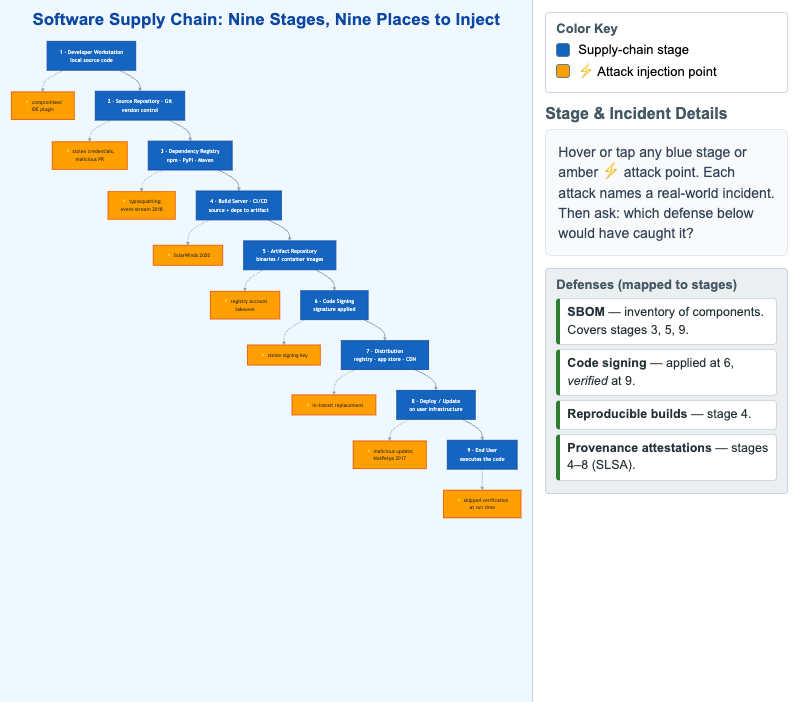
This diagram follows a single piece of software through the nine stages of a modern supply chain — from a developer's workstation, through the source repository, dependency registries, the CI/CD build server, the artifact repository, code signing, distribution, deploy/update, and finally execution on the end user's machine. The blue boxes are the stages a release actually passes through. Attached to each stage is an amber attack-injection point (marked with a ⚡), each labeled with a real incident: typosquatting and the 2018 event-stream hijack at the dependency registry, SolarWinds (2020) at the build server, and NotPetya (2017) at the deploy/update stage.
The teaching point is that the chain is only as strong as its weakest stage: a build server compromise (SolarWinds) produced a correctly signed malicious update, so signature checks alone did not help. That is why the right-hand panel maps the four major defenses to the stages they cover — SBOM (stages 3, 5, 9), code signing applied at stage 6 but only useful if verified at stage 9, reproducible builds (stage 4), and provenance attestations such as SLSA (stages 4–8). Hover over (or tap) any stage, any ⚡ attack point, or any defense row to read a one-line explanation in the panel, then reason about which control would have caught that specific incident.
Lesson Plan
Learning objective (Bloom: Analyze). Given a real-world supply-chain incident, students will identify which stage of the chain was compromised and determine which defense or defenses would have detected or prevented it.
Suggested classroom use. Present three incidents — event-stream, SolarWinds, and NotPetya — without their labels. For each, have students locate the compromised stage on the diagram, then argue which of the four defenses applies and whether it would prevent the attack or merely detect it after the fact. Use SolarWinds specifically to break the intuition that "it's signed, so it's safe."
Discussion questions:
- SolarWinds shipped a signed update that was malicious. Which stage was compromised, and which defense (and why not code signing alone) would have caught it?
- SBOM covers stages 3, 5, and 9 but not the build step itself. What class of attack does that gap leave open, and which other defense closes it?
- Why is verifying a signature at stage 9 a different control from applying one at stage 6 — and what goes wrong if a consumer skips the verification?
References
- Supply chain attack — Wikipedia
- SolarWinds (2020 cyberattack) — Wikipedia
- Software Bill of Materials (SBOM) — Wikipedia
- SLSA — Supply-chain Levels for Software Artifacts
Specification
The full specification below is extracted from Chapter 6: "Software Assurance and Supply Chain Security".
Type: workflow-diagram
sim-id: software-supply-chain-flow
Library: Mermaid
Status: Specified

A horizontal flow from left to right with nine nodes; attack-injection points marked with a red lightning bolt icon and labeled with a known incident.

1. Developer Workstation — local source code (lightning bolt: "compromised IDE plugin")
2. -> Source Repository (Git) — version control (lightning bolt: "stolen credentials, malicious PR")
3. -> Dependency Registry (npm, PyPI, Maven) — third-party libraries pulled in (lightning bolt: "typosquatting; event-stream 2018")
4. -> Build Server (CI/CD) — turns source + deps into artifact (lightning bolt: "SolarWinds 2020")
5. -> Artifact Repository — stores binaries / container images (lightning bolt: "registry account takeover")
6. -> Code Signing — signature applied (lightning bolt: "stolen signing key")
7. -> Distribution — package registry, app store, CDN (lightning bolt: "in-transit replacement")
8. -> Deploy / Update — running on user infrastructure (lightning bolt: "malicious update; NotPetya 2017")
9. -> End User — finally executes the code

Each node uses cybersecurity blue #1565c0. The lightning-bolt annotations use amber #ffa000. Hovering an annotation shows a 1-line incident summary.

Below the chain, a horizontal banner labeled "Defenses" lists controls aligned to each stage: SBOM (covers stages 3, 5, 9), code signing (stage 6, verified at 9), reproducible builds (stage 4), provenance attestations (stages 4-8, e.g., SLSA framework).

Learning objective (Bloom — Analyze): given a real-world supply-chain incident, identify which stage of the chain was compromised and which defenses would have detected or prevented it.

Responsive: chain wraps to two rows below 900px; attack annotations remain attached.

Implementation: Mermaid graph LR with custom node styling; tooltips via Mermaid click callbacks or a thin overlay layer.