Cyber Law Jurisdictional Map
You can embed this MicroSim in your own course page with the following iframe:
<iframe src="https://dmccreary.github.io/cybersecurity/sims/cyber-law-jurisdiction-map/main.html"
        width="100%" height="612" scrolling="no"></iframe>
About this MicroSim
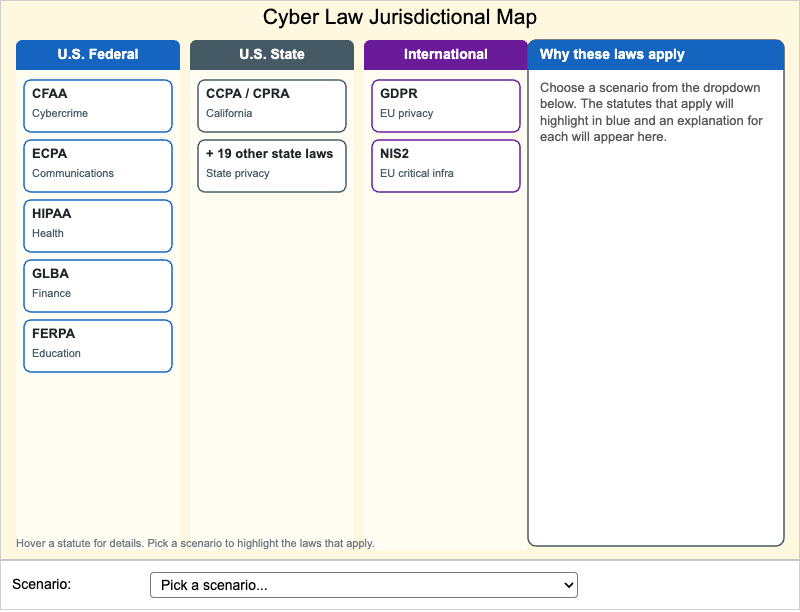
This interactive map groups the laws a cybersecurity practitioner is most likely to meet into three vertical bands: U.S. Federal (CFAA, ECPA, HIPAA, GLBA, FERPA), U.S. State (CCPA/CPRA plus a stacked card for the growing set of other state privacy laws), and International (GDPR and NIS2). Each statute is a rounded card colored to its band. Hover any card to reveal a tooltip with the law's scope, who it regulates, its key obligation, and its breach-notification window — so you can compare, for example, GDPR's 72-hour authority notice against HIPAA's 60-day window.
The real lesson is jurisdiction. Use the Scenario dropdown below the bands to pick a situation such as "A U.S. healthcare company stores European patient data on California servers." The MicroSim highlights every law that applies in cybersecurity blue, dims the rest, and lists in the right-hand panel why each highlighted law reaches the scenario — by data subject, data location, or the type of regulated entity. Working through the five scenarios shows that more than one regime usually applies at once, and that jurisdiction is rarely decided by server location alone.
Lesson Plan
Learning objective (Bloom: Understand → Analyze): Given a hypothetical data-handling scenario, students will identify which laws apply and explain why each one reaches the scenario.
Suggested classroom use: Before selecting a scenario, have students predict out loud which laws they think apply and on what basis. Then select the scenario and compare their prediction with the highlighted laws and the side-panel reasoning. Emphasize the cases where a law applies for a non-obvious reason (GDPR following EU data subjects regardless of server location).
Discussion questions:
- In the healthcare scenario, three laws apply for three different reasons. Name the trigger for each.
- Why does moving data to U.S. servers not remove GDPR obligations for EU residents' data?
- Which scenario has the shortest required breach-notification window, and how would that change an incident-response plan?
References
- Wikipedia: General Data Protection Regulation (GDPR) — the EU privacy law with extraterritorial reach.
- Wikipedia: Computer Fraud and Abuse Act (CFAA) — the primary U.S. anti-hacking statute.
- Wikipedia: California Consumer Privacy Act (CCPA) — the leading U.S. state privacy law.
- Wikipedia: NIS2 Directive — the EU directive on critical-infrastructure cybersecurity.
Specification
The full specification below is extracted from Chapter 14: "Societal Security: Law, Forensics, and Ethics".
Type: interactive-infographic
**sim-id:** cyber-law-jurisdiction-map
**Library:** p5.js

Learning objective (Bloom: Understand -> Analyze): Given a hypothetical scenario,
the student identifies which laws apply and why. Three vertical bands (U.S.
Federal, U.S. State, International) of statute cards. Hovering a statute reveals
scope, who is regulated, key obligation, and breach-notification window. A
Scenario Selector highlights applicable statutes in cybersecurity blue, dims the
others, and a side panel explains why each highlighted law applies. Responsive via
updateCanvasSize().