Device Attestation Flow
Run the Device Attestation Flow MicroSim Fullscreen
You can include this MicroSim on your own website with the following iframe:
<iframe src="https://dmccreary.github.io/cybersecurity/sims/device-attestation-flow/main.html" height="662" width="100%" scrolling="no"></iframe>
About this MicroSim
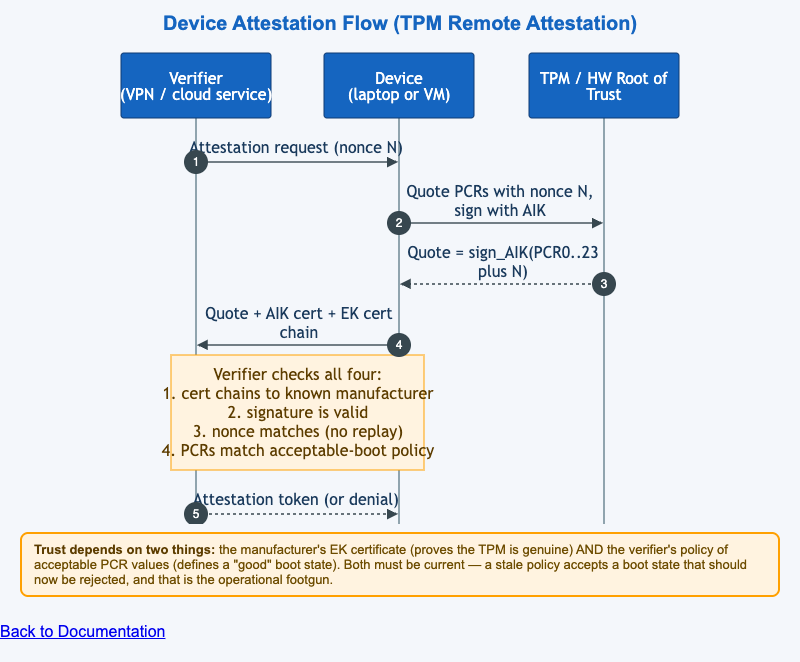
This sequence diagram walks through TPM-based remote attestation — how a verifier (a corporate VPN server or cloud service) gets cryptographic evidence that a device booted into a known-good state. Read it top to bottom: the verifier sends a fresh nonce, the device asks its TPM to quote its Platform Configuration Registers (PCRs) and sign them with an Attestation Identity Key (AIK), and the device returns that signed quote along with its AIK and EK certificate chain.
The amber note over the verifier holds the four checks that make or break trust: the certificate must chain to a known manufacturer, the signature must be valid, the nonce must match (defeating replay), and the PCRs must satisfy the verifier's policy of acceptable boot states. Only then does the verifier issue an attestation token. The highlighted note at the bottom names the operational footgun: trust rests on both the manufacturer's EK certificate and a current PCR policy — a stale policy will happily accept a boot state that should now be rejected. The actor lanes collapse to a single column on narrow screens.
Lesson Plan
Learning objective (Bloom — Understand): Students can trace the remote attestation exchange and explain why trust depends on both the EK certificate and a current PCR policy.
Suggested classroom use: Project the diagram and have students name, for each message, what it proves and to whom. Pause on the verifier's four checks and ask which one each common attack (replay, spoofed TPM, modified bootloader) would try to defeat.
Discussion questions:
- What specifically does the nonce N protect against, and what would go wrong without it?
- The TPM signs with an AIK, not the EK directly. Why introduce a separate attestation key?
- Who is responsible for keeping the "acceptable PCR values" policy current, and what is the blast radius if they fall behind after a firmware update?
References
- Trusted Platform Module (Wikipedia)
- Trusted Computing — remote attestation (Wikipedia)
- IETF RFC 9334 — Remote ATtestation procedureS (RATS) Architecture
Specification
The full specification below is extracted from Chapter 7: "Component and Hardware Security".
Type: workflow-diagram
**sim-id:** device-attestation-flow<br/>
**Library:** Mermaid<br/>
**Status:** Specified

A sequence diagram with three actors:

- **Verifier** (left) — e.g., corporate VPN server or cloud attestation service
- **Device** (middle) — e.g., laptop or VM
- **TPM / Hardware Root of Trust** (right) — on the device but conceptually distinct

Steps from top to bottom:

1. Verifier → Device: "Attestation request (nonce N)"
2. Device → TPM: "Quote PCRs with nonce N, sign with AIK"
3. TPM → Device: "Quote = sign_AIK(PCR0..23 || N)"
4. Device → Verifier: "Quote + AIK certificate + EK certificate chain"
5. Verifier checks: (a) certificate chains to known manufacturer, (b) signature is valid, (c) nonce matches, (d) PCRs match policy of acceptable boot states
6. Verifier → Device: "Attestation token (or denial)"

A side-note box at the bottom: "Trust depends on the manufacturer's EK certificate AND the verifier's policy of acceptable PCR values. Both must be current."

Color: cybersecurity blue for verifier and device, slate steel for the TPM/HW root, amber for the policy-check step (because policy currency is the operational footgun).

Responsive: actor lanes simplify to single column below 600px.

Implementation: Mermaid sequenceDiagram.