Privacy Engineering Decision Tree
Run the Privacy Decision Tree MicroSim Fullscreen
You can include this MicroSim on your own website with the following iframe:
<iframe src="https://dmccreary.github.io/cybersecurity/sims/privacy-decision-tree/main.html" height="1572" width="100%" scrolling="no"></iframe>
About this MicroSim
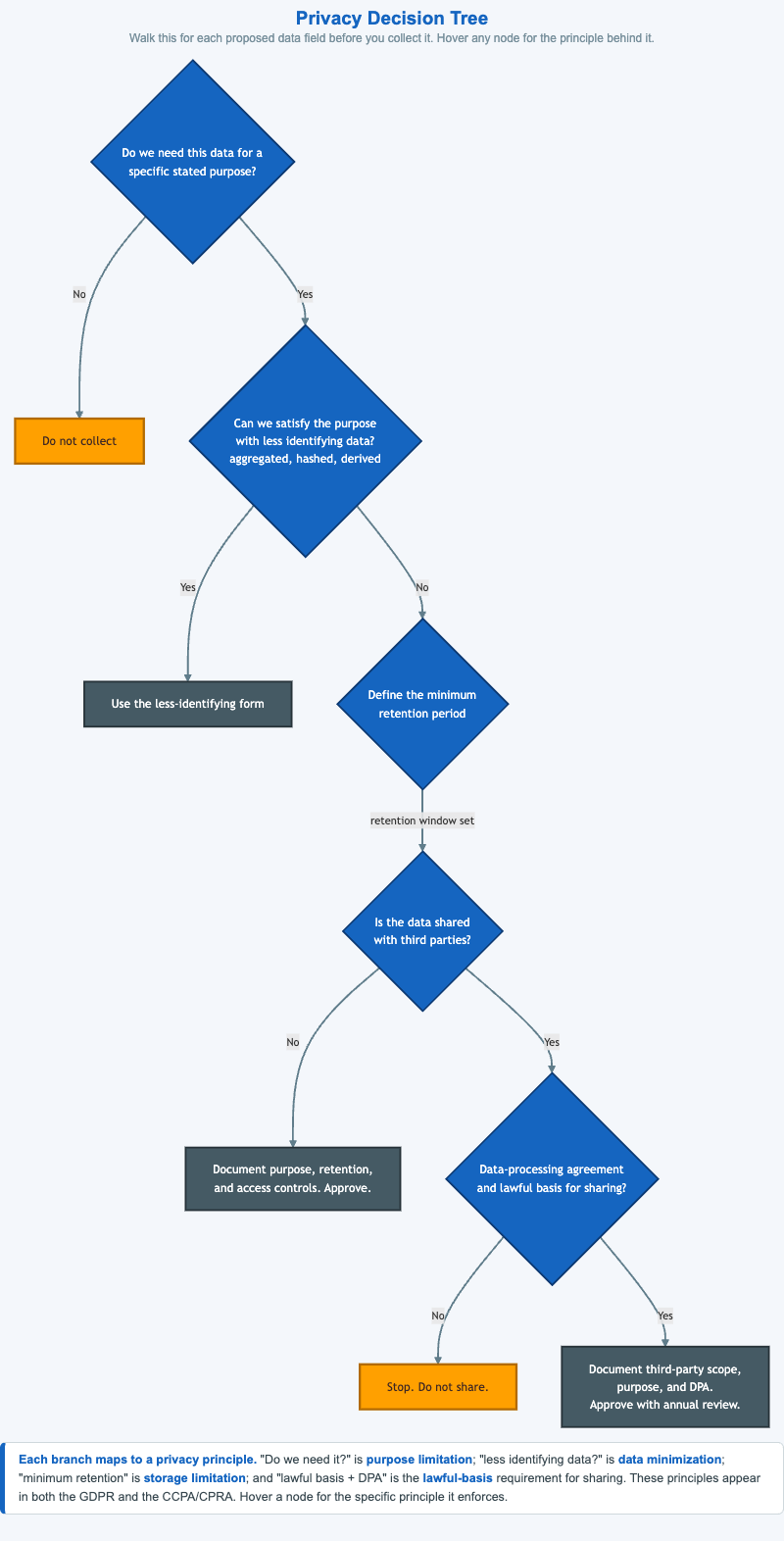
This decision tree is the one an engineer or privacy reviewer should walk for each proposed data field, before it is ever collected. It starts with the hardest question — do we need this data for a specific stated purpose? If not, the answer is the cleanest control there is: do not collect it. If you do need it, the tree pushes you toward the least identifying form that still works (aggregated, hashed, or derived), then forces you to set a minimum retention period, asks whether the data is shared with third parties, and — if it is — requires both a data-processing agreement and a lawful basis before approving the share.
The power of the tree is that every branch corresponds to a named privacy principle that appears in both the GDPR and the California CCPA/CPRA: purpose limitation, data minimization, storage limitation, and lawful basis. The two amber leaves ("Do not collect" and "Stop. Do not share.") are the stop conditions; the slate leaves are the approve/use outcomes. Hover any node to see the specific principle it enforces. The lesson is that good privacy is a series of small "no by default" decisions, not a single policy document.
Lesson Plan
Learning objective (Bloom — Apply): Students can apply a structured decision process to decide whether and how to collect a proposed data field, and map each branch to the GDPR/CCPA principle it enforces.
Suggested classroom use: Give each group a concrete field — a customer's date of birth, a precise GPS location, a device identifier — and have them walk the tree to a leaf, hovering each decision to name the principle. Compare where different fields land and why.
Discussion questions:
- A field is genuinely useful but not strictly needed for the stated purpose. Where does the tree send it, and which principle is that?
- Why does the tree prefer a hashed or aggregated form over the raw value even when collection is justified?
- Sharing requires both a DPA and a lawful basis. Why is either one alone insufficient?
References
- Data minimization (Wikipedia)
- General Data Protection Regulation (Wikipedia)
- California Consumer Privacy Act (Wikipedia)
Specification
The full specification below is extracted from Chapter 12: "Human Security: Identity, Authentication, and Social Engineering".
Type: workflow-diagram
**sim-id:** privacy-decision-tree<br/>
**Library:** Mermaid<br/>
**Status:** Specified

A top-down decision tree that an engineer or privacy reviewer walks through for each proposed data field.

Root: "Do we need this data for a specific stated purpose?"

- No → "Do not collect."
- Yes → "Can we satisfy the purpose with less identifying data (aggregated, hashed, derived)?"
  - Yes → "Use the less-identifying form."
  - No → "What is the minimum retention period to satisfy the purpose?"
    - Define retention window → "Is the data shared with third parties?"
      - No → "Document purpose, retention, and access controls. Approve."
      - Yes → "Is there a data-processing agreement and a lawful basis for sharing?"
        - No → "Stop. Do not share."
        - Yes → "Document third-party scope, purpose, and DPA. Approve with annual review."

Each leaf node has a small annotation linking to the relevant GDPR/CCPA principle (data minimization, purpose limitation, lawful basis, retention limits).

Color: cybersecurity blue for decision nodes, slate for outcome leaves, alert orange for "Do not collect" / "Stop" leaves. Responsive: collapses to a sequential checklist on narrow viewports.

Implementation: Mermaid graph TD with custom node classes.